Government Expands Residential Education Facilities for SC Students
Source:PIB ↗
কেন এটি গুরুত্বপূর্ণ
These schemes represent the government's targeted approach to bridging the educational gap for SC and ST communities. They are essential for understanding how state interventions in social infrastructure (hostels, residential schools) address structural inequalities and contribute to inclusive national development.
সারসংক্ষেপ
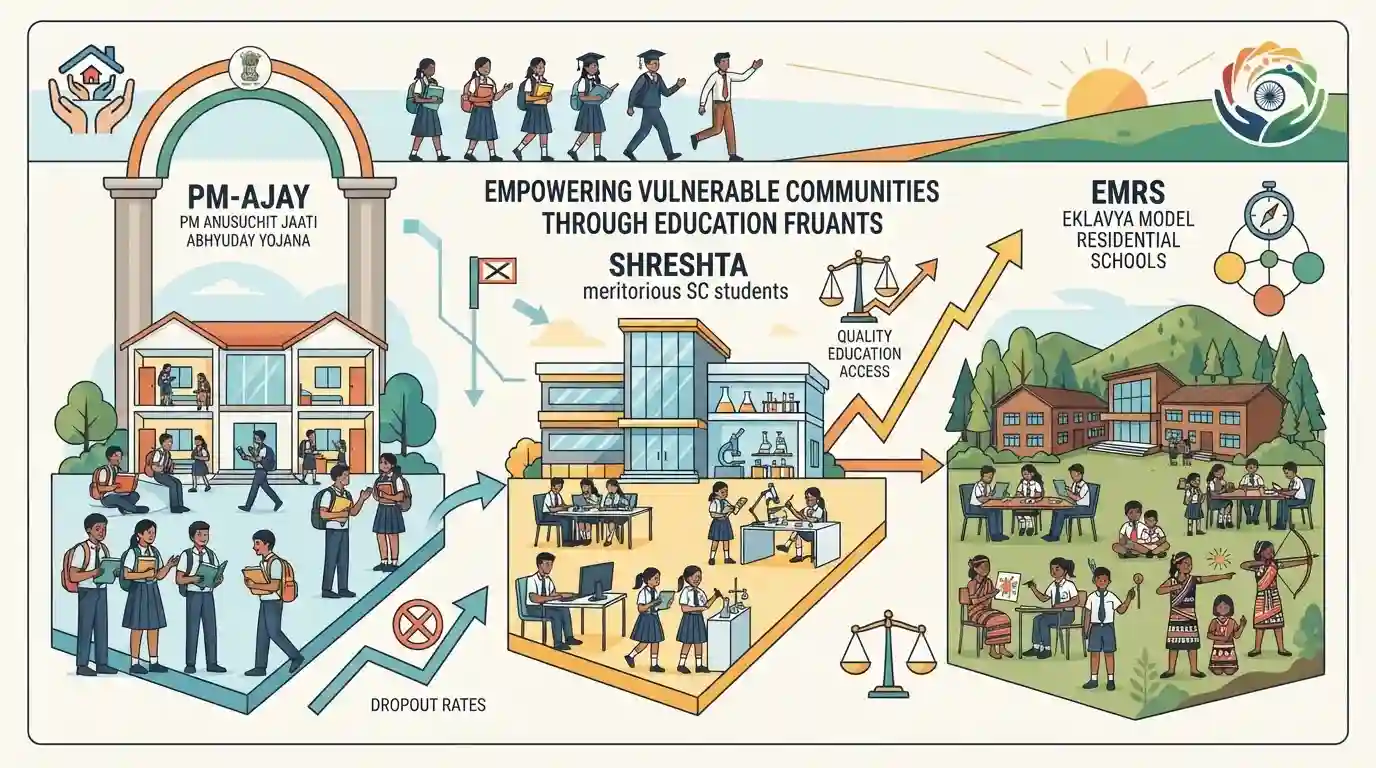
The Indian Government is expanding and strengthening access to quality residential education and hostel facilities for Scheduled Castes (SC) and tribal students. Key initiatives driving this effort include the hostel component of the Pradhan Mantri Anusuchit Jaati Abhyuday Yojana (PM-AJAY), the SHRESHTA scheme for meritorious SC students, and the Eklavya Model Residential Schools (EMRS) under the Ministry of Tribal Affairs. These comprehensive welfare measures are designed to curb dropout rates, provide safe learning environments, and ensure equitable educational opportunities for vulnerable social groups.
মূল বিষয়
- PM-AJAY (Pradhan Mantri Anusuchit Jaati Abhyuday Yojana) supports the construction of hostels for Scheduled Caste (SC) students to improve access to education and reduce dropout rates.
- The SHRESHTA scheme provides quality residential education to meritorious SC students either through private CBSE/State board schools or via grants-in-aid to NGO-operated residential schools.
- The Ministry of Tribal Affairs operates Eklavya Model Residential Schools (EMRS) to offer quality residential education to tribal boys and girls; out of 728 approved schools, 508 are currently functional.
- These schemes collectively aim to foster inclusive human resource development by addressing educational inequalities among historically marginalized communities.
গুরুত্বপূর্ণ শব্দ
Pradhan Mantri Anusuchit Jaati Abhyuday Yojana (PM-AJAY)

A centrally sponsored scheme formed by merging three earlier schemes. Implemented by the Ministry of Social Justice, it aims to reduce poverty and improve socio-economic indicators in Scheduled Caste-dominated villages through skill development, income generation, and infrastructure creation.
UPSC context
Relevant for GS Paper 2 (Welfare Schemes). Tests knowledge of SC empowerment mechanisms, rural infrastructure development, and scheme convergence.
Scheme for Residential Education for Students in High Schools in Targeted Areas (SHRESHTA)
A Ministry of Social Justice scheme providing meritorious Scheduled Caste (SC) students with fully funded scholarships to study in top private and NGO-run residential high schools (Classes 9-12), with admission granted through a national entrance test.
UPSC context
Important for GS Paper 2 (Education, Social Justice). Highlights targeted government interventions ensuring equitable access to quality education for marginalized groups.
Eklavya Model Residential Schools (EMRS)
Co-educational residential schools for Scheduled Tribe (ST) students in remote areas. Fully funded by the government, they provide quality education (Classes 6-12), aiming to establish one school in every block with a significant tribal population.
UPSC context
Key topic in GS Paper 2 (Vulnerable Sections, Education). Questions often focus on tribal welfare policies and reducing the urban-rural education divide.
National Education Society for Tribal Students (NESTS)
An autonomous organization established in 2019 under the Ministry of Tribal Affairs. It is the central nodal agency responsible for planning, establishing, standardizing, and managing Eklavya Model Residential Schools (EMRS) for tribal children nationwide.
UPSC context
Relevant for GS Paper 2 (Governance). Tests understanding of the specific administrative frameworks and nodal bodies supporting pan-India tribal education initiatives.
প্রিলিমস ফাঁদ
PM-AJAY is a Central Sector Scheme because it receives 100% funding support from the Central Government.
Despite receiving 100% central assistance, PM-AJAY is a Centrally Sponsored Scheme, not a Central Sector Scheme, because states must execute it via bottom-up Annual Action Plans.
সংযুক্ত স্থির ধারণা
How does Article 275(1) differ from Article 282 in financing state-level welfare?
- Statutory allocation: Article 275(1) mandates statutory grants-in-aid charged directly on the Consolidated Fund of India, primarily aimed at promoting ST welfare and Scheduled Area administration.
- Discretionary spending: Article 282 covers discretionary grants which the Union or State may make for any public purpose, even if outside their respective legislative domains.
What are the primary constitutional safeguards for SC/ST educational advancement?
- Article 46 DP Mandate: Directs the State to promote with special care the educational and economic interests of the weaker sections, particularly SCs and STs.
- Article 15(4) enabling provision: Empowers the State to make special provisions, including reservation of seats, for SC/ST advancement in educational institutions.
আন্তঃবিষয় প্যাটার্ন
Fiscal federalism + Statutory devolution
Explores how funding EMRS via Article 275(1) statutory grants safeguards tribal education budgets from standard federal delays associated with Centrally Sponsored Schemes.
PPP models + Welfare delivery
Highlights a policy shift toward outsourcing educational delivery to vetted private/NGO partners (SHRESHTA), testing state oversight and civil society regulatory mechanisms.

Expect comparative MCQs contrasting PM-AJAY and SHRESHTA target demographics, testing if aspirants can distinguish SC-specific vs ST-specific welfare.
সংযুক্ত PYQ · 3
সংযুক্ত PYQ · 3
- 2022MainsGS2
Besides the welfare schemes, India needs deft management of inflation and unemployment to serve the poor and the underprivileged sections of the society. Discuss.
- 2023MainsGS2
The crucial aspect of development process has been the inadequate attention paid to Human Resource Development in India. Suggest measures that can address this inadequacy.
- 2021MainsGS2
“Earn while you learn' scheme needs to be strengthened to make vocational education and skill training meaningful.” Comment.
