Health Ministry Organizes Workshop to Strengthen Leprosy Control
Source:PIB ↗
हे का महत्त्वाचे आहे
Leprosy is a neglected tropical disease with significant social stigma and chronic physical disability impacts. Understanding programmatic shifts from merely treating patients to achieving 'Interruption of Transmission' (IoT) is crucial for governance, healthcare delivery models, epidemiological concepts (like reverse contact tracing), and assessing India's progress toward global disease eradication goals.
सारांश
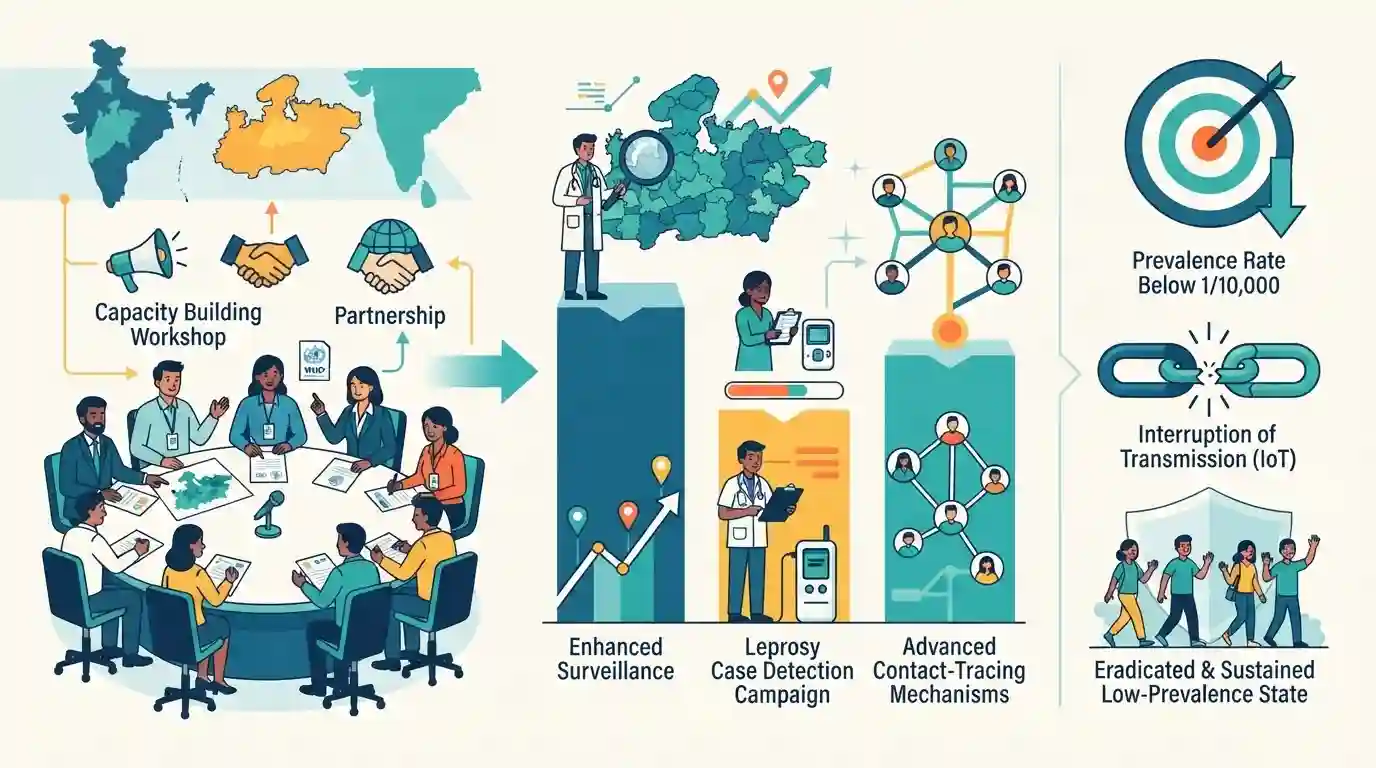
The Central Leprosy Division of the Union Health Ministry organized a two-day capacity-building workshop under the National Leprosy Eradication Programme (NLEP) in Indore, Madhya Pradesh. The workshop brought together key health officials, WHO, and technical partners to bolster epidemiological surveillance, improve Leprosy Case Detection Campaign (LCDC) outcomes, and operationalize advanced contact-tracing mechanisms. The primary goal is to achieve the Interruption of Transmission (IoT) of leprosy and sustain the prevalence rate below 1 case per 10,000 population across all districts.
मुख्य मुद्दे
- The Union Ministry of Health and Family Welfare organized a National Leprosy Eradication Programme (NLEP) Review-cum-Capacity Building Workshop in Indore, MP, focusing on Interruption of Transmission (IoT) of leprosy.
- India aims to sustain the leprosy prevalence rate below 1 per 10,000 population, highlighting early case detection, timely treatment, and the prevention of physical disabilities.
- The Leprosy Case Detection Campaign (LCDC) was reviewed with an emphasis on improving implementation quality and the effectiveness of grassroots-level active screening.
- A major technical focus was placed on Retrospective and Reverse Contact Tracing to pinpoint undiagnosed reservoirs of Mycobacterium leprae and break transmission dynamics in communities.
- The workshop integrated decentralized peer learning among district health units and active stakeholder participation, including civil society and the Association of People Affected by Leprosy (APAL), to combat stigma and incorporate patient-centric views into the eradication strategy.
महत्त्वाच्या संज्ञा
National Leprosy Eradication Programme (NLEP)

A centrally sponsored scheme under the National Health Mission aiming to make India leprosy-free. It focuses on early case detection, providing free Multi-Drug Therapy, preventing disabilities, and eliminating the social stigma associated with the disease.
UPSC context
Relevant for GS Paper 2 (Health, Vulnerable Sections). Tests knowledge of India's disease eradication strategies and public health targets.
Leprosy Case Detection Campaign (LCDC)
A specialized, active case-finding initiative under the NLEP involving massive door-to-door surveys in high-endemic districts. It aims to identify hidden or undetected cases early and initiate immediate treatment to break the chain of transmission.
UPSC context
Important for GS Paper 2 (Health). Tests awareness of targeted micro-level health interventions and active surveillance methods in India.
Central Leprosy Division (CLD)
The nodal agency functioning under the Directorate General of Health Services (MoHFW) responsible for the planning, implementation, and overall monitoring of the National Leprosy Eradication Programme across India.
UPSC context
Relevant for GS Paper 2 (Governance, Health). Tests knowledge of specific administrative bodies driving national health missions.
Association of People Affected by Leprosy (APAL)
A national networking organization working for the socio-economic empowerment, welfare, and mainstreaming of persons affected by leprosy. It actively advocates for their rights and plays a key role in de-stigmatization efforts alongside the government.
UPSC context
Useful for GS Paper 2 (Role of NGOs, Vulnerable Sections). Provides a concrete example of civil society collaboration in healthcare and rights advocacy.
पूर्वपरीक्षा सापळा
India has not yet achieved the WHO milestone of eliminating leprosy as a public health problem at the national level.
India officially achieved national-level elimination (<1 case/10,000) in 2005. The current 2027 target is complete interruption of transmission (eradication), though sub-national pockets of high prevalence still persist.
संबंधित स्थिर संकल्पना
What is Hansen’s Disease and how is it treated?
- Pathogen: Caused by the slow-growing bacterium Mycobacterium leprae, primarily targeting peripheral nerves, skin, and upper respiratory tract.
- Transmission: Spreads through prolonged mucosal droplet contact; it is not highly contagious and has a long incubation period.
- Therapy: Cured via Multi-Drug Therapy (MDT) using Rifampicin, Dapsone, and Clofazimine, preventing permanent disability and drug resistance.
What are the implications of a 'Notifiable Disease'?
- Legal Mandate: Requires all public and private clinical establishments to report diagnosed cases to local public health authorities immediately.
- Statutory Base: Declared under state-specific public health acts or the colonial-era Epidemic Diseases Act, 1897, to track outbreaks.
आंतर-विषय नमुने
Health Federalism and Centrally Sponsored Schemes
National leprosy targets require states to operationalize central directives, demonstrating how cooperative federalism drives public health outcomes under decentralized health delivery systems.
Human Rights and Neglected Diseases
Leprosy eradication involves removing historic civil disabilities, highlighting the intersection between the Right to Dignity (Article 21) and statutory public health interventions.

Expect statements testing the 2025 MDT regimen update, 2005 national elimination milestone, and the 2027 transmission interruption target.
संबंधित PYQ · 3
संबंधित PYQ · 3
- 2014PrelimsGS1
Consider the following diseases: 1. Diphtheria 2. Chickenpox 3. Smallpox Which of the above diseases has/have been eradicated in India?
- 2021MainsGS2
“Besides being a moral imperative of a Welfare State, primary health structure is a necessary precondition for sustainable development.” Analyze.
- 2024MainsGS2
In a crucial domain like the public healthcare system the Indian State should play a vital role to contain the adverse impact of marketisation of the system. Suggest some measures through which the State can enhance the reach of public healthcare at the grassroots level.
