Mines and Minerals Amendment Act Rationalizes State Taxation
Source:PIB ↗
આ શા માટે મહત્વનું છે
Following the recent Supreme Court judgments affirming states' rights to tax mineral-bearing lands, this legislative amendment by the Union acts as a counter-measure to cap and regulate these levies. It is highly relevant for GS Paper 2 (Centre-State relations, legislative powers under Entry 50/54) and GS Paper 3 (Resource mobilization, manufacturing competitiveness, and critical minerals).
સારાંશ
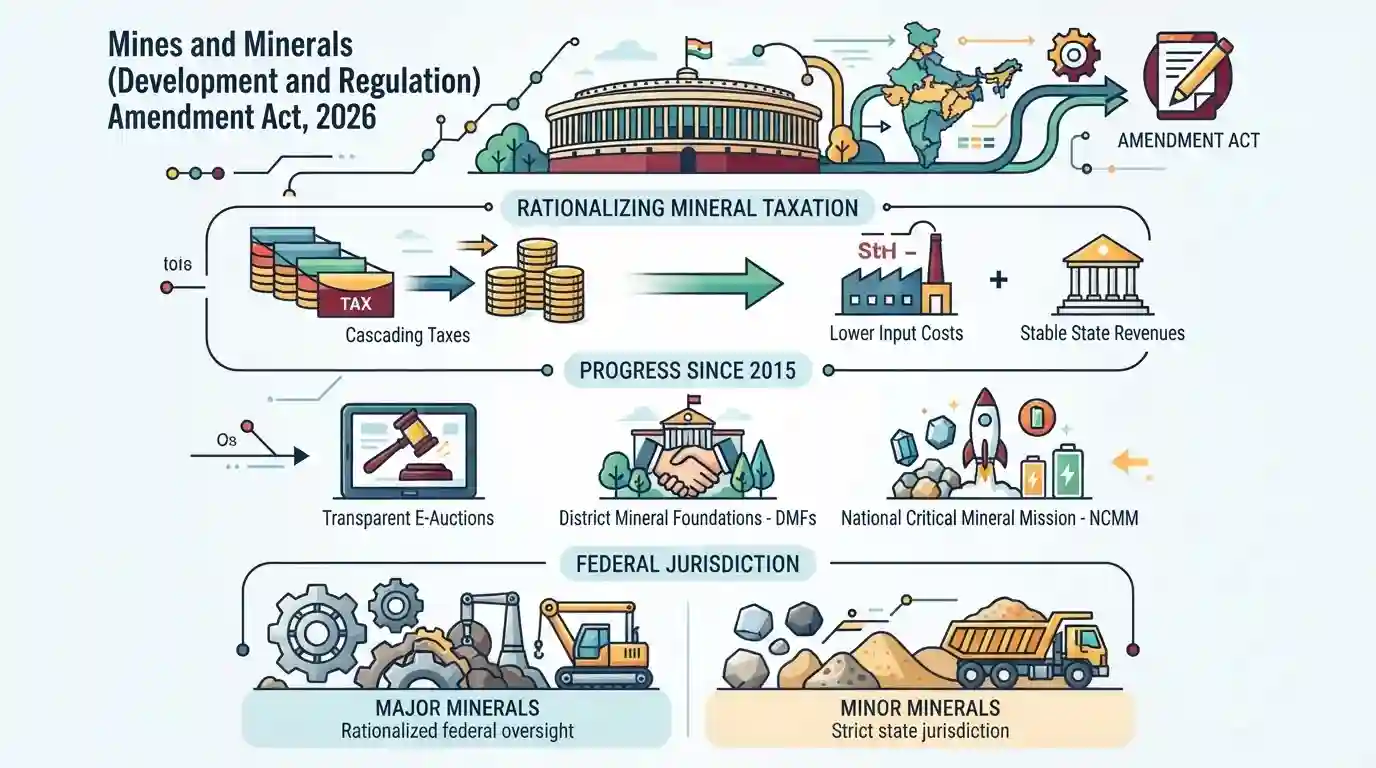
The Mines and Minerals (Development and Regulation) Amendment Act, 2026, introduces statutory corrections to rationalize the complex web of state-level taxes on major minerals. By preventing cascading tax burdens, the Act seeks to lower input costs for infrastructure and manufacturing without compromising state revenues. The government highlights significant progress in the mining sector since 2015, including transparent e-auctions, the establishment of District Mineral Foundations (DMFs), and major investments through the National Critical Mineral Mission (NCMM). Notably, minor minerals remain strictly under state jurisdiction.
મુખ્ય મુદ્દા
- The MMDR Amendment Act, 2026 aims to rationalize multi-point state-level mineral taxation to prevent cascading cost effects on critical sectors like steel, cement, and power.
- The Act ensures that states, which currently collect about 90% of mineral revenues, will not lose out; a stable tax regime is expected to boost upfront capital and long-term production.
- Key reforms highlighted include 100% transparent competitive e-auctions since 2015, the creation of District Mineral Foundations (DMFs), and the National Critical Mineral Mission (NCMM) with a ₹16,300 crore outlay.
- Minor minerals, such as sand, gravel, and clay, are explicitly kept out of the 2026 amendment's purview and remain exclusively regulated and taxed by State Governments.
- To secure the supply chain and reduce import dependency, the government has launched a ₹1,500 crore critical mineral recycling scheme and empowered KABIL for overseas exploration in places like Argentina.
મહત્વપૂર્ણ શબ્દો
Mines and Minerals (Development and Regulation) Amendment Act, 2026

A 2026 legislative amendment preventing state governments from levying fresh taxes on mineral rights and lands without central conditions. It aims to establish a uniform fiscal framework and prevent cascading tax burdens on critical resources.
UPSC context
Crucial for GS-2 (Centre-State Relations) and GS-3 (Economy). Tests understanding of federal taxation powers and economic rationalization in mining.
National Critical Mineral Mission (NCMM)
An initiative launched to build a secure, self-reliant ecosystem for critical minerals through domestic exploration, overseas acquisition, and recycling. It targets minerals vital for clean energy, defense, and high-tech manufacturing.
UPSC context
Vital for GS-3 (Economy/Environment). Tests India’s strategic mineral security, clean energy transition goals, and supply chain resilience.
District Mineral Foundation (DMF)
A non-profit statutory trust set up by State governments in mining-affected districts. Funded by miner contributions, it implements local welfare and development projects to mitigate the adverse socio-environmental impacts of mining.
UPSC context
High-yield for GS-2 (Governance) and Prelims. Highlights resource-sharing, tribal welfare, and inclusive development in mining-heavy regions.
Pradhan Mantri Khanij Kshetra Kalyan Yojana (PMKKKY)
A welfare scheme utilizing DMF funds to implement developmental projects in mining-affected areas. It focuses on high-priority needs like healthcare, education, drinking water, and sustainable livelihoods for impacted communities.
UPSC context
Important for GS-2 (Welfare Schemes). Tests how statutory funds are explicitly mobilized for marginalized populations in resource-rich states.
Khanij Bidesh India Limited (KABIL)
A joint venture company under the Ministry of Mines created to identify, explore, and acquire strategic critical minerals overseas. It ensures raw material security for domestic manufacturing and green energy.
UPSC context
Relevant for GS-2 (International Relations) and GS-3 (Economy). Connects to India's resource diplomacy, international partnerships, and strategic autonomy.
પ્રિલિમ્સ ટ્રેપ
State Governments have the exclusive power to define and notify a mineral as a minor mineral.
The Central Government exclusively defines what constitutes a 'minor mineral', while State Governments hold the power to frame rules, grant concessions, and collect royalties.
સંલગ્ન સ્થિર ખ્યાલો
How does the 7th Schedule divide powers over mining and taxation?
- Union List (Entry 54): Parliament regulates mines and mineral development to the extent declared expedient in public interest.
- State List (Entry 23): States regulate mines and mineral development, subject to Union provisions under List I.
- State List (Entry 50): States can tax mineral rights, but this is subject to limitations imposed by Parliament (e.g., MMDR Act).
What is the mandate and funding structure of District Mineral Foundations (DMFs)?
- Statutory Trusts: Established under the MMDR Act, 2015, as non-profit statutory bodies functioning in mining-affected districts.
- Welfare Objective: Exclusively mandated to work for the welfare of persons and areas affected by mining, not for exploration.
- Leaseholder Funding: Funded via mandatory contributions from mining leaseholders based on a prescribed percentage of the royalty paid.
આંતર-વિષય પેટર્ન
Mineral taxation & Fiscal Federalism
The 2024 SC judgment affirming States' rights to tax minerals under Entry 50 intersects directly with Parliament's legislative counter-moves via the MMDR 2026 Amendment.
KABIL & overseas critical minerals
Securing lithium in Argentina via KABIL ties domestic mining reform to India's geopolitical strategy for critical mineral supply chains and EV transition targets.

Expect a multi-statement question contrasting Union vs State powers over minor/major minerals, paired with DMFs' welfare-only mandate.
સંલગ્ન PYQ · 5
સંલગ્ન PYQ · 5
- 2016PrelimsGS1
What is/are the purpose/purposes of 'District Mineral Foundations' in India? 1. Promoting mineral exploration activities in mineral-rich districts 2. Protecting the interests of the persons affected by mining operations 3. Authorizing State Governments to issue licences for mineral exploration Select the correct answer using the code given below.
- 2019PrelimsGS1
With reference to the management of minor minerals in India, consider the following statements: 1. Sand is a 'minor mineral' according to the prevailing law in the country. 2. State Governments have the power to grant mining leases of minor minerals, but the powers regarding the formation of rules related to the grant of minor minerals lie with the Central Government. 3. State Governments have the power to frame rules to prevent illegal mining of minor minerals. Which of the statements given above is/are correct?
- 2025PrelimsGS1
Consider the following statements : Statement I: In India, State Governments have no power for making rules for grant of concessions in respect of extraction of minor minerals even though such minerals are located in their territories. Statement II: In India, the Central Government has the power to notify minor minerals under the relevant law. Which one of the following is correct in respect of the above statements?
- 2025MainsGS2
Examine the evolving pattern of Centre-State financial relations in the context of planned development in India. How far have the recent reforms impacted the fiscal federalism in India?
- 2025MainsGS3
Mineral resources are fundamental to the country's economy and these are exploited by mining. Why is mining considered an environmental hazard? Explain the remedial measures required to reduce the environmental hazard due to mining.
