Carbon Border Adjustment Mechanism Preparedness for Exporters
Source:PIB ↗
ఇది ఎందుకు ముఖ్యం
The EU's CBAM is a prime example of environment-linked trade policy that serves as a non-tariff barrier, directly impacting major Indian industrial exports like steel and aluminium. Understanding the government's measures to build domestic verification capacities and prepare exporters is vital for grasping modern international trade conflicts, protectionism, and climate negotiation dynamics (CBDR-RC).
సారాంశం
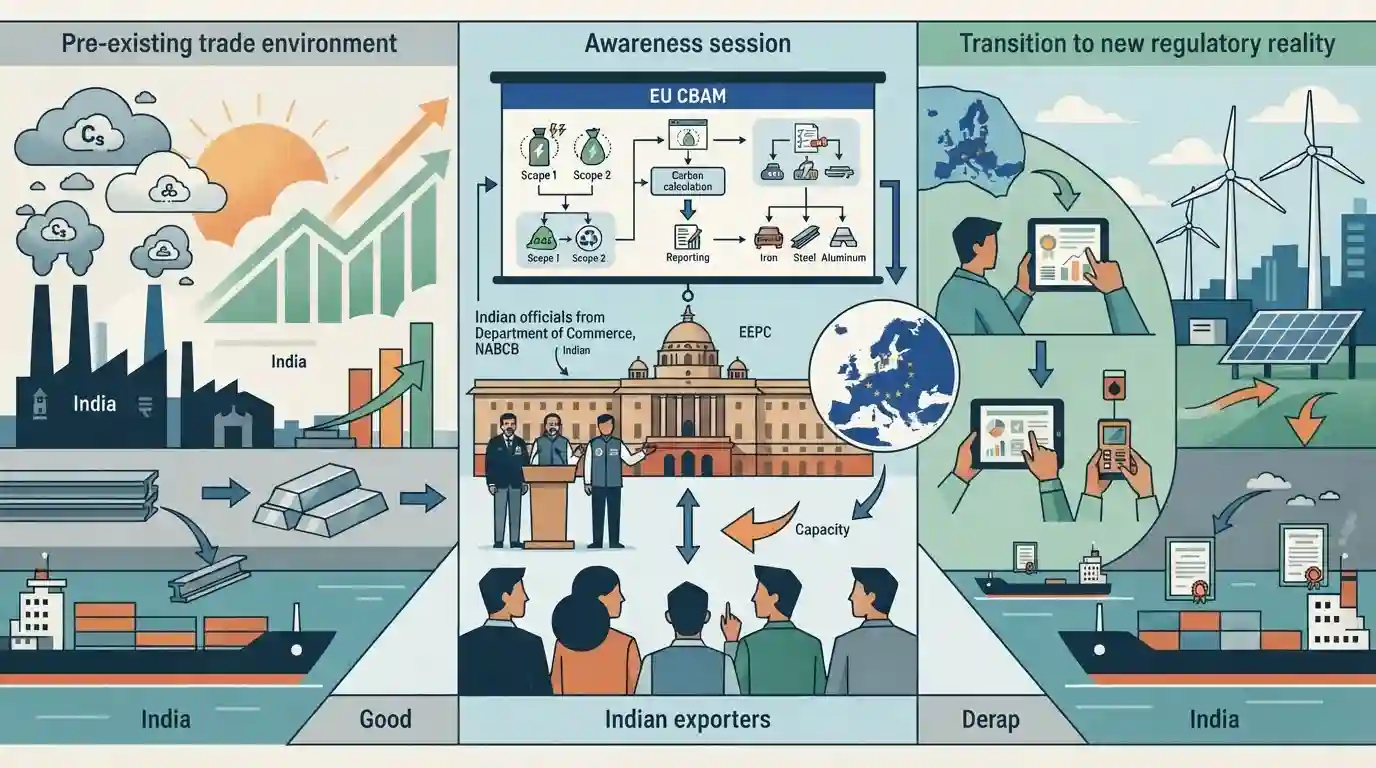
The Department of Commerce, in collaboration with the National Accreditation Board for Certification Bodies (NABCB) and the Engineering Export Promotion Council (EEPC), hosted an awareness session on the European Union's Carbon Border Adjustment Mechanism (EU CBAM) at Vanijya Bhawan, New Delhi. Aimed at enhancing Indian exporters' preparedness, the sessions covered CBAM frameworks, embedded emissions calculation, reporting compliance, and sector-specific case studies on iron, steel, and aluminium. The initiative highlights India's efforts to build a credible domestic emissions verification ecosystem and help exporters adapt to rising international sustainability-focused trade regulations.
ముఖ్య అంశాలు
- The Department of Commerce organized an awareness and sensitization session on EU Carbon Border Adjustment Mechanism (CBAM) regulations in collaboration with NABCB and EEPC.
- The session focused on enhancing preparedness among Indian exporters by covering core aspects like embedded emissions calculations, data collection and reporting, and accreditation.
- Detailed sector-specific discussions and case studies were conducted for the iron & steel and aluminium sectors, which are heavily affected by the EU's CBAM regulation.
- The role of a robust domestic accreditation and verification ecosystem was emphasized to build international confidence in emissions data submitted by Indian exporters.
- The government reaffirmed its commitment to handholding exporters through capacity-building to adapt to evolving, sustainability-driven non-tariff measures in global markets.
ముఖ్యమైన పదాలు
Carbon Border Adjustment Mechanism (CBAM)

A European Union environmental policy that imposes carbon-linked tariffs on imported carbon-intensive goods (such as steel, aluminium, and cement) to prevent 'carbon leakage' and level the playing field.
UPSC context
GS Paper III (Economy/Environment); tests knowledge of global climate regulations, non-tariff trade barriers, and their direct impact on Indian exports.
Ministry of Commerce & Industry
A Union ministry responsible for formulating and executing trade, investment, and industrial policies in India, operating through the Department of Commerce and the Department for Promotion of Industry and Internal Trade (DPIIT).
UPSC context
GS Paper II (Government Policies) & III (Economy); tests knowledge of structures governing India’s international trade and domestic industrial development.
Department of Commerce
A department within the Ministry of Commerce and Industry tasked with regulating international trade, implementing India's Foreign Trade Policy, managing bilateral/multilateral commercial relations, and promoting exports.
UPSC context
GS Paper III (Economy); tests executive initiatives in export promotion, foreign trade, and handling trade disputes or standardizations.
National Accreditation Board for Certification Bodies (NABCB)
A constituent board of the Quality Council of India (QCI) that provides formal international accreditation to certification, inspection, and verification bodies, ensuring conformity assessment results are globally recognized.
UPSC context
GS Paper III (Economy); tests standard conformity, international quality compliance systems, and domestic quality assurance infrastructures facilitating global trade.
Engineering Export Promotion Council (EEPC)
A trade and investment promotion agency under the Ministry of Commerce & Industry, established in 1955 to promote Indian engineering exports and assist domestic manufacturers with global trade compliance.
UPSC context
GS Paper III (Economy); tests understanding of export-oriented institutions, trade facilitation bodies, and assistance frameworks for MSME and engineering sectors.
ప్రిలిమ్స్ ఉచ్చు
The National Accreditation Board for Certification Bodies (NABCB) operates under the Ministry of Environment, Forest and Climate Change.
NABCB is a constituent board of the Quality Council of India (QCI), which functions under the Ministry of Commerce and Industry.
అనుసంధానమైన స్థిర భావనలు
What is Carbon Leakage and how does CBAM mitigate it?
- Definition: Occurs when industries relocate production to nations with weaker climate policies to avoid local carbon costs.
- Mitigation: CBAM imposes a carbon price on imports equivalent to the domestic carbon price under EU's Emissions Trading System.
- WTO Alignment: Designed to mirror domestic carbon taxes to avoid violating GATT's National Treatment principle.
What is the Quality Council of India (QCI)?
- Establishment: Set up in 1997 as an autonomous body under the Department for Promotion of Industry and Internal Trade (DPIIT).
- Structure: Jointly promoted by the government and premier industry associations (ASSOCHAM, CII, and FICCI).
- Leadership: Headed by a Chairman appointed by the Prime Minister of India based on industry recommendations.
అంతర-అంశ నమూనాలు
Green Protectionism vs CBDR Principle
CBAM pits environmental trade barriers against UNFCCC's 'Common but Differentiated Responsibilities' principle, raising trade disputes under WTO law.
GVC Integration and MSME Compliance
Tier-1 metal exporters rely on MSME suppliers. Strict embedded emissions auditing forces costly green transition demands down to resource-constrained Indian MSMEs.

Unilateral green trade measures (like EU's CBAM) will likely be tested on their compatibility with WTO rules and UNFCCC's CBDR principle.
అనుసంధాన PYQలు · 3
అనుసంధాన PYQలు · 3
- 2025MainsGS3
What are the challenges before the Indian economy when the world is moving away from free trade and multilateralism to protectionism and bilateralism? How can these challenges be met?
- 2026PrelimsGS1
Which of the following is/are the most significant implication(s) of obtaining Oeko-Tex certification for Eri Silk in the global textile industry ? 1. It allows Indian exporters to compete in high-end markets that prioritise chemical-free products. 2. It confirms that Eri Silk meets international safety, environmental, and quality standards, enabling its entry into premium eco-conscious markets. Select the answer using the code given below :
- 2025MainsGS3
Write a review on India's climate commitments under the Paris Agreement (2015) and mention how these have been further strengthened in COP26 (2021). In this direction, how has the first Nationally Determined Contribution intended by India been updated in 2022?
