Incentive Mechanisms for Domestic Piped Natural Gas Adoption
Source:PIB ↗
આ શા માટે મહત્વનું છે
It showcases government mechanisms to accelerate the transition to a gas-based economy and meet SDG 7 targets for clean cooking fuel. Understanding the Administered Price Mechanism (APM) and City Gas Distribution (CGD) economics is crucial for questions on energy security, natural gas pricing, and reducing import dependence on expensive LNG.
સારાંશ
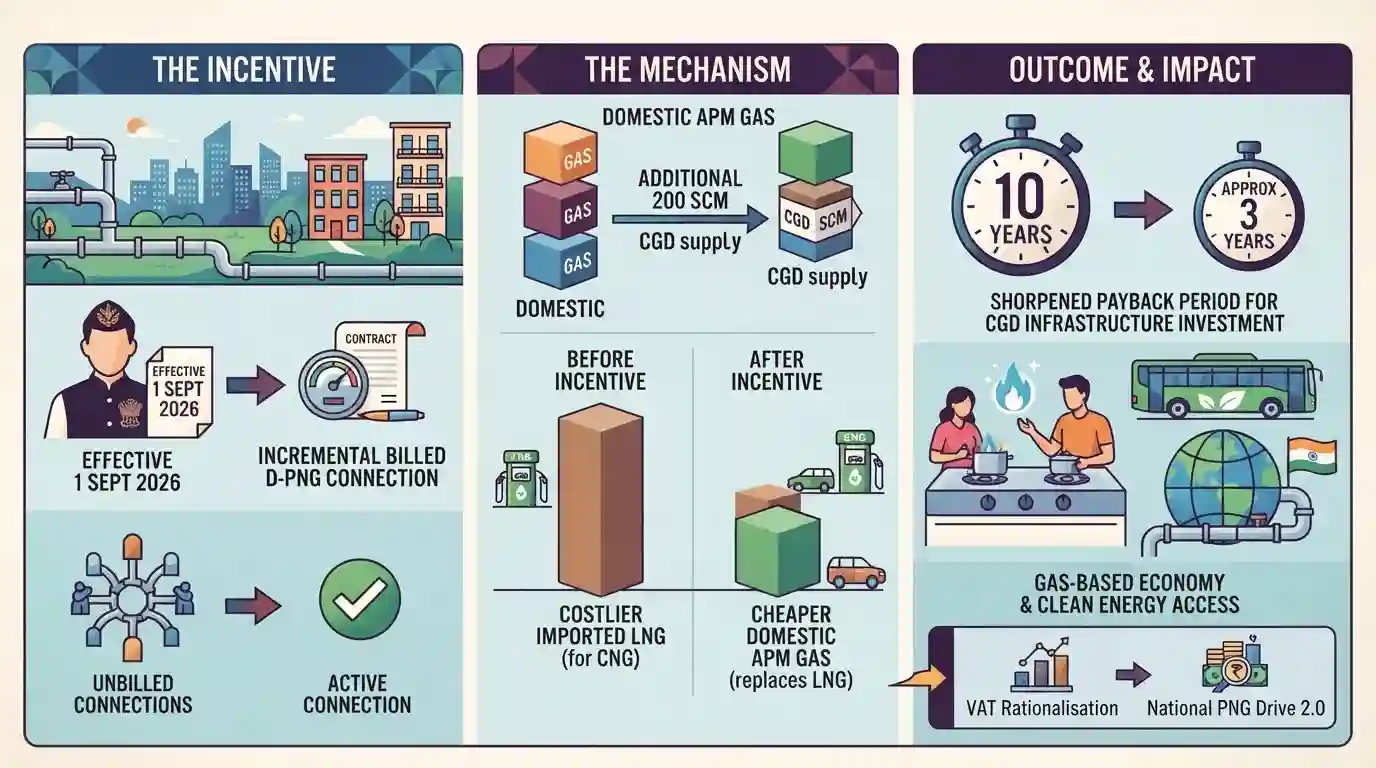
The Ministry of Petroleum & Natural Gas has launched an Incentive Scheme effective from 1 September 2026 to accelerate the adoption of Domestic Piped Natural Gas (D-PNG). Despite having infrastructural readiness, many connections remain unbilled; this scheme aims to motivate City Gas Distribution (CGD) companies to convert these into active connections and expand their networks. Under the Administered Price Mechanism (APM/NAPM) framework, CGDs will receive an additional 200 Standard Cubic Meters (SCM) of lower-priced domestic APM gas for every incremental billed connection above a specified threshold. This cheaper domestic gas will replace costlier imported LNG currently used for Compressed Natural Gas (CNG) in transport, significantly lowering overall gas sourcing costs. The resulting financial benefit is expected to drastically shorten the payback period for CGD capital investments from around 10 years to roughly 3 years. Ultimately, the scheme furthers India's push towards a gas-based economy by ensuring a safe, convenient, and environmentally friendly clean cooking fuel supply, building upon previous reforms like VAT rationalisation and the National PNG Drive 2.0.
મુખ્ય મુદ્દા
- The Incentive Scheme takes effect on 1 September 2026 to boost active Domestic Piped Natural Gas (D-PNG) connections and expand the current 1.74 crore connection base.
- City Gas Distribution (CGD) companies will be allocated an additional 200 SCM of cheaper domestically-produced APM gas for every incremental billed D-PNG connection above a threshold.
- The additional APM gas substitutes costlier imported LNG used for transport (CNG), lowering overall gas sourcing costs for the CGDs.
- This financial incentive reduces the payback period for capital expenditure in D-PNG infrastructure from approximately 10 years to just 3 years.
- The scheme supports environmental sustainability by promoting clean cooking fuel, which reduces carbon emissions and improves indoor air quality.
- It builds on prior initiatives like reducing VAT on natural gas to 5%, launching the Unified PNG registration portal, and streamlining regulatory clearances.
મહત્વપૂર્ણ શબ્દો
Incentive Scheme for Promotion of Domestic PNG Connections

A government initiative effective September 2026 that provides city gas distributors with extra low-priced APM gas to encourage converting unbilled connections into active, billed ones.
UPSC context
GS Paper III (Infrastructure, Energy); tests policy interventions for expanding clean, network-based domestic fuel infrastructure.
City Gas Distribution (CGD) companies
Entities authorized by the Petroleum and Natural Gas Regulatory Board (PNGRB) to develop and operate natural gas pipeline networks for domestic, commercial, and vehicular consumers.
UPSC context
GS Paper III (Infrastructure, Energy); tests understanding of the regulatory framework and last-mile retail supply chain of natural gas.
Administered Price Mechanism (APM)
A pricing framework where the Indian government regulates natural gas prices, particularly from legacy domestic fields, currently linked to a monthly average of the Indian crude basket.
UPSC context
GS Paper III (Indian Economy, Resource Pricing); tests understanding of government-regulated pricing structures and subsidies in the energy sector.
Piped Natural Gas (PNG)
Natural gas, predominantly methane, delivered directly to households and industries via low-pressure pipelines, offering a cleaner, safer, and continuous alternative to liquefied petroleum gas.
UPSC context
GS Paper III (Energy, Infrastructure); tests understanding of fuel types, safety profiles, and India’s transition to a gas-based economy.
National PNG Drive 2.0
A time-bound nationwide campaign launched by the PNGRB to accelerate the expansion of city gas distribution infrastructure and boost domestic and commercial PNG connections.
UPSC context
GS Paper III (Infrastructure, Government Policies); tests key clean energy drives and initiatives tackling domestic LPG import dependence.
પ્રિલિમ્સ ટ્રેપ
The additional APM gas allocation under the scheme is directly supplied to households to subsidize their domestic cooking bills.
The additional cheaper APM gas goes to City Gas Distribution companies to substitute expensive imported LNG in transport (CNG), lowering overall capital payback periods.
સંલગ્ન સ્થિર ખ્યાલો
What is the Administered Price Mechanism (APM) for natural gas?
- Origin: Gas produced from legacy nomination fields of ONGC and OIL, allocated by the government to high-priority sectors.
- Pricing framework: Linked to the Indian crude basket price, subject to a government-mandated price floor and ceiling.
- Priority allocation: City Gas Distribution (domestic PNG and transport CNG) receives top priority in APM gas allocation.
What is the Petroleum and Natural Gas Regulatory Board?
- Statutory status: Established under the PNGRB Act, 2006, to regulate midstream and downstream petroleum and natural gas activities.
- Price regulation: It regulates network tariffs and access, but does not directly set the retail consumer prices of petroleum products.
આંતર-વિષય પેટર્ન
Energy security + Import substitution
Shifting transport fuel from imported LNG to domestic APM gas via CGD cross-subsidization strengthens India's balance of payments and insulates the economy from global energy volatility.
Gas-based economy + COP targets
Transitioning from coal/biomass to natural gas (targeting 15% mix by 2030) serves as a crucial transitional bridge to meet India's net-zero commitments by 2070.

Multi-statement questions on India's 15% gas-mix target, APM pricing mechanisms, and city gas licensing are highly probable in Prelims.
સંલગ્ન PYQ · 2
સંલગ્ન PYQ · 2
- 2018MainsGS3
“Access to affordable, reliable, sustainable and modern energy is the sine qua non to achieve Sustainable Development Goals (SDGs).” Comment on the progress made in India in this regard.
- 2025PrelimsGS1
Consider the following activities : I. Production of crude oil II. Refining, storage and distribution of petroleum III. Marketing and sale of petroleum products IV. Production of natural gas How many of the above activities are regulated by the Petroleum and Natural Gas Regulatory Board in our country?
