Fiscal Federalism and Mineral Taxation Reforms in India
Source:PIB ↗
ఇది ఎందుకు ముఖ్యం
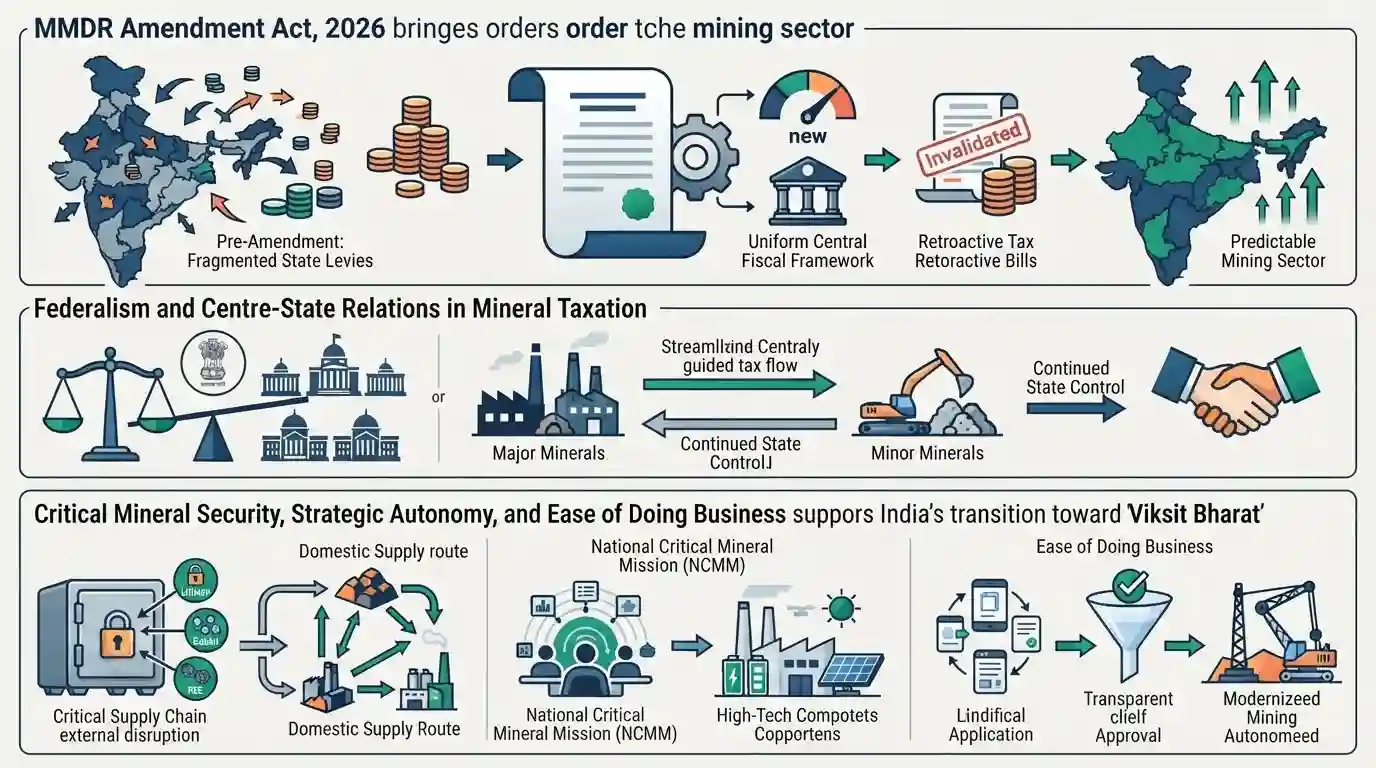
The division of taxing powers between the Centre and States over mineral rights is a high-profile constitutional and federal issue in India (often intersecting with landmark Supreme Court judgments on mineral taxation). This legislative amendment directly reshapes India's cooperative federalism and fiscal regime by centralizing the regulatory authority over mineral levies to prevent internal market fragmentation, control downstream costs, and secure supply chains for critical minerals.
సారాంశం
The Mines and Minerals (Development and Regulation) (MMDR) Amendment Act, 2026 introduces a predictable, uniform, and centrally-guided fiscal framework for India's mining sector. It restrains State Governments from unilaterally imposing fresh levies or cesses on mineral rights and mineral-bearing lands (via a new Section 9D), and invalidates pending retrospective tax demands. This reform addresses the high, fragmented State-tax burden that outpriced domestic mining against imports and threatened critical mineral security. While protecting State control over minor minerals and leaving their existing share of major mineral auction revenues intact, the Act seeks to strengthen investments, energy security, and manufacturing, supporting India's transition toward 'Viksit Bharat'.
ముఖ్య అంశాలు
- The MMDR Amendment Act, 2026 establishes a uniform fiscal framework by limiting State Governments' power to levy fresh taxes on mineral rights and mineral-bearing lands, unless they align with conditions prescribed by the Central Government.
- A newly inserted Section 9D restricts any State-imposed tax, cess, or levy based on mineral quantity, value, royalty, or other metrics, except under conditions/restrictions defined by the Centre.
- The Act invalidates all pending, unpaid retrospective tax demands raised by States prior to the amendment, though already collected/deposited amounts remain non-refundable.
- Rule-making power under Section 13 of the MMDR Act is amended, giving the Central Government the authority to prescribe rules and conditions for State-level mineral levies.
- The reform targets the cumulative burden of up to 14 varying State taxes and charges (such as royalty, dead rent, DMF, transit fees, and land taxes), which inflated domestic extraction costs and caused user industries to rely heavily on imports.
- High state levies on strategically vital minerals (e.g., graphite and uranium) made domestic mining economically unviable, endangering critical mineral and energy security goals.
- States' fiscal interests are protected: States still receive approximately 90% of mining revenues, which grew by 354% since 2014 due to the competitive auction premium system. Additionally, the regulation of nearly 50 minor minerals (e.g., sand, gravel, granite) remains entirely under State control.
- The backgrounder highlights key decade-long reforms since 2014, including mandatory competitive e-auctions, the launch of the National Critical Mineral Mission (NCMM) in Jan 2025, overseas sourcing by KABIL in Argentina, and local development funding via DMFs/PMKKKY.
ముఖ్యమైన పదాలు
Mines and Minerals (Development and Regulation) Amendment Act, 2026

An Act of Parliament amending the 1957 Act to establish a uniform mineral taxation framework, restrict state levies on mineral-bearing lands, and allow lease holders to add minerals to existing leases.
UPSC context
GS Paper II (Federalism) & GS Paper III (Mining Sector). Tests legislative powers over resource taxation.
National Critical Mineral Mission (NCMM)
A strategic initiative launched in 2025 to secure India's supply chains, boost domestic exploration and recycling, and facilitate overseas acquisition of critical minerals essential for clean energy.
UPSC context
GS Paper III (Infrastructure & Energy Security). Tests self-reliance and green energy transition strategies.
Pradhan Mantri Khanij Kshetra Kalyan Yojana (PMKKKY)
A developmental scheme implemented by District Mineral Foundations using accrued funds to execute welfare projects and ensure sustainable livelihoods for people in mining-affected districts.
UPSC context
GS Paper II (Welfare Schemes) & GS Paper III. Tests inclusive growth and tribal-welfare governance.
District Mineral Foundations (DMFs)
Non-profit statutory trusts set up in mining-affected districts under the MMDR Act to utilize mining-royalty contributions for the benefit and development of affected local communities.
UPSC context
GS Paper II (Decentralization & Social Justice). Tests local-level resource management and decentralized planning.
Khanij Bidesh India Limited (KABIL)
A joint venture company of NALCO, HCL, and MECL under the Ministry of Mines, mandated to acquire, explore, develop, and process strategic and critical minerals overseas.
UPSC context
GS Paper III (Energy Security). Tests India's international resource diplomacy and critical mineral sourcing.
National Mineral Exploration and Development Trust (NMEDT)
A statutory non-profit trust established under the MMDR Act (also NMET) to promote, fund, and accelerate regional and detailed mineral exploration activities across India.
UPSC context
GS Paper III (Economic Development/Resources). Tests institutional frameworks for natural resource discovery.
Geological Survey of India (GSI)
Established in 1851, GSI is India's premier national geoscientific agency under the Ministry of Mines, responsible for geological mapping, resource assessments, and earth science research.
UPSC context
GS Paper I & III (Geography/Resources). Tests roles of premier scientific and exploratory bodies.
ప్రిలిమ్స్ ఉచ్చు
The MMDR Amendment Act, 2026 strips State Governments of their administrative and rule-making jurisdiction over minor minerals.
The 2026 amendment targets unilateral state taxes/cesses on major/critical minerals under Section 9D, but explicitly leaves the regulation, licensing, and rule-making power of minor minerals fully under State control.
అనుసంధానమైన స్థిర భావనలు
How does the Constitution distribute legislative powers over mines and minerals?
- Union List Entry 54: Empowers Parliament to regulate mines and mineral development to the extent declared by law to be in the public interest.
- State List Entry 23: Gives States jurisdiction over mines and mineral development, but explicitly subjects this to the limits of Union List Entry 54.
- State List Entry 50: Allows States to tax mineral rights, but explicitly subjects this power to any limitations imposed by Parliament by law.
What is the regulatory distinction between Major and Minor Minerals?
- Declaration Power: The Central Government retains the sole authority under Section 3(e) of the MMDR Act to notify any mineral as a 'minor mineral'.
- State Domain: State Governments have complete powers to frame rules, set royalties, and regulate the extraction of minor minerals (e.g., sand, gravel, clay).
- Major Minerals: Governed primarily by Central rules and classification, although State Governments conduct the auctions and collect the revenue.
అంతర-అంశ నమూనాలు
Fiscal Federalism vs Resource Nationalism
Explores the constitutional friction between the Centre's drive for uniform resource pricing and the States' sovereign taxing powers under Entry 50 of List II.
Critical Minerals & Green Energy Transition
Links domestic mining fiscal reforms to India's clean tech ambitions, showing how mineral cost structures impact local lithium-ion battery and solar manufacturing.

Multi-statement questions contrasting Entry 50 (List II) taxing rights with Section 9D limits on major vs minor minerals are highly likely.
అనుసంధాన PYQలు · 5
అనుసంధాన PYQలు · 5
- 2025PrelimsGS1
Consider the following statements : I. India has joined the Minerals Security Partnership as a member. II. India is a resource-rich country in all the 30 critical minerals that it has identified. III. The Parliament in 2023 has amended the Mines and Minerals (Development and Regulation) Act, 1957 empowering the Central Government to exclusively auction mining lease and composite license for certain critical minerals. Which of the statements given above are correct?
- 2025PrelimsGS1
Consider the following statements : Statement I: In India, State Governments have no power for making rules for grant of concessions in respect of extraction of minor minerals even though such minerals are located in their territories. Statement II: In India, the Central Government has the power to notify minor minerals under the relevant law. Which one of the following is correct in respect of the above statements?
- 2026PrelimsGS1
Which of the following statements about Rare Earth Elements (REEs) and Critical Minerals is/are correct ? 1. Modern technological innovations including Artificial Intelligence, robotics and space exploration extensively utilise Rare Earth Elements (REEs). 2. China has the highest share in mining of REEs followed by India. 3. The Government of India launched the National Critical Mineral Mission (NCMM) in 2025 to establish a robust framework for self-reliance in the critical mineral sector. 4. Rare Earth Elements are a set of 13 metallic elements. Select the answer using the code given below :
- 2016PrelimsGS1
What is/are the purpose/purposes of 'District Mineral Foundations' in India? 1. Promoting mineral exploration activities in mineral-rich districts 2. Protecting the interests of the persons affected by mining operations 3. Authorizing State Governments to issue licences for mineral exploration Select the correct answer using the code given below.
- 2019PrelimsGS1
With reference to the management of minor minerals in India, consider the following statements: 1. Sand is a 'minor mineral' according to the prevailing law in the country. 2. State Governments have the power to grant mining leases of minor minerals, but the powers regarding the formation of rules related to the grant of minor minerals lie with the Central Government. 3. State Governments have the power to frame rules to prevent illegal mining of minor minerals. Which of the statements given above is/are correct?
