Priority Sector Lending Reforms and Public Sector Banking
Source:PIB ↗
हे का महत्त्वाचे आहे
The confluence provides crucial updates on the government's strategic direction for Public Sector Banks, particularly regarding Priority Sector Lending, agricultural value chain financing, and financial inclusion for youth. These are core topics under GS Paper 3 (Indian Economy) and help candidates understand ongoing banking sector reforms and digital financial integration (RuPay-UPI).
सारांश
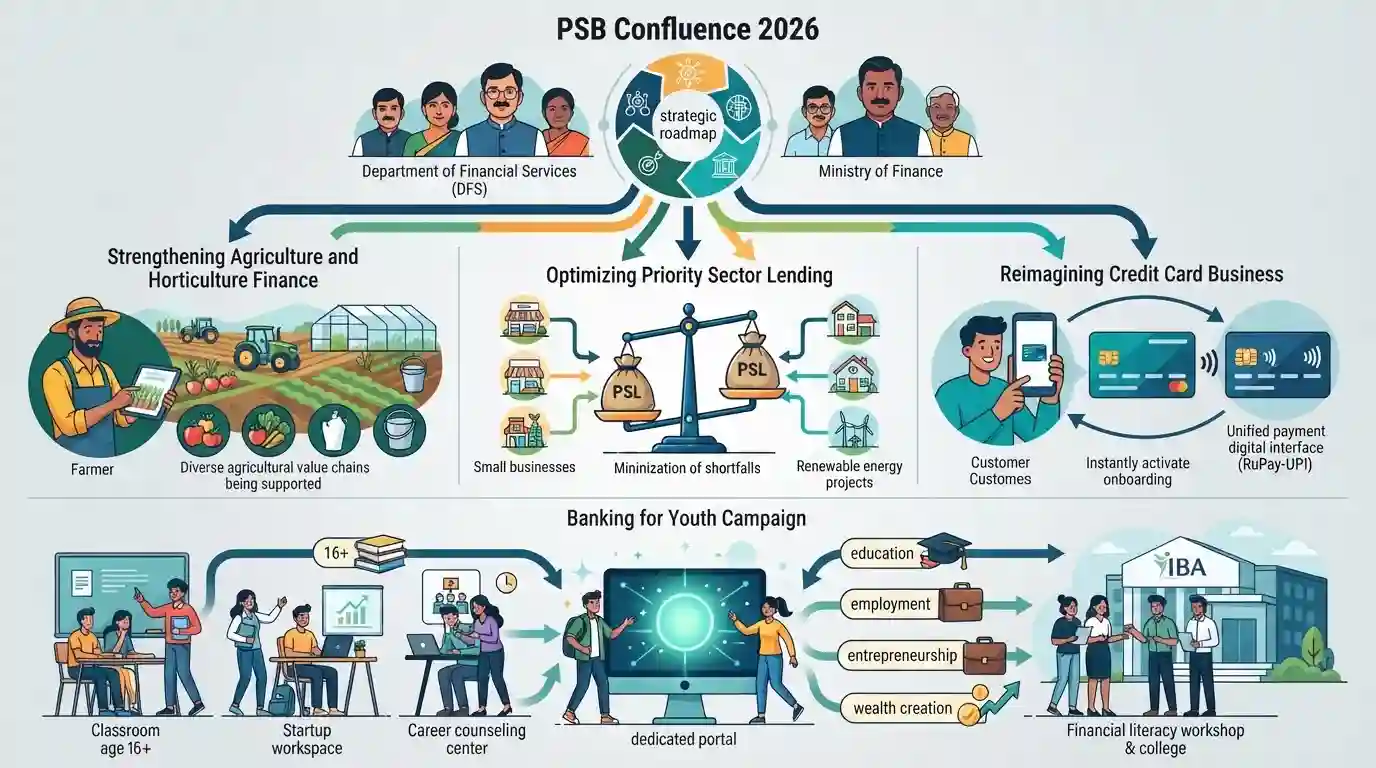
The 'PSB Confluence 2026', organized by the Department of Financial Services (DFS) under the Ministry of Finance, concluded with actionable strategies for Public Sector Banks (PSBs) and Public Financial Institutions (PFIs) across seven key themes. Day 2 focused on strengthening financing for agriculture and horticulture value chains, optimizing Priority Sector Lending (PSL) by minimizing target shortfalls, and reimagining the credit card business through digital onboarding and RuPay-UPI integration. Additionally, a nationwide 'Banking for Youth Campaign', coordinated by the Indian Banks' Association (IBA), was announced. Launching on October 2, 2026, the campaign will target individuals above 16 years of age through a dedicated portal and physical outreach at educational campuses, aiming to support their financial needs in education, employment, entrepreneurship, and wealth creation.
मुख्य मुद्दे
- The Department of Financial Services (DFS) organized a two-day 'PSB Confluence 2026' for Public Sector Banks (PSBs) and Public Financial Institutions (PFIs) to deliberate on seven themes critical to the next phase of banking growth.
- Key themes included strengthening the Agriculture and Horticulture Value Chain Infrastructure (including FPOs, storage, and logistics), and optimizing Priority Sector Lending (PSL) by minimizing shortfalls and ensuring productive credit flow.
- Strategies to reimagine the credit card business were explored, focusing on digital onboarding, cross-selling, and leveraging the RuPay-UPI integration.
- A major initiative, the 'Banking for Youth Campaign', was announced. Coordinated by the Indian Banks' Association (IBA), the month-long campaign will begin on October 2, 2026.
- The youth campaign targets citizens above 16 years, involving a common online portal/app and physical outreach at educational and skilling institutions to support their financial journey regarding education, employment, and entrepreneurship.
महत्त्वाच्या संज्ञा
Priority Sector Lending (PSL)

A regulatory framework mandated by the Reserve Bank of India (RBI) requiring banks to allocate a specified percentage of credit to essential, under-served sectors like agriculture, MSMEs, education, housing, and weaker sections.
UPSC context
GS Paper III (Indian Economy); tests credit distribution mechanisms, financial inclusion strategies, and agricultural sector financing.
Banking for Youth Campaign
A month-long digital and physical outreach campaign launching on October 2, 2026, targeting citizens above 16 years, aimed at building long-term banking relationships from campus to career and driving financial literacy.
UPSC context
GS Paper III (Indian Economy); tests financial literacy initiatives, youth demographic empowerment schemes, and financial inclusion policies.
Indian Banks' Association (IBA)
A premier voluntary association and representative body of banks and financial institutions in India, established in 1946, that works to standardize banking practices, coordinate industry policies, and promote robust financial systems.
UPSC context
GS Paper III (Indian Economy); tests roles of key institutional associations in banking reforms and wage negotiations.
Unified Payments Interface (UPI)
A real-time, instant payment system developed by the National Payments Corporation of India (NPCI) that facilitates seamless inter-bank peer-to-peer and peer-to-merchant transactions through a single mobile application.
UPSC context
GS Paper III (Science & Tech/Economy); tests digital public infrastructure, fintech developments, and cashless economy initiatives.
RuPay
India's indigenous, open-loop card payment network launched by the National Payments Corporation of India (NPCI) in 2012, serving as a low-cost, secure domestic alternative to international card networks like Visa and Mastercard.
UPSC context
GS Paper III (Indian Economy); tests indigenous financial technology, digital payment systems, and financial inclusion mechanisms.
Public Sector Banks (PSBs)
Government-owned commercial banks in India where the majority stake (51% or more) is held by the Union Ministry of Finance or state entities, playing a vital role in national development.
UPSC context
GS Paper III (Indian Economy - Banking); tests state ownership, NPA management, and banking sector reforms.
Department of Financial Services (DFS)
A key department under the Ministry of Finance responsible for formulating policies and supervising institutions related to banking, insurance, pension reforms, and public financial systems in India.
UPSC context
GS Paper II (Governance/Executive Structure); tests institutional mechanisms shaping economic policies, regulatory bodies, and banking reforms.
पूर्वपरीक्षा सापळा
The Indian Banks' Association (IBA) is a statutory regulatory body established under the Banking Regulation Act.
IBA is a voluntary association of bank managements established in 1946; it has no statutory or regulatory powers, which rest solely with the RBI.
संबंधित स्थिर संकल्पना
What happens when banks fail to meet Priority Sector Lending (PSL) targets?
- RIDF Allocation: Commercial banks must deposit their target shortfalls primarily into the Rural Infrastructure Development Fund (RIDF) managed by NABARD.
- Alternative Funds: Shortfalls may also be directed to other financial institutions like SIDBI, NHB, or MUDRA based on RBI directives.
- Interest Penalty: The interest rate on these deposits is fixed by the RBI and is typically low to serve as a financial disincentive.
How is the RBI's Financial Inclusion Index (FI-Index) structured?
- Three Parameters: It captures inclusion across three parameters: Access (35% weight), Usage (45% weight), and Quality (20% weight).
- Range of Index: The index uses a scale of 0 (complete financial exclusion) to 100 (complete financial inclusion).
- No Base Year: Uniquely, the index is built without a base year, reflecting cumulative development across all stakeholders over time.
आंतर-विषय नमुने
RuPay-UPI + Credit-driven Consumption
Linking credit cards to UPI shifts digital payments from deposit-backed transactions to credit-driven consumption, affecting domestic savings and retail inflation patterns under GS3.
PSL Shortfalls + Agri-Logistics Infrastructure
Directing PSL credit towards horticulture value chains and FPOs addresses the logistics bottlenecks and post-harvest losses highlighted in GS3 farm economy syllabus.

Multi-statement questions on financial inclusion may mix RBI's FI-Index weights with the structural nature of IBA and PSL targets.
संबंधित PYQ · 4
संबंधित PYQ · 4
- 2013PrelimsGS1
Priority Sector Lending by banks in India constitutes the lending to
- 2018PrelimsGS1
With reference to the governance of public sector banking in India, consider the following statements: 1. Capital infusion into public sector banks by the Government of India has steadily increased in the last decade. 2. To put the public sector banks in order, the merger of associate banks with the parent State Bank of India has been affected. Which of the statements given above is/are correct?
- 2019PrelimsGS1
The Chairmen of public sector banks are selected by the
- 2022MainsGS3
Is inclusive growth possible under market economy ? State the significance of financial inclusion in achieving economic growth in India.
