Digital Public Infrastructure Cooperation in BRICS Framework
Source:PIB ↗
Why It Matters
It illustrates India's proactive diplomatic strategy to internationalize its homegrown Digital Public Infrastructure (like India Stack) through multilateral forums such as BRICS, thereby shaping future global norms in e-governance and technological sovereignty.
Summary
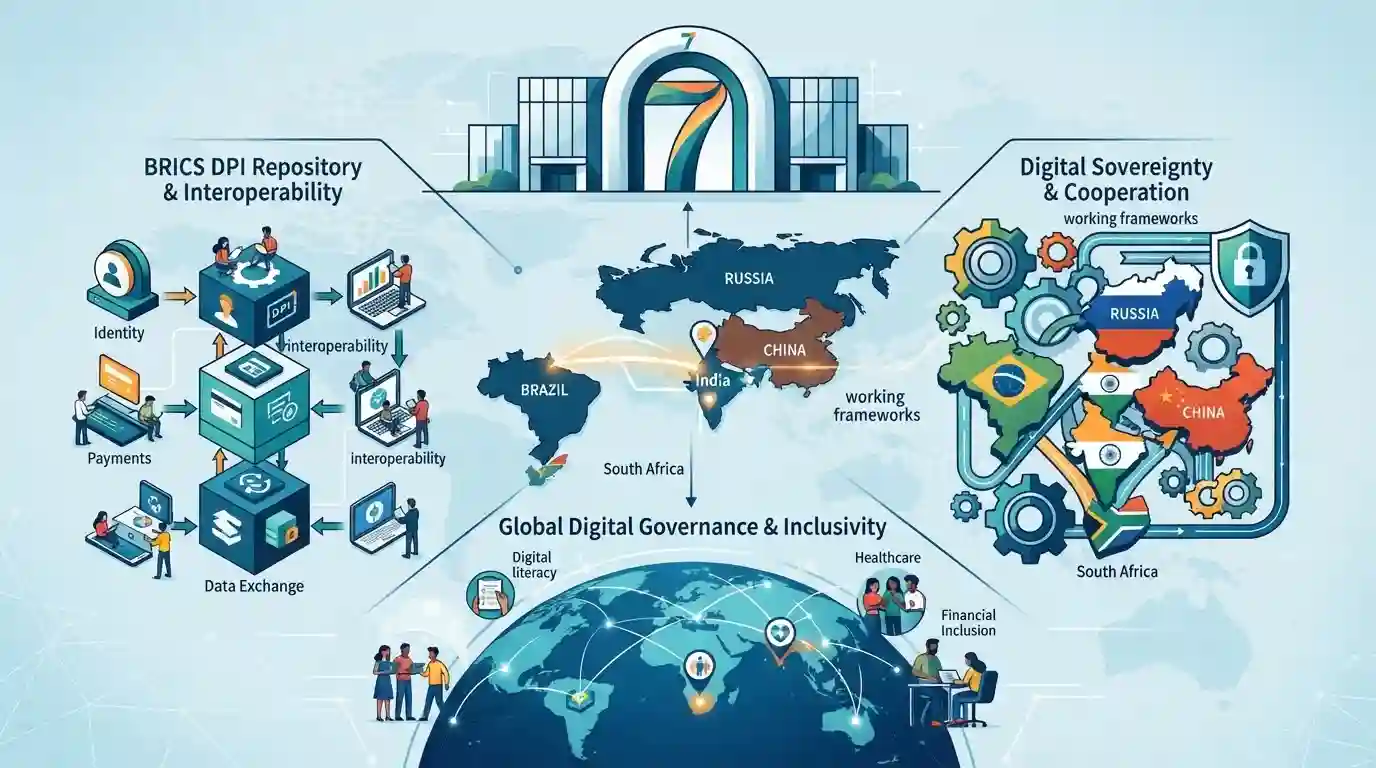
India recently hosted the 7th BRICS ICT Working Group meeting in Pune, highlighting the strategic role of Digital Public Infrastructure (DPI) and digital governance in shaping multilateral technological cooperation. During the sessions, India pitched a concept note for a BRICS DPI Repository, aiming to promote affordable, inclusive, and interoperable digital services globally. The discussions underlined core principles like digital sovereignty, leading to the formulation of working frameworks for expert groups on digital applications and governance within the BRICS bloc.
Key Points
- The 7th BRICS ICT Working Group meeting in Pune held dedicated sessions for the Focus Group on Digital Public Infrastructure and the Digital BRICS Task Force.
- India presented a concept note on creating a BRICS DPI Repository and Pilot Projects to showcase the efficacy of scalable digital frameworks.
- DPI was emphasized as an enabler for affordable, reliable, and citizen-centric digital services built on principles of openness, interoperability, and digital sovereignty.
- Draft terms of reference were prepared for the Digital Applications Expert Group (DAEG) and Digital Governance Expert Group (DGEG) to guide future BRICS digital cooperation.
Important Terms
Digital Public Infrastructure (DPI)

A foundational digital network comprising digital identity, real-time payments, and data-sharing systems that enables inclusive, secure, and efficient delivery of public and private services.
UPSC context
GS Paper III (Science & Tech/Economy); tests understanding of e-governance, digital inclusion, and India's global leadership.
BRICS Digital Public Infrastructure Repository
A proposed database within the BRICS framework, introduced by India, to compile and share open-source digital public infrastructure solutions and best practices among member nations.
UPSC context
GS Paper II (International Relations) & GS III (IT); assesses Indian leadership in multilateral digital diplomacy.
BRICS
An influential intergovernmental grouping of major emerging economies, originally consisting of Brazil, Russia, India, China, and South Africa, focusing on political, economic, and security cooperation.
UPSC context
GS Paper II (International Relations); tests knowledge of geopolitical alliances, multilateral forums, and emerging market dynamics.
Digital BRICS Task Force
A specialized body established under the BRICS ICT cooperation framework to deploy ICT infrastructure, support digital transformation, and promote digital literacy across member states.
UPSC context
GS Paper II (Multilateral Groupings) & GS III (IT); tests understanding of digital cooperation policies in international forums.
Digital Governance Expert Group
A proposed expert body under the BRICS ICT working group aimed at establishing collaborative frameworks, sharing best practices, and policy recommendations for secure, sovereign, and inclusive digital governance.
UPSC context
GS Paper II (E-Governance/Sovereignty); assesses comprehension of collaborative international guidelines for secure public digital administration.
Digital Applications Expert Group
A proposed BRICS technical panel tasked with identifying, analyzing, and developing joint digital applications and software platforms to address developmental and technical needs across member states.
UPSC context
GS Paper III (Science & Technology); tests strategies for multilateral technical collaboration and interoperable software application development.
Prelims Trap
The BRICS DPI Repository is a funding mechanism established by the New Development Bank (NDB).
The Repository is a proposed knowledge-sharing framework and platform for pilot projects, not a financial fund managed by the NDB.
Static Concepts Connected
What are the core layers of India's Digital Public Infrastructure (India Stack) model?
- Identity Layer: Provides foundational, verifiable digital identity to citizens to ensure inclusion (e.g., Aadhaar, e-Sign).
- Payments Layer: Facilitates seamless, low-cost, and interoperable digital financial transactions (e.g., UPI, Aadhaar Enabled Payment System).
- Data Empowerment Layer: Ensures secure, consent-based data sharing through institutional structures (e.g., DigiLocker, Account Aggregator framework).
How does the BRICS grouping operate institutionally?
- Informal Grouping: It lacks a formal charter or permanent secretariat; the agenda is driven by the rotating Chairship and annual summits.
- New Development Bank: Mobilizes resources for infrastructure and sustainable development projects in BRICS and other emerging economies.
- Contingent Reserve Arrangement: A framework providing short-term liquidity support to member nations to forestall balance of payments crises.
Cross-Topic Patterns
DPI as Global South Soft Power
India leverages its successful domestic DPI (UPI, Aadhaar) as diplomatic leverage in multilateral forums like G20 and BRICS to champion technological leadership for the Global South.
Digital Sovereignty vs. Open Data Flows
The BRICS DPI framework emphasizes 'digital sovereignty' and national data ownership, contrasting sharply with Western-led 'Data Free Flow with Trust' (DFFT) models pushed in G7.

Expect a multi-statement IR/Tech question contrasting India’s DPI proposals in G20 (Global DPI Repository) with those in BRICS.
Linked PYQs · 5
Linked PYQs · 5
- 2012MainsGS2
Compare the significance of IBSA and BRICS in the context of India's multilateral diplomacy.
- 2025MainsGS2
e-governance projects have a built-in bias towards technology and back-end integration than user-centric designs. Examine.
- 2024MainsGS2
e-governance is not just about the routine application of digital technology in service delivery process. It is as much about multifarious interactions for ensuring transparency and accountability. In this context evaluate the role of the 'Interactive Service Model' of e-governance.
- 2025PrelimsGS1
Consider the following statements with regard to BRICS : I. 16th BRICS Summit was held under the Chairship of Russia in Kazan. II. Indonesia has become a full member of BRICS. III. The theme of the 16th BRICS Summit was Strengthening Multiculturalism for Just Global Development and Security. Which of the statements given above is/are correct?
- 2014PrelimsGS1
With reference to a grouping of countries known as BRICS, consider the following statements: 1. The First Summit of BRICS was held in Rio de Janeiro in 2009. 2. South Africa was the last to join the BRICS grouping. Which of the statements given above is/are correct?
