Antitrust Regulation of Corporate Acquisitions in India
Source:PIB ↗
কেন এটি গুরুত্বপূর্ণ
This development serves as a practical example of the Competition Commission of India's mandate to regulate combinations (mergers and acquisitions) under the Competition Act, 2002. Understanding CCI's functions is crucial for the UPSC GS-2 syllabus concerning statutory and regulatory bodies.
সারসংক্ষেপ
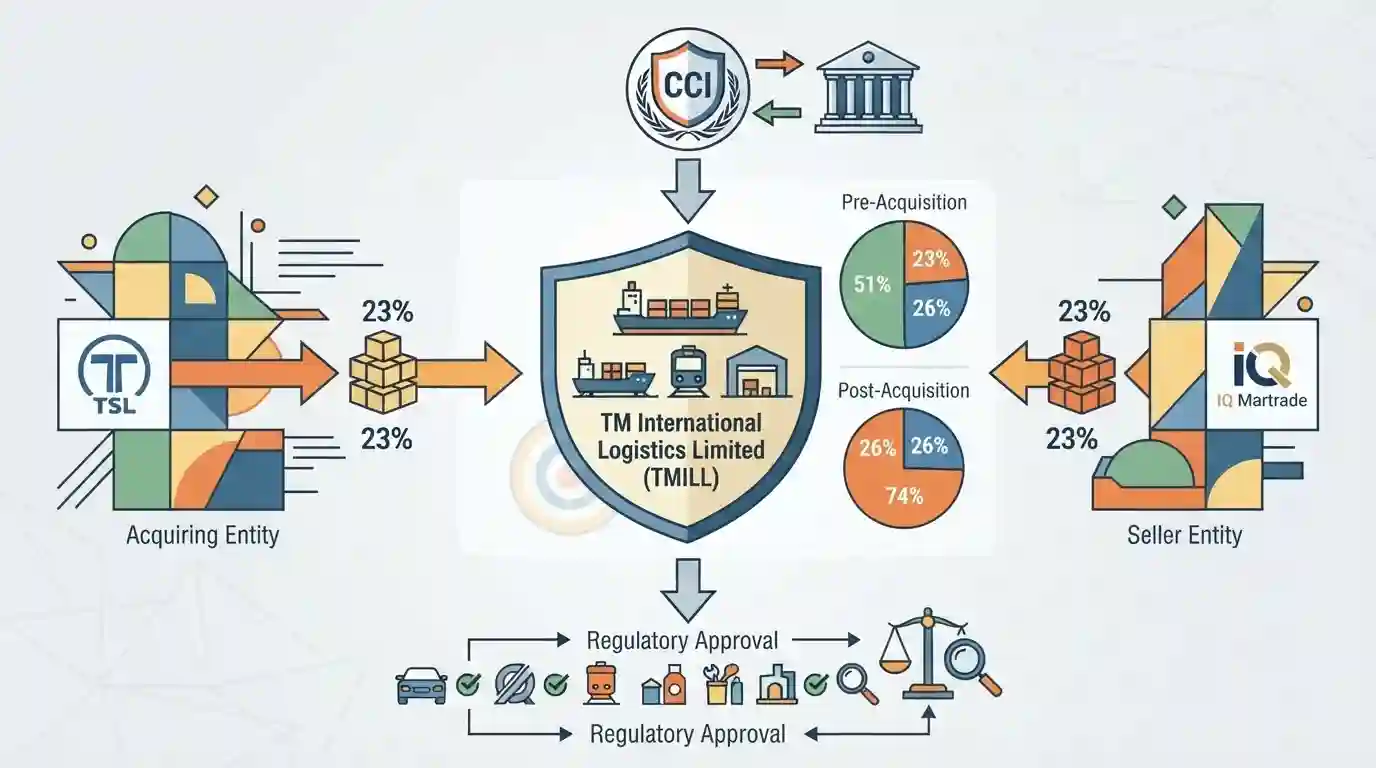
The Competition Commission of India (CCI) has approved the acquisition of a 23% equity shareholding in TM International Logistics Limited (TMILL) by Tata Steel Limited (TSL). The shares are being acquired from IQ Martrade Holding und Management GmbH. Following the transaction, Tata Steel will hold a 74% stake in the logistics joint venture, while NYK Holding (Europe) B.V. will retain its 26% share. The approval highlights the CCI's regulatory role in overseeing corporate combinations to ensure market competitiveness.
মূল বিষয়
- The Competition Commission of India (CCI) has cleared Tata Steel Limited's acquisition of a 23% equity stake in TM International Logistics Limited (TMILL).
- The stake is being acquired from IQ Martrade Holding und Management GmbH.
- Following this acquisition, Tata Steel's total shareholding in TMILL increases to 74%, with the remaining 26% held by NYK Holding (Europe) B.V.
- TMILL provides diverse logistics services, including port operations, shipping, freight forwarding, customs clearance, and warehousing.
গুরুত্বপূর্ণ শব্দ
Competition Commission of India (CCI)

A statutory, quasi-judicial body established under the Competition Act, 2002, to promote fair market competition, prevent anti-competitive agreements, and regulate mergers and acquisitions in India.
UPSC context
GS Paper II (Statutory Bodies) and GS Paper III (Indian Economy); tests regulatory governance and market competitiveness.
Competition Act, 2002
The primary Indian legislation designed to promote market competition, protect consumer interests, and prohibit anti-competitive practices like cartelization and the abuse of dominant market positions.
UPSC context
GS Paper II (Government Policies) and GS Paper III (Economic Development); tests legal provisions governing trade.
Tata Steel Limited (TSL)
Established in 1907, Tata Steel is one of India's largest and most geographically diversified multinational steel-making companies, operating as a key player in core industrial infrastructure.
UPSC context
GS Paper III (Industrial Growth & Infrastructure); tests understanding of core industries and economic contributions.
TM International Logistics Limited (TMILL)
A leading international logistics provider incorporated in 2002 as a joint venture, offering single-window end-to-end supply chain solutions including port operations, shipping, and warehousing.
UPSC context
GS Paper III (Infrastructure and Logistics); tests private joint ventures and modernization in India's logistics sector.
প্রিলিমস ফাঁদ
Appeals against any decision or order passed by the CCI lie directly before the Supreme Court of India or the High Courts.
Under the Finance Act 2017, the dedicated Competition Appellate Tribunal (COMPAT) was dissolved, and its powers were transferred to the National Company Law Appellate Tribunal (NCLAT). Appeals do not go directly to the Supreme Court or High Courts.
সংযুক্ত স্থির ধারণা
What is the Deal Value Threshold in Indian competition law?
- Legislative Origin: Introduced via the Competition (Amendment) Act, 2023, specifically to capture asset-light but high-valuation digital/tech market acquisitions.
- Quantitative Trigger: Mandates CCI approval for transactions valued above ₹2,000 crore if the target enterprise has significant business operations in India.
- Regulatory Purpose: Prevents 'killer acquisitions' where big firms acquire nascent tech competitors before they trigger traditional asset/turnover thresholds.
What is the appellate framework for CCI rulings?
- NCLAT Jurisdiction: Acts as the designated forum to hear and dispose of appeals against orders passed by the CCI.
- Tribunal Merger: Replaced the Competition Appellate Tribunal (COMPAT) in 2017 to streamline corporate tribunals under the Ministry of Corporate Affairs.
- Supreme Court Recourse: Any person aggrieved by an NCLAT order can file an appeal directly to the Supreme Court of India.
আন্তঃবিষয় প্যাটার্ন
Logistics Efficiency vs. Market Dominance
Consolidating logistics firms under industrial giants helps lower India's logistics costs to GDP ratio, but requires robust competition oversight to prevent captive monopoly pricing.
Tribunal Reform and Judicial Backlogs
Examines the administrative challenges of merging tribunals like COMPAT into NCLAT, analyzing judicial delays in antitrust dispute resolution and its overall impact on ease of doing business.

CCI's 2023 amendment (Deal Value Threshold) and NCLAT's jurisdiction over mergers are prime targets for GS-2/GS-3 analytical questions.
সংযুক্ত PYQ · 1
সংযুক্ত PYQ · 1
- 2023MainsGS2
Discuss the role of the Competition Commission of India in containing the abuse of dominant position by the Multi-National Corporations in India. Refer to the recent decisions.
