Administrative Convergence in Rural Development and Agriculture
Source:PIB ↗
આ શા માટે મહત્વનું છે
The integration of Agriculture and Rural Development ministries addresses the persistent silos in rural governance. By intertwining agricultural modernization (food processing, natural farming) with women's empowerment (SHGs) and emphasizing core ethical values for administrators, the initiative provides a multi-dimensional strategy to solve rural distress and achieve holistic development. The 'four mantras' also provide an excellent illustrative example for GS4 answers on public service values.
સારાંશ
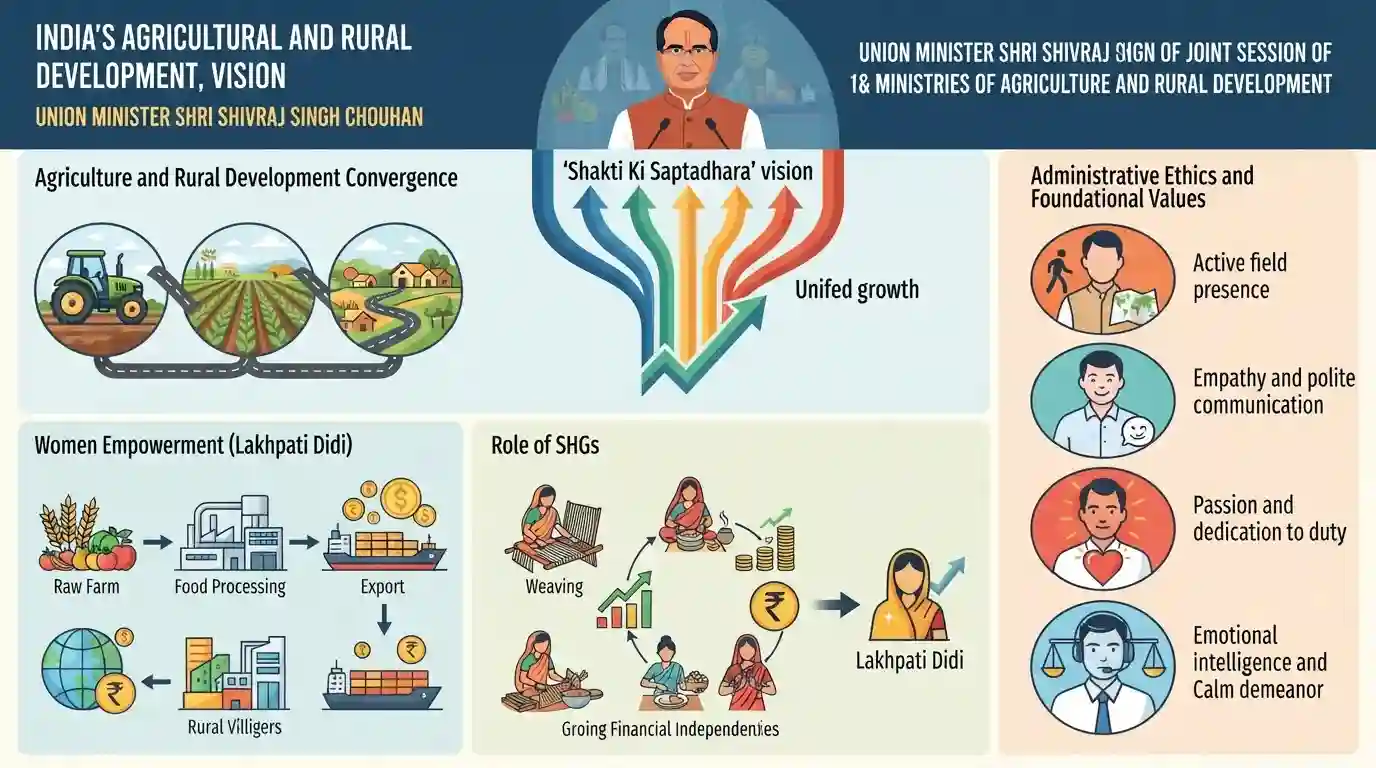
Union Minister Shri Shivraj Singh Chouhan addressed a joint meeting of the Ministry of Agriculture and Rural Development, emphasizing the need for both departments to work cohesively to implement PM Modi's 'Shakti Ki Saptadhara' vision. This convergence aims to create holistic district and state-level agricultural roadmaps focusing on natural farming, crop diversification, food processing, packaging, and global market access. Highlighting the goal of rural women's empowerment, the Minister lauded the ongoing efforts to create Lakhpati Didis through Self-Help Groups (SHGs). In a distinct message to government officials, he outlined four key mantras for effective public service: "Paanv mein chakkar" (active field presence), "munh mein shakkar" (empathy and polite communication), "seene mein aag" (passion and dedication to duty), and "maathe par barf" (emotional intelligence and calm demeanor). This holistic approach integrates agricultural growth, rural economic empowerment, and ethical governance.
મુખ્ય મુદ્દા
- Convergence for Rural Transformation: The Ministries of Agriculture and Rural Development are urged to function as a unified 'family' to implement state and district-level roadmaps for comprehensive rural upliftment.
- Economic Empowerment via 'Shakti Ki Saptadhara': Focuses on expanding the Lakhpati Didi initiative through Self Help Groups (SHGs), empowering rural women to become independent economic actors.
- Agricultural Modernization: Emphasizes moving beyond traditional farming towards natural farming, crop diversification, food processing, packaging, and tapping into global export markets.
- Four Mantras of Public Service: The Minister highlighted field mobility (paanv mein chakkar), empathetic communication (munh mein shakkar), passionate dedication (seene mein aag), and cool-headedness (maathe par barf) as essential ethical traits for civil servants.
મહત્વપૂર્ણ શબ્દો
Lakhpati Didi Initiative

A Ministry of Rural Development scheme empowering women in Self-Help Groups to earn an annual household income exceeding ₹1 lakh through skill training, financial inclusion, and diverse livelihood activities.
UPSC context
GS Paper 2 (Social Justice) and GS Paper 3 (Inclusive Growth). Tests knowledge of women's empowerment and rural development programs.
Shakti Ki Saptadhara
PM Modi’s “Seven Streams of Strength” vision for a developed India (Viksit Bharat) by 2047, emphasizing agricultural prosperity, crop diversification, food processing, and farm-to-global-market connectivity.
UPSC context
GS Paper 2 (Government Policies) and GS Paper 3 (Agriculture). Tests understanding of India's long-term developmental roadmaps.
Self-Help Groups (SHGs)
Small, informal, community-based collectives—predominantly comprising rural women—that pool savings, access credit, and engage in joint livelihood activities to achieve financial and socio-economic empowerment.
UPSC context
GS Paper 2 (Role of SHGs). Tests mechanisms of grassroots governance, poverty alleviation, and microfinance.
Foundational Values of Civil Service
Core ethical principles for administrators, summarized by the Minister as field presence, empathetic communication, passionate dedication, and emotional intelligence (patience and composure during crises).
UPSC context
GS Paper 4 (Ethics, Integrity & Aptitude). Directly tests emotional intelligence, public service values, and empathetic administration.
પ્રિલિમ્સ ટ્રેપ
The Lakhpati Didi scheme is a direct-benefit transfer scheme that provides an annual cash grant of ₹1 lakh to rural households.
Lakhpati Didi is an outcome-focused capacity-building and micro-enterprise framework under DAY-NRLM to enable sustainable self-earned income; it does not provide any direct fiscal cash transfers.
સંલગ્ન સ્થિર ખ્યાલો
What is the structural framework of DAY-NRLM for rural women's SHGs?
- Federated Structure: Operates on a multi-tiered federated structure—Self Help Groups (SHGs) at hamlet level, Village Organizations (VOs) at village level, and Cluster Level Federations (CLFs) at block level.
- Financial Mobilization: Employs Community Investment Support Fund (CIF) and Revolving Fund (RF) to build financial discipline and leverage bank credit directly, reducing informal debt.
- Panchayat Linkage: Integrates with local self-governments via the PRI-SHG convergence to improve access to basic public services and rights entitlement.
How do Emotional Intelligence and Empathy function as core civil service values?
- Emotional Intelligence: Involves identifying, understanding, and managing emotions (calmness or 'maathe par barf') to maintain objective decision-making during high-pressure public delivery situations.
- Empathy & Compassion: Requires going beyond mere sympathy to proactively understand and alleviate the hardships of vulnerable citizens through active field engagement (paanv mein chakkar).
- Dedicated Service: Translating public policy into welfare outcomes requires administrative passion and high motivation (seene mein aag) to overcome bureaucratic inertia.
આંતર-વિષય પેટર્ન
SHGs + Agro-Export Value Chains
Linking the Lakhpati Didi initiative with food processing and global standards transitions rural cooperative institutions from local survival micro-finance to export-oriented agricultural enterprises.
Administrative Ethics + Welfare Delivery
Integrating emotional intelligence (maathe par barf) and field-level empathy directly impacts the execution of grassroots social welfare programs, demonstrating GS-4's practical application in GS-2 schemes.

Multi-statement questions will likely target the newly doubled target (6 crore by 2029-30) and structural criteria of Lakhpati Didis.
સંલગ્ન PYQ · 5
સંલગ્ન PYQ · 5
- 2020MainsGS3
What are the challenges and opportunities of food processing sector in the country? How can income of the farmers be substantially increased by encouraging food processing?
- 2021MainsGS3
What are the present challenges before crop diversification? How do emerging technologies provide an opportunity for crop diversification?
- 2021MainsGS2
Can the vicious cycle of gender inequality, poverty and malnutrition be broken through microfinancing of women SHGs? Explain with examples.
- 2014MainsGS2
The penetration of Self Help Groups (SHGs) in rural areas in promoting participation in development programmes is facing socio-cultural hurdles. Examine.
- 2022MainsGS4
Apart from intellectual competency and moral qualities, empathy and compassion are some of the other vital attributes that facilitate the civil servants to be more competent in tackling the crucial issues or taking critical decisions. Explain with suitable illustrations.
