State Led Implementation of Digital Connectivity in Chhattisgarh
Source:PIB ↗
ఇది ఎందుకు ముఖ్యం
This article is highly relevant for UPSC Mains GS2 (Governance/Digital Divide) and GS3 (Infrastructure/Economy). It details the transformation of the Universal Service Obligation Fund (USOF) into the Digital Bharat Nidhi (DBN) under the Telecommunications Act, 2023, and showcases a cooperative federalism model (State-led) in deploying digital infrastructure to historically underserved and Left-Wing Extremism (LWE)-affected rural pockets of Chhattisgarh.
సారాంశం
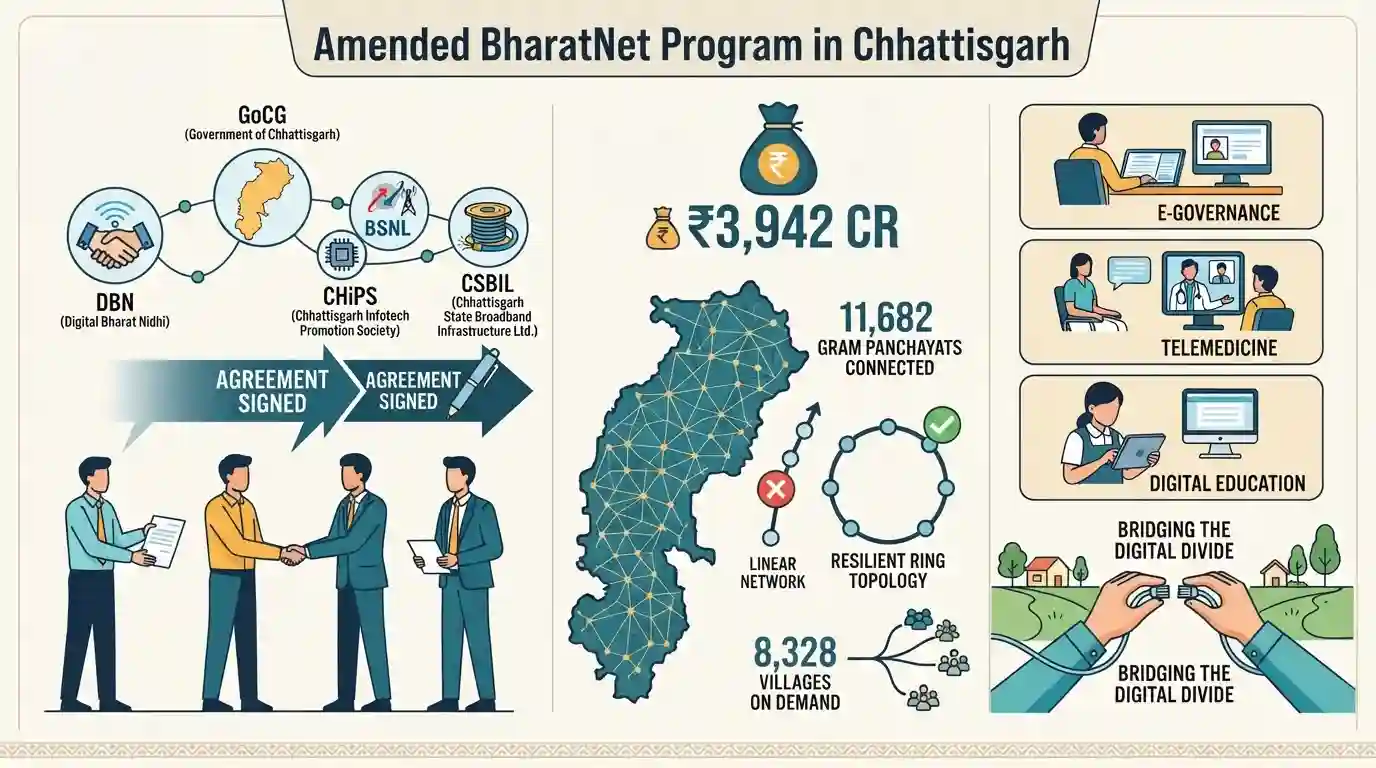
An agreement has been signed between the Digital Bharat Nidhi (DBN), the Government of Chhattisgarh, CSBIL, BSNL, and CHiPS to implement the Amended BharatNet Program under the State-led model. Backed by ₹3,942 crore in central financial support, the project will cover 11,682 Gram Panchayats—upgrading linear networks to resilient ring topologies—and connect 8,328 villages on demand. This initiative leverages the restructured Digital Bharat Nidhi (formerly the Universal Service Obligation Fund or USOF, renamed under the Telecommunications Act, 2023) to strengthen digital infrastructure, bridge the digital divide, and boost e-governance, telemedicine, and digital education across Chhattisgarh's rural and remote areas.
ముఖ్య అంశాలు
- An agreement was signed to implement the Amended BharatNet Program in Chhattisgarh under a State-led model, involving Digital Bharat Nidhi (DBN), the state government, CSBIL, BSNL, and CHiPS.
- The Union Government has approved financial support of ₹3,942 crore for the initiative, aiming to provide more than 3 lakh rural home fiber connections.
- The project has a total scope of 11,682 Gram Panchayats: upgrading 4,048 Phase I GPs from linear to ring topology for resilience, covering 5,964 Phase II GPs, and including 1,670 newly created GPs, alongside 8,328 villages connected on demand.
- Under the Telecommunications Act, 2023, the Universal Service Obligation Fund (USOF) has been restructured and renamed as the Digital Bharat Nidhi (DBN).
- DBN is an attached office under the Department of Telecommunications (DoT), with a mandate to support telecommunication access in underserved rural, remote, and urban areas through schemes like BharatNet, 4G Saturation, and LWE/border area mobile connectivity projects.
ముఖ్యమైన పదాలు
Amended BharatNet Program

An upgraded phase of the BharatNet project that replaces linear optical networks with resilient ring topologies. It connects Gram Panchayats and extends broadband to non-GP villages on demand to accelerate rural internet connectivity.
UPSC context
GS-3 (Infrastructure). Relevant for topics on digital infrastructure, bridging the rural-urban digital divide, and broadband connectivity.
Digital Bharat Nidhi
A dedicated fund established under the Telecommunications Act 2023, replacing the Universal Service Obligation Fund (USOF). Funded by telecom operator levies, it finances telecom infrastructure in underserved rural, remote, and urban areas.
UPSC context
GS-3 (Economy/Infrastructure). Tests knowledge of telecom sector financing, rural digital empowerment, and recent policy changes.
Telecommunications Act, 2023
A landmark law streamlining India's telecom sector by replacing colonial-era laws like the Indian Telegraph Act, 1885. It simplifies licensing, reforms spectrum allocation, and restructures the USOF into the Digital Bharat Nidhi.
UPSC context
GS-2 (Government Policies). Important for understanding regulatory frameworks, legislative reforms in communication, and digital governance.
Indian Telegraph (Amendment) Act, 2003
Legislation that granted statutory status to the Universal Service Obligation Fund (USOF). It formalized the collection of a Universal Access Levy from telecom operators to fund rural connectivity.
UPSC context
GS-2/GS-3. Provides foundational context for India's historical telecom policies and the evolution of rural digital funding mechanisms.
Department of Telecommunications
A department under the Ministry of Communications responsible for formulating telecom policies, granting licenses, managing radio frequency spectrum, and administering the Digital Bharat Nidhi for rural connectivity.
UPSC context
GS-2 (Governance). Relevant for understanding the institutional framework and nodal bodies executing India's digital public infrastructure.
ప్రిలిమ్స్ ఉచ్చు
Digital Bharat Nidhi collections are directly managed by DoT and restricted exclusively to rural broadband projects.
DBN collections (5% levy on AGR) are first credited to the Consolidated Fund of India (CFI). Furthermore, the Telecom Act 2023 expanded its mandate to include underserved urban areas and R&D.
అనుసంధానమైన స్థిర భావనలు
How is the Digital Bharat Nidhi (formerly USOF) funded and administered?
- Funding Source: Funded via a 5% Universal Service Levy charged on the Adjusted Gross Revenue (AGR) of telecom operators.
- CFI Routing: Collections are mandatorily credited to the Consolidated Fund of India (CFI) first, requiring parliamentary appropriation before use.
- Expanded Mandate: Unlike USOF's strict rural focus, DBN funds telecom R&D, pilot projects, and connectivity in underserved urban areas.
Why is BharatNet upgrading from linear to ring network topology?
- Linear Vulnerability: Nodes are connected sequentially. A single cable cut causes a complete outage for all downstream Gram Panchayats.
- Ring Redundancy: Nodes are connected in a closed loop. If one link fails, traffic automatically reroutes in the opposite direction.
- Objective: The transition ensures highly resilient, uninterrupted broadband connectivity, which is critical for telemedicine and e-governance services.
అంతర-అంశ నమూనాలు
Telecom Act 2023 & Right of Way (RoW)
The Telecom Act 2023 not only created DBN but also established uniform Right of Way (RoW) rules, a critical bottleneck-breaker for expediting BharatNet optical fiber rollouts across state and private lands.
AGR Dispute & Digital Bharat Nidhi
DBN is financed via a 5% levy on Adjusted Gross Revenue (AGR). Historical Supreme Court rulings on AGR inclusion directly impact the revenue pool available for bridging India's digital divide.

Expect multi-statement questions contrasting DBN's expanded mandate (urban areas, R&D) and CFI funding route against the old USOF.
అనుసంధాన PYQలు · 2
అనుసంధాన PYQలు · 2
- 2023MainsGS3
What is the status of digitalization in the Indian economy? Examine the problems faced in this regard and suggest improvements.
- 2021MainsGS2
Has digital illiteracy, particularly in rural areas, coupled with lack of Information and Communication Technology (ICT) accessibility hindered socio-economic development? Examine with justification.
