Digital Public Infrastructure Integration in Toll Operations
Source:PIB ↗
Why It Matters
Provides a concrete example of how e-governance and Digital Public Infrastructure (DPI) like DigiLocker and VAHAN can be integrated to improve public service delivery, eliminate manual intervention, and enhance transparency. It directly connects to the UPSC syllabus regarding infrastructure development, application of technology in transportation, and electronic toll collection methods.
Summary
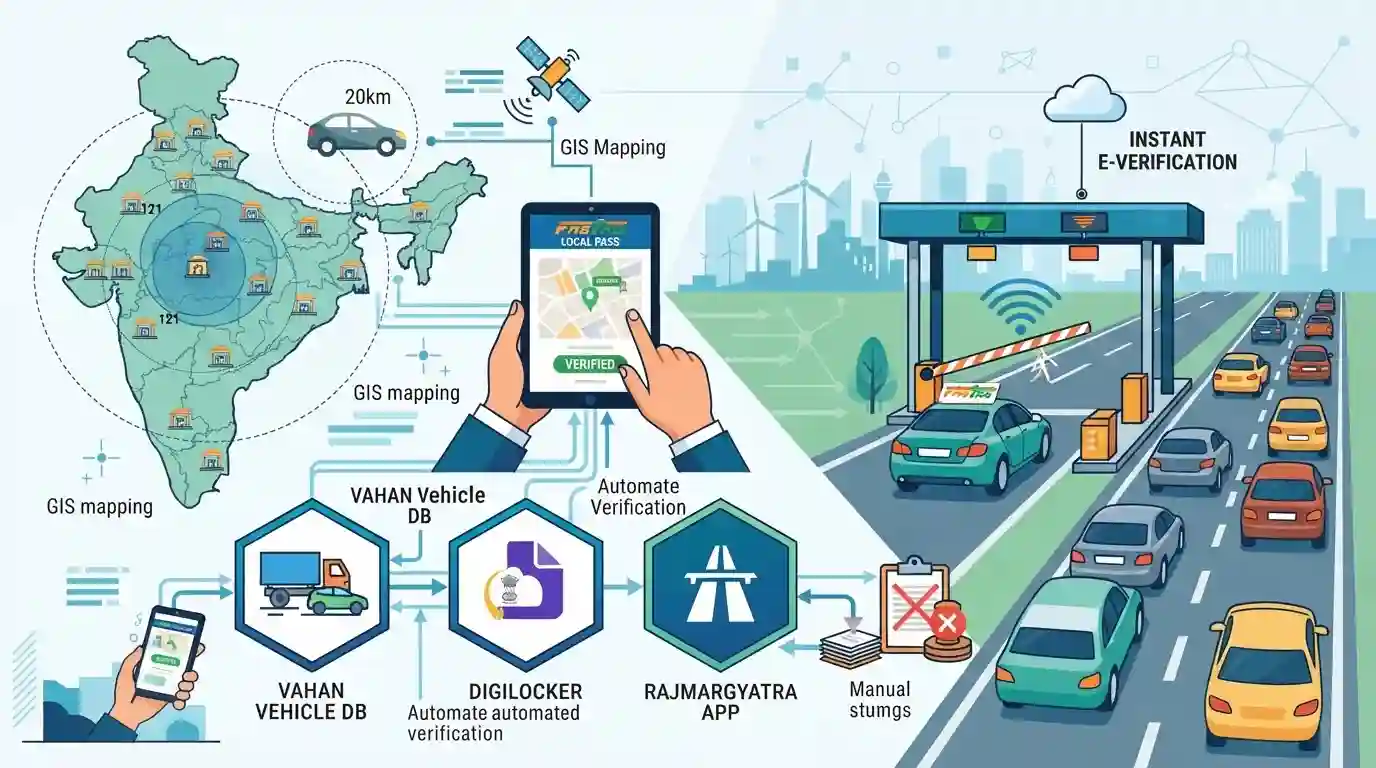
The National Highways Authority of India (NHAI) has expanded its digital FASTag Local Pass facility to 121 toll plazas nationwide, moving towards full coverage. Highway users residing within a 20 km radius of a toll plaza can now apply for the pass using the 'Rajmargyatra' app. The system leverages GIS mapping for location validation and integrates with 'VAHAN' and 'DigiLocker' to automatically verify vehicle details and addresses. By eliminating physical document submissions and manual checks, the initiative reduces processing time, limits chances of forgery, and exemplifies the role of e-governance in ensuring seamless public service delivery.
Key Points
- The NHAI has expanded the digital FASTag Local Pass facility to 121 toll plazas across the country, aiming for eventual nationwide coverage.
- The 'Rajmargyatra' mobile app facilitates a seamless application process for the digital local pass without the need for physical documents.
- The system uses Geographic Information System (GIS) based validation to verify that the applicant's residence falls within a 20 km radius of the toll plaza.
- Integration with government databases like 'VAHAN' and 'DigiLocker' allows automated verification of vehicle ownership and residential addresses.
- This digitalization eliminates manual verification, cuts down waiting times, prevents document forgery, and enhances overall transparency.
Important Terms
FASTag

An electronic toll collection system in India utilizing Radio Frequency Identification (RFID) technology to enable automatic cashless toll payments directly from linked accounts while vehicles are in motion.
UPSC context
GS Paper III (Infrastructure); tests understanding of electronic tolling, RFID applications, and Digital Public Infrastructure in transportation.
Rajmargyatra App
A unified, citizen-centric mobile application developed by the National Highways Authority of India (NHAI) to provide commuters with real-time highway information, toll services, and hassle-free complaint redressal.
UPSC context
GS Paper II (E-Governance); tests knowledge of citizen-centric service delivery, digital initiatives, and national highway grievance mechanisms.
VAHAN
A centralized, national vehicle registration database managed by the Ministry of Road Transport and Highways to digitize and streamline vehicle records, permits, and taxes across India.
UPSC context
GS Paper II (E-Governance); tests familiarity with national registries, digital administrative reforms, and inter-state vehicle tracking databases.
DigiLocker
A secure, cloud-based digital wallet under India's Digital India initiative that allows citizens to access, share, and verify legally authentic, digitally signed documents electronically.
UPSC context
GS Paper II (E-Governance/Government Policies); tests understanding of Digital Public Infrastructure, paperless governance, and digital citizen empowerment.
National Highways Authority of India (NHAI)
An autonomous statutory body under the Ministry of Road Transport and Highways, established to develop, maintain, and manage India's extensive network of National Highways.
UPSC context
GS Paper III (Infrastructure); tests familiarity with statutory bodies, highway development policies, and infrastructure management frameworks.
Prelims Trap
"The FASTag Local Pass is available for all commercial and private vehicles residing within a 20-km radius."
The discounted Local Monthly Pass under the 2008 Rules is strictly restricted to non-commercial private vehicles. Commercial vehicles are excluded.
Static Concepts Connected
How does FASTag RFID technology function for electronic toll collection?
- Passive technology: Utilizes passive Radio Frequency Identification (RFID) tags that contain no internal batteries, powered instead by the toll reader's electromagnetic waves.
- Frequency band: Operates in the UHF (Ultra High Frequency) band (860-960 MHz) to allow for instantaneous, long-range reading as vehicles approach.
- Financial integration: Each tag is linked to a prepaid wallet or bank account for automated, moving-vehicle deduction via the National Electronic Toll Collection (NETC) program.
What is the VAHAN database and its administrative structure?
- National Registry: A highly centralized national vehicle registry pooling registration data from State and Regional Transport Offices (RTOs) across India.
- Nodal Ministry: It is maintained by the Ministry of Road Transport and Highways (MoRTH), not the NHAI.
- API Integration: Serves as a backbone for e-Challan, FASTag KYC verification, stolen vehicle tracking, and automated motor insurance compliance checks.
Cross-Topic Patterns
DPI integration for law enforcement
Linking VAHAN to ANPR cameras and FASTag demonstrates how administrative databases are evolving into real-time legal enforcement tools, directly tying service access to insurance and toll compliance.
Transition to Multi-Lane Free Flow (MLFF)
Digitizing local passes paves the way for barrier-less highways, utilizing overhead ANPR and RFID to deduct tolls at cruising speeds, shifting infrastructure from physical checkpoints to virtual geofences.

Expect a multi-statement Prelims question mixing RFID tech principles, VAHAN database ownership, and the 20km Local Pass rule.
Linked PYQs · 3
Linked PYQs · 3
- 2024MainsGS3
What is the technology being employed for electronic toll collection on highways? What are its advantages and limitations? What are the proposed changes that will make this process seamless? Would this transition carry any potential hazards?
- 2024MainsGS2
e-governance is not just about the routine application of digital technology in service delivery process. It is as much about multifarious interactions for ensuring transparency and accountability. In this context evaluate the role of the 'Interactive Service Model' of e-governance.
- 2023MainsGS2
e-governance, as a critical tool of governance, has ushered in effectiveness, transparency and accountability in governments. What inadequacies hamper the enhancement of these features ?
