National Industrial Corridor Development Programme Apex Review
Source:PIB ↗
কেন এটি গুরুত্বপূর্ণ
Understanding the evolution of India's industrial corridors (NICDP), integrated logistics via PM GatiShakti, and the newly launched BHAVYA scheme is crucial for GS3 answers on manufacturing, MSME growth, and infrastructure bottlenecks.
সারসংক্ষেপ
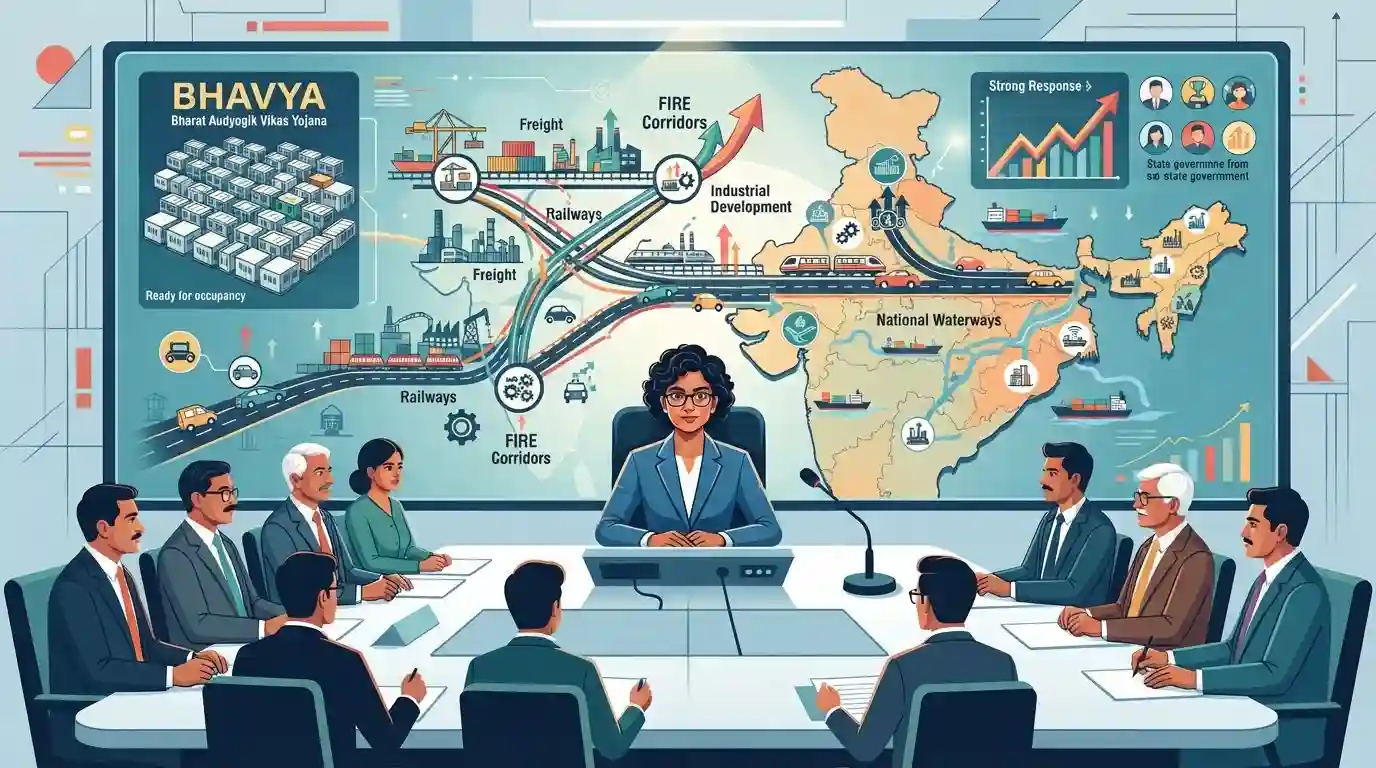
Union Minister Nirmala Sitharaman chaired the 3rd Apex Monitoring Authority meeting of NICDIT to review the National Industrial Corridor Development Programme (NICDP). The meeting highlighted the need for faster execution, stressing the convergence of Freight, Industrial Development, Railways, and Expressways ('FIRE Corridors') and alignment with PM GatiShakti to establish globally competitive manufacturing ecosystems. A key highlight was the review of the newly rolled-out Bharat Audyogik Vikas Yojana (BHAVYA), which aims to develop 100 plug-and-play industrial parks and has received a robust response from states. Further emphasis was placed on integrating national waterways into corridor development, empowering Special Purpose Vehicles (SPVs), and expanding industrial infrastructure into North-Eastern states.
মূল বিষয়
- The 3rd Meeting of the Apex Monitoring Authority of NICDIT reviewed the progress of the National Industrial Corridor Development Programme (NICDP), aiming to bolster the manufacturing sector.
- Policymakers stressed the importance of 'FIRE Corridors' (Freight, Industrial Development, Railways and Expressways) and integrated planning through the PM GatiShakti national master plan.
- The meeting reviewed the rollout of Bharat Audyogik Vikas Yojana (BHAVYA), which envisages the development of 100 investment-ready, plug-and-play industrial parks across India.
- Four industrial smart cities (Dholera, Shendra-Bidkin, Greater Noida, and Vikram Udyogpuri) have officially entered the production stage.
- Discussions highlighted integrating national waterways with Industrial Corridors and strengthening industrial infrastructure in the North-Eastern States.
গুরুত্বপূর্ণ শব্দ
National Industrial Corridor Development Programme (NICDP)

India's flagship program aimed at developing futuristic, integrated industrial corridors and smart greenfield cities to boost manufacturing GDP, global competitiveness, and job creation with plug-and-play infrastructure.
UPSC context
GS Paper III: Industrial policy, infrastructure, and growth. Tests understanding of regional development and export promotion strategies.
Bharat Audyogik Vikas Yojana (BHAVYA)
A Central scheme approved in March 2026 with a ₹33,660 crore outlay to develop 100 plug-and-play, investment-ready industrial parks nationwide, streamlining land acquisition and ease of doing business.
UPSC context
GS Paper III: Government schemes, industrial growth, and investment models. Tests knowledge of manufacturing ecosystems and cooperative federalism.
PM GatiShakti
A transformative digital platform launched for integrated planning and coordinated execution of multi-modal connectivity infrastructure projects, reducing logistics costs across economic zones and industrial corridors.
UPSC context
GS Paper III: Infrastructure planning, logistics, and multi-modal transport. Tests digital governance and project execution efficiency.
National Industrial Corridor Development and Implementation Trust (NICDIT)
An apex administrative body under DPIIT that acts as the primary financing and coordinating agency for establishing industrial corridors and smart cities under NICDP.
UPSC context
GS Paper III: Investment models and regulatory bodies. Tests understanding of administrative architecture for mega infrastructure financing.
National Industrial Corridor Development Corporation Limited (NICDC)
A special purpose vehicle incorporated to plan, promote, and facilitate the development of industrial corridor projects, acting as the key implementation arm under DPIIT.
UPSC context
GS Paper III: Industrial growth and public-private partnerships. Tests knowledge of execution structures and institutional mechanisms for industrialization.
প্রিলিমস ফাঁদ
The Apex Monitoring Authority of NICDIT is chaired by the Union Minister of Commerce and Industry.
While NICDIT lies under DPIIT (Ministry of Commerce), its Apex Monitoring Authority is chaired by the Union Finance Minister, with the Commerce Minister as Vice-Chair.
সংযুক্ত স্থির ধারণা
What is the institutional framework of the National Industrial Corridor Programme (NICDP)?
- Apex Trust: NICDIT (National Industrial Corridor Development and Implementation Trust) under DPIIT oversees and channels central funds for all corridors.
- Implementation Body: NICDC acts as the central project development agency and coordinates with state-level Special Purpose Vehicles (SPVs).
- Financing Model: SPVs are set up as joint ventures between the Government of India (through NICDIT) and respective State Governments to develop the nodes.
What is the Special Purpose Vehicle (SPV) model in infrastructure development?
- Definition: It is a legal entity created for a specific, narrow project to isolate financial risk and ease funding acquisition.
- Equity sharing: Joint ventures typically split equity 50:50 between the Center (via NICDIT) and the state government (which usually contributes land).
- Autonomy: Provides operational freedom to plan, allocate land, and manage local utilities without typical bureaucratic delays.
আন্তঃবিষয় প্যাটার্ন
Corridor development and fiscal federalism
Collaborative central-state SPV models under NICDIT test cooperative federalism by tying central capital assistance to state land pooling and ease-of-doing-business reforms.
Logistics cost and export competitiveness
Integrating 'FIRE Corridors' with PM GatiShakti aims to reduce India's logistics cost from ~13% to under 8% of GDP, directly boosting manufacturing export competitiveness.

Questions may target the institutional structure of NICDIT, specifically its chairperson and the core features of the BHAVYA scheme.
সংযুক্ত PYQ · 3
সংযুক্ত PYQ · 3
- 2021MainsGS3
“Investment in infrastructure is essential for more rapid and inclusive economic growth.” Discuss in the light of India's experience.
- 2023MainsGS3
Faster economic growth requires increased share of the manufacturing sector in GDP, particularly of MSMEs. Comment on the present policies of the Government in this regard.
- 2017MainsGS3
Industrial growth rate has lagged-behind in the overall growth of Gross-Domestic-Product (GDP) in the post-reform period." Give reasons. How far the recent changes in Industrial-Policy are capable of increasing the industrial growth rate?
