SEED Scheme Implementation for Nomadic and Semi-Nomadic Tribes
Source:PIB ↗
ఇది ఎందుకు ముఖ్యం
DNTs/NTs/SNTs are among the most invisibilized and historically marginalized groups in India. Questions on social justice often require assessing the effectiveness of welfare schemes for explicitly targeted vulnerable populations. Familiarity with the DWBDNC board, the NCDNT commission, and the multi-sectoral SEED scheme provides concrete fodder for GS2 Mains answers on affirmative action and inclusive development.
సారాంశం
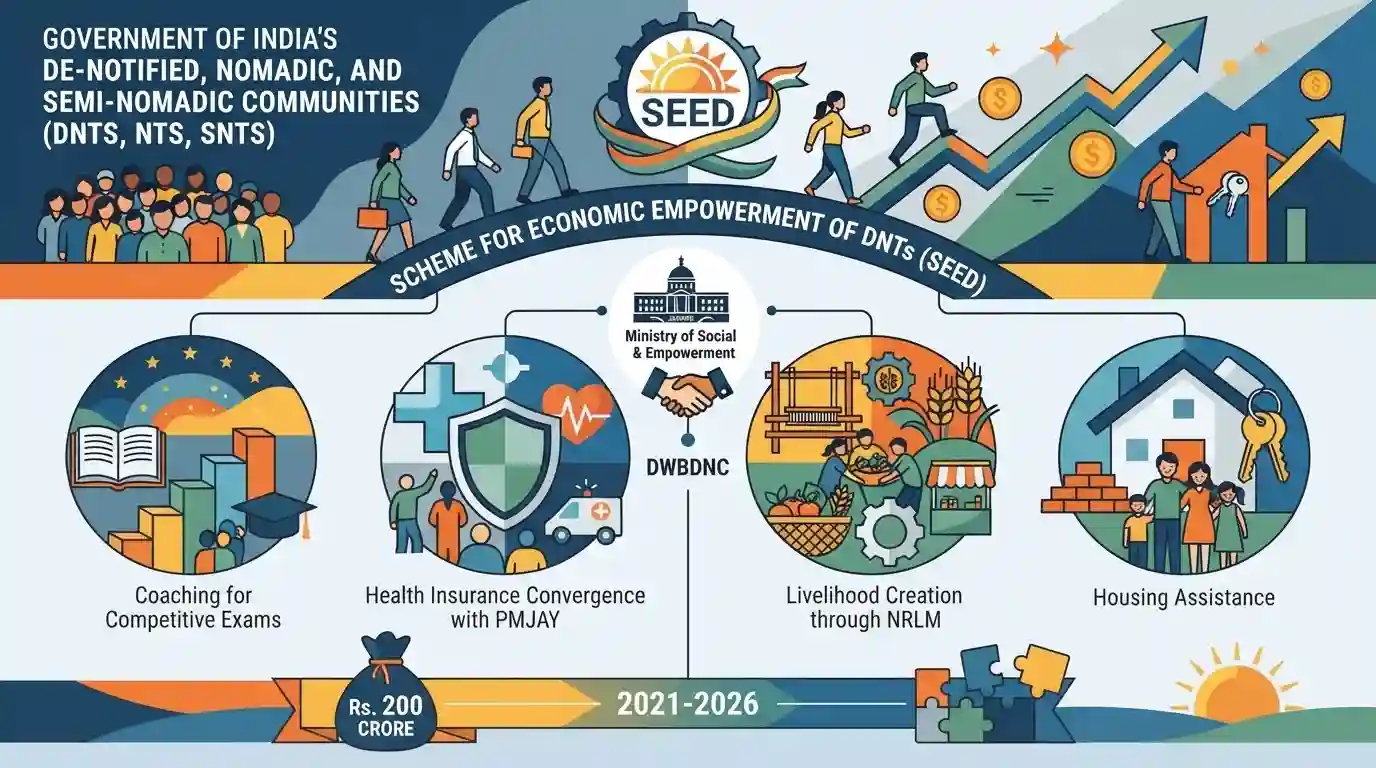
The Government of India has ramped up initiatives for the historically disadvantaged De-notified, Nomadic, and Semi-Nomadic Communities (DNTs, NTs, SNTs) by rolling out the Scheme for Economic Empowerment of DNTs (SEED). Administered by the Ministry of Social Justice and Empowerment through the Development and Welfare Board for De-notified, Nomadic and Semi-Nomadic Communities (DWBDNC), the SEED scheme provides targeted interventions in four critical areas: coaching for competitive exams, health insurance convergence with PMJAY, livelihood creation through NRLM, and housing assistance. Backed by a Rs. 200 crore allocation from 2021-2026, the program marks a dedicated push to integrate these invisible and highly vulnerable groups—many of whom still lack distinct constitutional categorization—into formal developmental and welfare nets.
ముఖ్య అంశాలు
- The Ministry of Social Justice and Empowerment launched the SEED scheme with an allocation of Rs. 200 crore (2021-22 to 2025-26) for the economic empowerment of De-notified, Nomadic, and Semi-Nomadic Tribes (DNT/NT/SNT).
- Historically marginalized, these communities largely remain outside the purview of formal SC/ST/OBC quotas; the National Commission for DNTs (NCDNT) was established in 2015 to recommend specific interventions.
- The Development and Welfare Board for DNTs/NTs/SNTs (DWBDNC), registered in 2019, is the nodal agency implementing welfare programs.
- The SEED scheme features four targeted components: educational empowerment via competitive coaching, health insurance linked to PMJAY, livelihood generation through NRLM integration, and housing assistance modeled on PMAY.
- The Anthropological Survey of India and Tribal Research Institutes have been tasked to study and document 267 currently unclassified DNT communities.
ముఖ్యమైన పదాలు
De-notified, Nomadic and Semi-Nomadic Tribes (DNTs)

Communities historically marginalized and stigmatized as "born criminals" under the colonial-era Criminal Tribes Act of 1871 (repealed in 1952). They practice seasonal or continuous migration and lack distinct constitutional classification.
UPSC context
GS Paper II: Social Justice; tests issues faced by historically stigmatized, marginalized, and non-enumerated communities.
Scheme for Economic Empowerment of DNTs (SEED)
A central sector scheme launched in 2022 to provide quality coaching, health insurance convergence, livelihood promotion, and housing assistance to marginalized DNT, NT, and SNT communities.
UPSC context
GS Paper II: Government schemes and policies; tests social integration and targeted welfare delivery mechanisms.
Development and Welfare Board for De-notified, Nomadic and Semi-Nomadic Communities (DWBDNC)
A board established in 2019 under the Ministry of Social Justice and Empowerment to design, implement, and monitor social welfare and rehabilitation programs for DNT/NT/SNTs.
UPSC context
GS Paper II: Statutory, regulatory and quasi-judicial bodies; tests institutional mechanisms for vulnerable groups.
National Commission for De-notified, Nomadic and Semi-Nomadic Tribes (NCDNT)
Investigative commissions (notably the Renke and Idate commissions) set up to study the socio-economic status, prepare state-wise identification lists, and recommend welfare strategies for DNTs.
UPSC context
GS Paper II: Bodies constituted for the protection of vulnerable sections; tests policy advisory bodies and enumeration issues.
Pradhan Mantri Jan Arogya Yojana (PM-JAY)
A centrally sponsored flagship health assurance scheme under Ayushman Bharat providing cashless, paperless health cover of up to ₹5 lakh per family annually for secondary and tertiary hospitalisation.
UPSC context
GS Paper II: Social sector services relating to Health; tests universal health coverage and out-of-pocket expenditure mitigation.
Deendayal Antyodaya Yojana - National Rural Livelihoods Mission (DAY-NRLM)
A flagship poverty alleviation program under the Ministry of Rural Development aiming to mobilize rural poor households into Self-Help Groups (SHGs) to promote sustainable, diversified livelihoods.
UPSC context
GS Paper III: Poverty alleviation and employment; tests grassroots mobilization, financial inclusion, and SHG development.
ప్రిలిమ్స్ ఉచ్చు
The SEED Scheme for De-notified, Nomadic and Semi-Nomadic Tribes (DNT/NT/SNT) is implemented by the Ministry of Tribal Affairs.
DNTs are not uniformly classified as Scheduled Tribes; they are spread across SC, ST, and OBC lists. Thus, MoSJE (not Ministry of Tribal Affairs) administers the SEED scheme.
అనుసంధానమైన స్థిర భావనలు
What is the historical and legal origin of De-notified Tribes (DNTs) in India?
- Colonial branding: Under the Criminal Tribes Act of 1871, the British colonial government classified over 150 communities as inherently criminal and subject to systemic surveillance.
- Post-independence repeal: The Act was repealed in 1952, "de-notifying" these communities; this landmark liberation is celebrated annually as Vimukti Diwas on August 31.
- Habitual Offenders Acts: Though de-notified, many states immediately enacted Habitual Offenders Acts, which functionally preserved colonial policing practices and continued community-wide social stigma.
Which key commissions have shaped policy and recommended reforms for DNTs?
- Renke Commission (2008): Estimated the DNT population at ~10.74 crore and recommended extending welfare and reservation benefits comparable to SC/ST categories.
- Idate Commission (2018): Identified ~1,200 distinct communities, mapped their severe socio-economic deprivation, and recommended establishing a permanent statutory commission for their protection.
అంతర-అంశ నమూనాలు
Colonial criminal laws and policing
The legacy of the Criminal Tribes Act, 1871, persists through state Habitual Offenders Acts, illustrating how colonial-era administrative classifications continue to institutionalize social bias and modern police profiling.
Scheme convergence and federal execution
SEED's operational model highlights a growing trend in welfare design: instead of standalone structures, it layers targeted identity-based funding onto existing universal schemes like PM-JAY and NRLM.

SEED Scheme questions will likely test the nodal Ministry (MoSJE vs Tribal), DWBDNC's legal status, and historical commissions like Renke.
అనుసంధాన PYQలు · 3
అనుసంధాన PYQలు · 3
- 2019MainsGS2
Performance of welfare schemes that are implemented for vulnerable sections is not so effective due to absence of their awareness and active involvement at all stages of policy process. Discuss.
- 2023MainsGS2
“Development and welfare schemes for the vulnerable, by its nature, are discriminatory in approach.” Do you agree? Give reasons for your answer.
- 2019PrelimsGS1
Consider the following statements about Particularly Vulnerable Tribal Groups (PVTGs) in India : 1. PVTGs reside in 18 States and one Union Territory. 2. A stagnant or declining population is one of the criteria for determining PVTG status. 3. There are 95 PVTGS officially notified in the country so far. 4. Irular and Konda Reddi tribes are included in the list of PVTGs. Which of the statements given above are correct?
