Central Information Commission Second Appeals Portal Upgrade
Source:PIB ↗
हे का महत्त्वाचे आहे
The Right to Information Act is a cornerstone of citizen-centric governance. Upgrading the digital infrastructure for RTI appeals (AppCoMS 2.0) directly aligns with UPSC GS2 themes of e-governance (interactive service models, user-centric designs), the functioning of statutory bodies (CIC), and mechanisms ensuring transparency and accountability.
सारांश
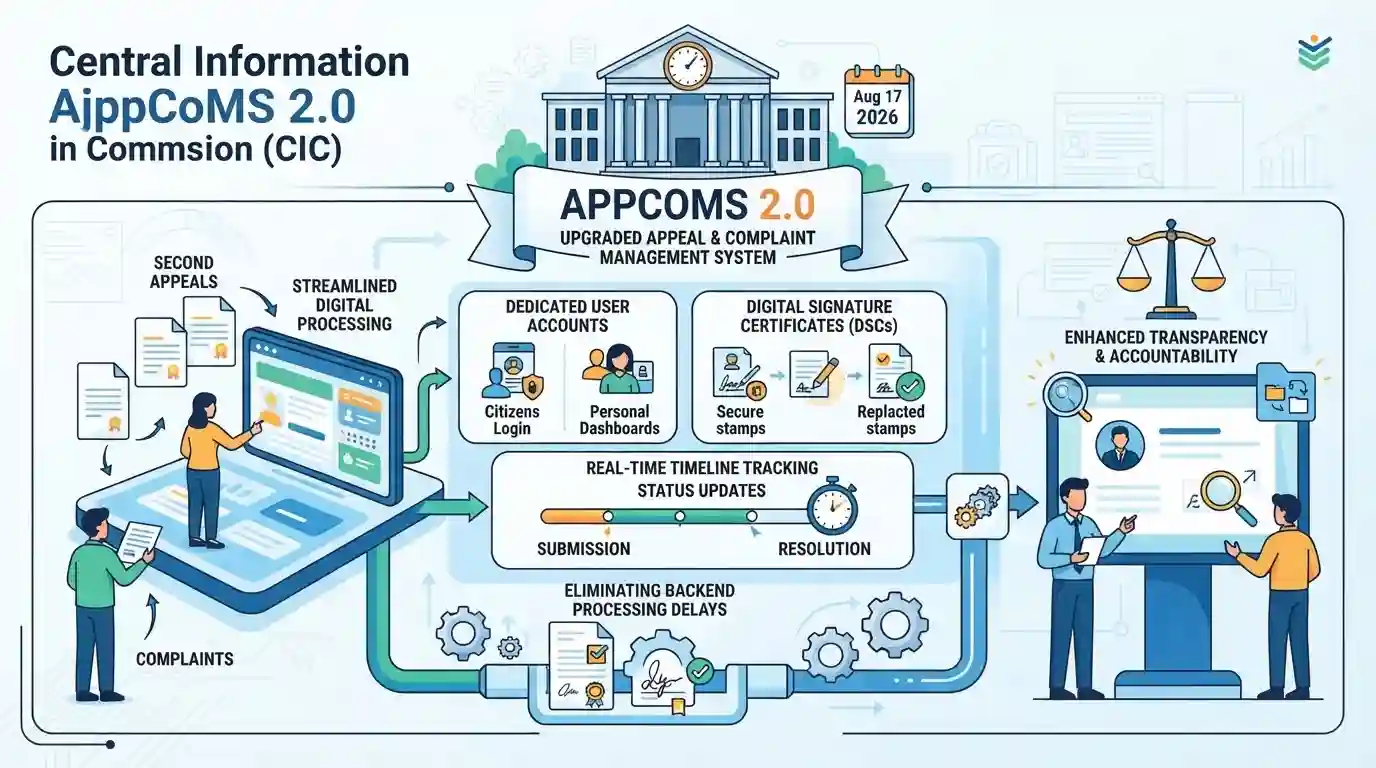
The Central Information Commission (CIC) launched AppCoMS 2.0 on August 17, 2026. This upgraded Appeal and Complaint Management System streamlines the digital processing of Second Appeals and Complaints under the RTI Act, 2005. By introducing dedicated user accounts, real-time timeline tracking, and Digital Signature Certificates (DSCs), the portal enhances the transparency and accountability of the RTI process. The initiative exemplifies user-centric e-governance by eliminating backend processing delays and providing a more interactive, accessible platform for citizens and public officers.
मुख्य मुद्दे
- The Central Information Commission (CIC) launched AppCoMS 2.0, an upgraded portal for managing Second Appeals and Complaints under the RTI Act, 2005.
- The upgraded platform shifts from a pure case-management system to a comprehensive 'Interactive Service Model', providing secure, dedicated user accounts for applicants, Central Public Information Officers (CPIOs), and stakeholders.
- Key features include real-time case timeline tracking, document uploads directly by CPIOs, and the use of Digital Signature Certificates (DSCs) to digitally sign and issue official orders.
- The initiative reflects the government's emphasis on user-centric e-governance designs, reducing administrative delays, and strengthening transparency and digital delivery of quasi-judicial services.
महत्त्वाच्या संज्ञा
Right to Information Act, 2005

A landmark Indian legislation that empowers citizens to request access to information held by public authorities, aiming to promote transparency, curb corruption, and secure administrative accountability.
UPSC context
GS Paper II (Governance, Transparency & Accountability); crucial for questions on citizen empowerment and administrative transparency.
Central Information Commission (CIC)
The apex statutory appellate authority constituted under Section 12 of the RTI Act, 2005, to adjudicate appeals and complaints concerning central public authorities.
UPSC context
GS Paper II (Statutory Bodies); tests structural understanding of institutions upholding citizens' right to information.
Appeal and Complaint Management System (AppCoMS)
An end-to-end digital portal by the CIC to process second appeals and complaints, upgraded to version 2.0 with enhanced tracking, user accounts, and digital signatures.
UPSC context
GS Paper II (E-Governance); highlights digital administrative reforms, transparency initiatives, and technology-driven grievance redressal.
Ministry of Personnel, Public Grievances & Pensions
The nodal ministry in India responsible for administrative reforms, civil service management, and public grievances, with its Department of Personnel and Training administering the RTI Act.
UPSC context
GS Paper II (Structure of Executive); essential for studying governance reforms and centralized grievance systems like CPGRAMS.
पूर्वपरीक्षा सापळा
The Chief Justice of India is a member of the selection committee that recommends the appointment of the CIC.
The three-member selection committee consists of the Prime Minister, Leader of the Opposition in Lok Sabha, and a nominated Union Cabinet Minister. The CJI is not a member.
संबंधित स्थिर संकल्पना
What is the statutory basis and appointment process of the Central Information Commission?
- Statutory Status: Established under Section 12 of the RTI Act, 2005, making it an independent quasi-judicial watchdog, not a constitutional body.
- Appointment Committee: Appointed by the President on recommendations of a committee: PM, Leader of Opposition in Lok Sabha, and a nominated Union Cabinet Minister.
- Composition Limit: Consists of the Chief Information Commissioner and up to ten Information Commissioners.
How did the RTI (Amendment) Act, 2019 impact the Commission's autonomy?
- Tenure Flexibility: Removed the fixed 5-year tenure; terms are now entirely determined and prescribed by the Central Government.
- Salary Determination: Removed parity with Election Commissioners; salaries and service conditions of Central and State ICs are now set by the Union.
आंतर-विषय नमुने
E-Governance + Accountability
AppCoMS 2.0 demonstrates how citizen-centric e-governance applications can reduce bureaucratic delays and strengthen the right to information.
Digital Judicial Infrastructure
Transitioning quasi-judicial processes online mirrors the e-Courts Project, addressing systemic case pendency through digital workflows.

RTI Amendment Act (2019) impacts combined with institutional efficacy of the CIC remains a key theme for GS-2 Polity.
संबंधित PYQ · 3
संबंधित PYQ · 3
- 2020MainsGS2
Recent amendments to the Right to Information Act will have profound impact on the autonomy and independence of the Information Commission". Discuss.
- 2024MainsGS2
e-governance is not just about the routine application of digital technology in service delivery process. It is as much about multifarious interactions for ensuring transparency and accountability. In this context evaluate the role of the 'Interactive Service Model' of e-governance.
- 2025MainsGS2
e-governance projects have a built-in bias towards technology and back-end integration than user-centric designs. Examine.
