Kharif Crops Area Coverage and Agricultural Sowing Progress Data
Source:PIB ↗
આ શા માટે મહત્વનું છે
The progress of Kharif sowing is a fundamental macroeconomic indicator for India. It heavily influences agricultural GDP growth, rural demand, and inflation (specifically food inflation). Understanding India's cropping patterns, the dominance of rice, the geographical distribution of cash crops like cotton and sugarcane, and the push for 'Shree Anna' (millets) forms a core part of the GS1 (Geography) and GS3 (Agriculture) syllabus.
સારાંશ
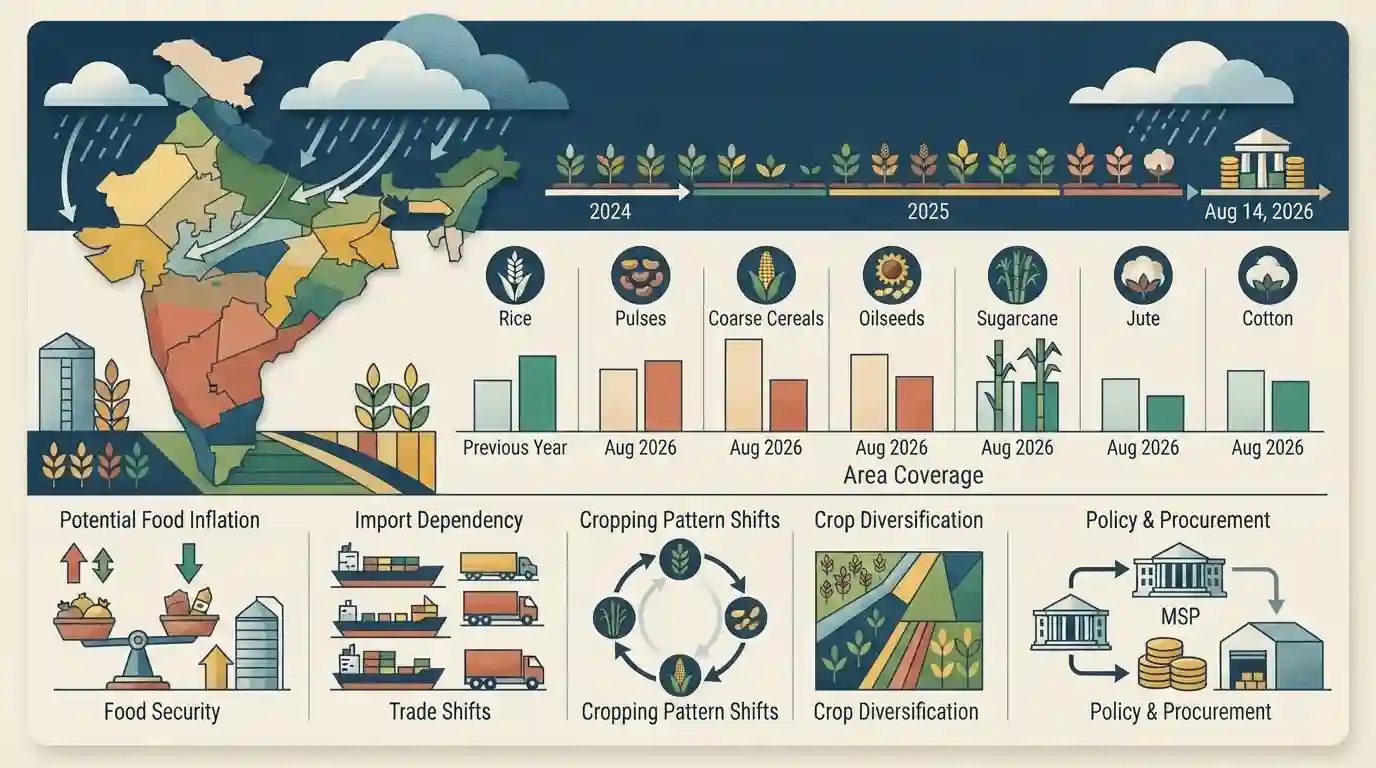
The Ministry of Agriculture and Farmers Welfare released updated figures for the area coverage under various Kharif crops as of 14 August 2026. The data tracks the sowing progress of critical Kharif crops such as rice, pulses, coarse cereals (Shree Anna), oilseeds, sugarcane, jute, and cotton across India, comparing them to previous years' benchmarks. Such regular updates serve as essential economic and agricultural indicators, reflecting the direct impact of the southwest monsoon's performance on crop acreage. Variations in sowing areas for specific crops—particularly pulses and oilseeds—often act as early warning signals for potential food inflation or shifts in agricultural trade and import dependency. The report underscores the broader dynamics of India's cropping patterns, crop diversification efforts, and the importance of timely agricultural data for policymaking regarding procurement, MSP adjustments, and overarching food security.
મુખ્ય મુદ્દા
- The Ministry of Agriculture and Farmers Welfare released the progress report on area coverage under Kharif crops as of mid-August 2026.
- The report tracks the acreage of key Kharif crops, including rice, pulses, coarse cereals (Shree Anna), oilseeds, sugarcane, jute & mesta, and cotton.
- Sowing progress acts as a direct barometer of the performance, spatial, and temporal distribution of the Southwest Monsoon.
- Tracking changes in the sown area of essential commodities like pulses and oilseeds is critical for anticipating domestic food inflation, adjusting agricultural policies, and managing import dependencies.
મહત્વપૂર્ણ શબ્દો
Minimum Support Price (MSP)

The pre-announced minimum price guaranteed by the Government of India to purchase select agricultural crops from farmers, safeguarding them against sudden market price crashes.
UPSC context
GS Paper 3 (Agriculture); tests crop pricing policies, procurement mechanisms, and farmer safety nets.
Shree Anna Initiative
A major policy initiative launched by the Government of India to promote the production, consumption, and global export of climate-resilient, nutrient-rich millets.
UPSC context
GS Paper 3 (Agriculture/Food Security); tests sustainable dryland farming and nutritional security.
Kharif Crops
Monsoon-dependent crops sown at the onset of the southwest monsoon (June-July) and harvested in autumn (September-October), requiring warm, humid conditions.
UPSC context
GS Paper 1 (Geography); tests understanding of cropping patterns, seasons, and agricultural climate dependency.
Crop Diversification
The agricultural practice of growing a variety of crops instead of relying on a single monoculture, aimed at improving soil health and mitigating risks.
UPSC context
GS Paper 3 (Agriculture); tests sustainable farming patterns, soil conservation, and water management.
Ministry of Agriculture & Farmers Welfare
The apex administrative ministry of the Government of India responsible for executing laws, rules, and schemes related to agriculture and farmer welfare.
UPSC context
GS Paper 2 (Government Policies); tests understanding of governance and institutional support in the primary sector.
પ્રિલિમ્સ ટ્રેપ
"Black gram (urad) is exclusively cultivated as a Kharif crop in India."
While predominantly Kharif, urad is highly versatile and can be cultivated as a Rabi or Zaid crop, particularly in peninsular India utilizing residual moisture.
સંલગ્ન સ્થિર ખ્યાલો
How do major commercial and food crops rank by cultivated acreage in India?
- Rice dominance: Rice consistently accounts for the absolute highest cultivated area among all crops during the Kharif season.
- Cotton vs Sugarcane: The acreage under cotton is significantly larger in India, typically more than double the area dedicated to sugarcane.
- Oilseeds vs Cereals: The total cultivated area for oilseeds generally exceeds the area dedicated to coarse cereals across the country.
What is the structural difference in India's import dependency for edible oils versus pulses?
- Edible oils deficit: India remains heavily import-dependent, sourcing roughly 60% of its domestic vegetable oil consumption from abroad, making it the world's largest importer.
- Pulses self-sufficiency: India has achieved strong self-sufficiency in pulses (approximately 90%) due to sustained policy interventions, MSP support, and targeted procurement.
આંતર-વિષય પેટર્ન
Kharif sowing & RBI inflation targeting
Sowing deficits in critical crops like pulses act as early warning signals for food inflation, directly impacting the RBI Monetary Policy Committee's interest rate decisions.
Shree Anna & Climate Smart Agriculture
The push for millets connects dryland farming to climate resilience policies, aligning with initiatives like NICRA to mitigate the impacts of erratic southwest monsoons.

Expect comparative statements on crop acreage (Cotton > Sugarcane) or the seasonal versatility (Kharif/Rabi) of pulses like urad.
સંલગ્ન PYQ · 5
સંલગ્ન PYQ · 5
- 2019PrelimsGS1
With reference to the cultivation of Kharif crops in India in the last five years, consider the following statements: 1. Area under rice cultivation is the highest. 2. Area under the cultivation of jowar is more than that of oilseeds. 3. Area of cotton cultivation is more than that of sugarcane. 4. Area under sugarcane cultivation has steadily decreased. Which of the statements given above are correct?
- 2020PrelimsGS1
With reference to pulse production in India, consider the following statements: 1. Black gram can be cultivated as both kharif and rabi crop. 2. Green-gram alone accounts for nearly half of pulse production. 3. In the last three decades, while the production of kharif pulses has increased, the production of rabi pulses has decreased. Which of the statements given above is/are correct?
- 2013PrelimsGS1
Consider the following crops : 1. Cotton 2. Groundnut 3. Rice 4. Wheat Which of these are Kharif crops?
- 2004PrelimsGS1
Consider the following crops: 1. Cotton 2. Groundnut 3. Maize 4. Mustard Which of the above are Kharif crops?
- 2025MainsGS3
Explain the factors influencing the decision of the farmers on the selection of high value crops in India.
