Electronic Component Manufacturing Scheme Plant Operations Progress
Source:PIB ↗
ఇది ఎందుకు ముఖ్యం
India's heavy reliance on imported electronic components constitutes a major part of its trade deficit. Moving beyond final-stage assembly to domestic component manufacturing under schemes like ECMS is crucial for strategic autonomy, value addition, and long-term economic growth.
సారాంశం
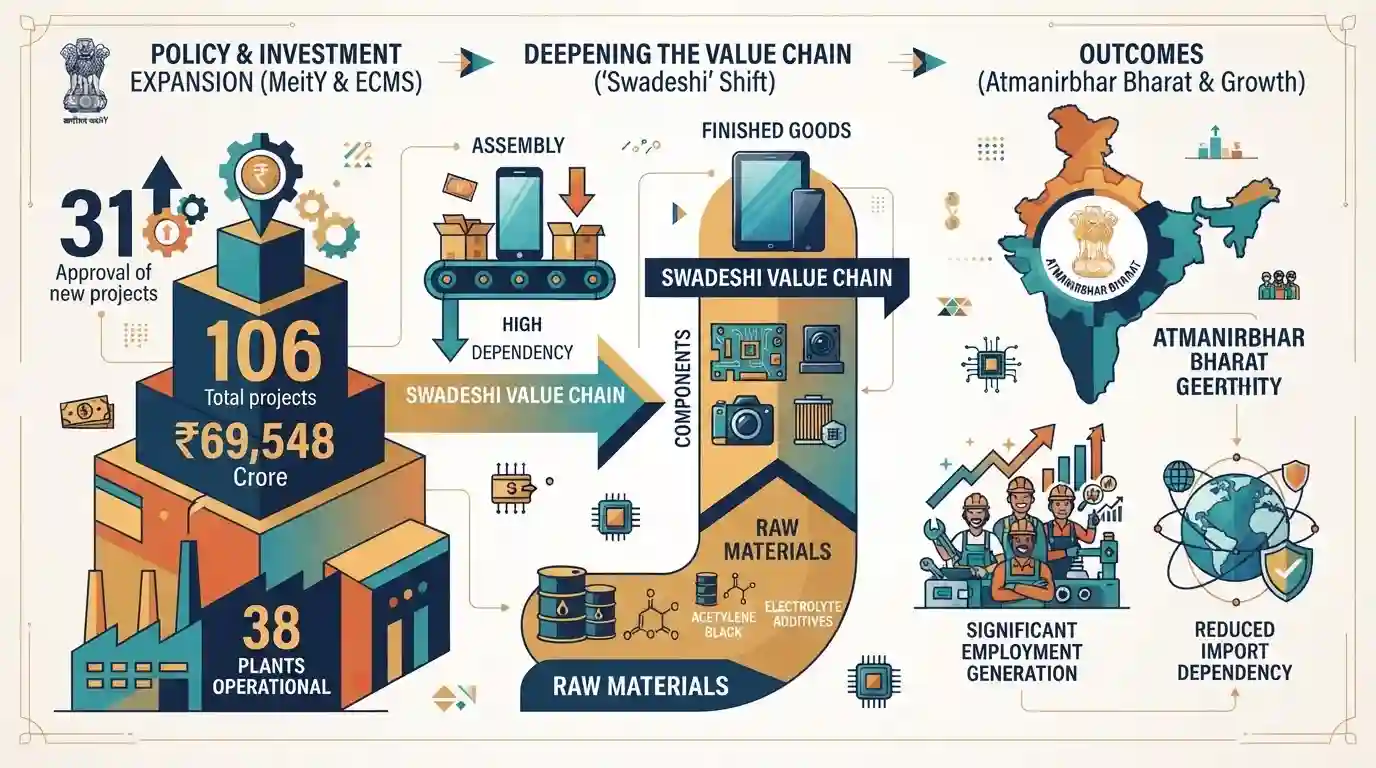
The Ministry of Electronics and Information Technology (MeitY) has expanded the Electronics Component Manufacturing Scheme (ECMS) by approving 31 new projects, bringing the total approved investment to ₹69,548 crore across 106 projects. With 38 plants already operational, the initiative aims to shift India's electronics sector from basic assembly to a deep-rooted 'Swadeshi' value chain by promoting the domestic manufacturing of critical components (such as PCBs, filters, and camera modules) and essential raw materials (like acetylene black and electrolyte additives). This push towards Atmanirbharta is expected to generate significant employment and reduce import dependency.
ముఖ్య అంశాలు
- The Ministry of Electronics and IT (MeitY) approved 31 new proposals under the Electronics Component Manufacturing Scheme (ECMS), bringing total approved projects to 106 with an updated investment target of ₹69,548 crore.
- The scheme is expected to generate around 75,000 direct jobs and drive self-reliance in the electronics supply chain.
- A total of 38 plants are already operational, and 16 are in advanced stages of construction or machinery installation.
- The scheme marks a strategic shift from mere final assembly to deep-rooted domestic manufacturing of critical components (PCBs, filters, coils, speakers, camera modules) and essential raw materials (acetylene black, electrolyte additives).
ముఖ్యమైన పదాలు
Electronics Component Manufacturing Scheme (ECMS)

A central government scheme notified in 2025 providing turnover-linked and capital expenditure-linked incentives to boost domestic manufacturing of electronic components, sub-assemblies, and capital goods while reducing import dependence.
UPSC context
GS Paper III (Industrial Policy). Tests knowledge of financial incentives promoting self-reliance and supply chain resilience in electronic manufacturing.
Ministry of Electronics and Information Technology (MeitY)
The nodal ministry of the Government of India responsible for formulating IT policies, electronics hardware manufacturing, digital governance, and the growth of India's semiconductor ecosystem.
UPSC context
GS Paper II & III (E-Governance/Infrastructure). Tests understanding of executive bodies driving technology, digital public infrastructure, and hardware policies.
Electronic Industries Association of India (ELCINA)
India's oldest professional association (founded 1967) representing the electronics hardware manufacturing ecosystem, promoting the electronic value chain, and advising the government on related industrial policies.
UPSC context
GS Paper III (Industrial Growth). Tests understanding of private-public partnerships and industry bodies in scaling manufacturing value addition.
ప్రిలిమ్స్ ఉచ్చు
ECMS operates solely as a standard Production-Linked Incentive (PLI) scheme, disbursing fiscal support based entirely on incremental sales.
ECMS is a hybrid scheme. Unlike pure PLI, it combines turnover-linked, hybrid, and capex-linked incentives, even withholding 5% of capex support until employment thresholds are met.
అనుసంధానమైన స్థిర భావనలు
What is an inverted duty structure and how does it harm domestic manufacturing?
- Definition: It occurs when tariff rates on imported raw materials or intermediate inputs are higher than those on finished products.
- Economic Impact: It discourages domestic manufacturing because local value-adders face higher input costs than competitors importing the finished zero-duty product.
- Policy Correction: Schemes like ECMS correct this by offsetting input cost disadvantages through targeted capital and turnover subsidies.
What are the structural stages of value addition in electronics manufacturing?
- Downstream (Assembly): Low-value phase involving final assembly, testing, and packaging, typically contributing only 5% to 15% of the total product value.
- Midstream (Components): High-value phase involving manufacture of sub-assemblies and complex components like multi-layer PCBs, sensors, and display units.
- Upstream (Fab and Design): Highest-value, highly capital-intensive stage involving semiconductor fabrication, intellectual property creation, and chip design.
అంతర-అంశ నమూనాలు
Electronics localization + Critical Mineral Diplomacy
ECMS incentives for local cathode active materials link directly to India's Mineral Security Partnership (MSP) efforts to secure lithium and cobalt supply chains.
Trade Agreements + Rules of Origin
Sourcing components locally under ECMS allows Indian electronic exports to meet the strict local value-addition thresholds required under FTAs like the India-UAE CEPA.

Exam may target the policy shift from assembly to component manufacturing, focusing on ECMS's hybrid incentives and employment-linked payouts.
అనుసంధాన PYQలు · 3
అనుసంధాన PYQలు · 3
- 2025MainsGS3
India aims to become a semiconductor manufacturing hub. What are the challenges faced by the semiconductor industry in India? Mention the salient features of the India Semiconductor Mission.
- 2026PrelimsGS1
Which one of the following pairs of semiconductor plants in India and their locations is not correctly matched ?
- 2023PrelimsGS1
Consider the following statements: Statement-I: India accounts for 3.2% of global export of goods. Statement-II: Many local companies and some foreign companies operating in India have taken advantage of India's 'Production-linked Incentive' scheme. Which one of the following is correct in respect of the above statements?
