Electoral Literacy Clubs and Voter Awareness Initiatives by ECI
Source:PIB ↗
આ શા માટે મહત્વનું છે
Fostering electoral literacy and addressing voter apathy among youth and urban populations are central to the health of Indian democracy. Understanding the ECI's voter awareness initiatives (like SVEEP, ELCs) and digital governance tools (like ECINet) is highly relevant for GS Paper 2 (Polity, Constitutional Bodies, and Electoral Reforms) and GS Paper 4 (Democratic Ethics).
સારાંશ
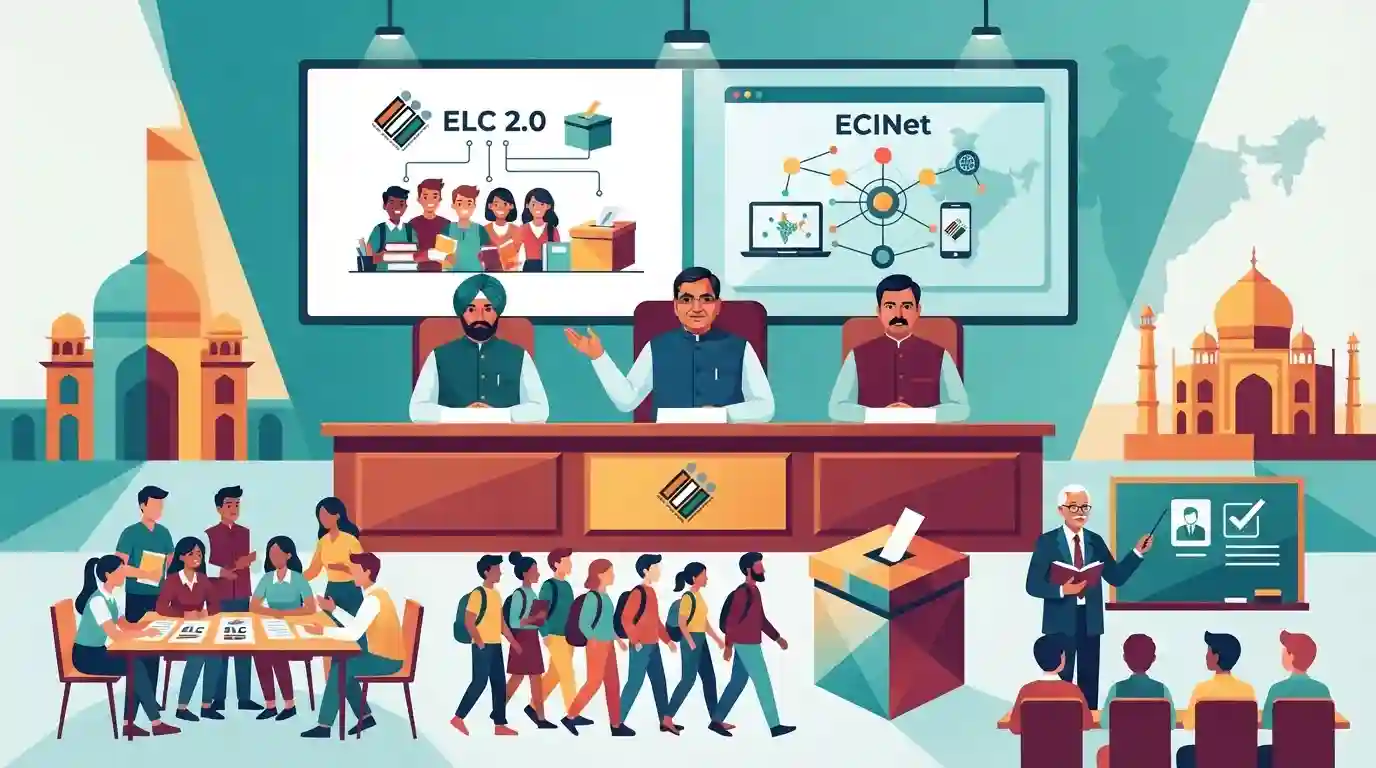
Chief Election Commissioner Gyanesh Kumar, along with Election Commissioner Sukhbir Singh Sandhu, launched the Electoral Literacy Clubs 2.0 (ELC 2.0) and the ECINet portal during a national conference. The CEC called upon academia and educational institutions to act as catalysts in strengthening democratic participation, addressing youth and urban voter apathy, and promoting informed and ethical voting among first-time and young voters across India.
મુખ્ય મુદ્દા
- CEC Gyanesh Kumar urged academic leaders to play an active role in building democratic consciousness and electoral literacy among youth.
- The Election Commission of India (ECI) launched the upgraded Electoral Literacy Clubs 2.0 (ELC 2.0) to engage young and first-time voters through modernized, interactive, and gamified content.
- The ECINet Portal was launched as a digital platform to network, support, and monitor the performance and resource needs of ELCs nationwide.
- The initiatives target the critical challenge of youth and urban voter apathy, aiming to bridge the gap between registration and actual turnout.
- The ECI emphasized informed and ethical voting, encouraging critical evaluation to counter disinformation and electoral malpractices.
મહત્વપૂર્ણ શબ્દો
Electoral Literacy Clubs 2.0

An upgraded, digitally enabled initiative by the Election Commission of India aimed at educational institutions. It educates students and first-time voters about electoral processes to reduce youth voter apathy and promote informed democratic participation.
UPSC context
GS Paper 2 (Polity). Important for questions on ECI initiatives addressing youth voter apathy and promoting electoral literacy.
ECINet Portal
A unified digital platform by the Election Commission of India integrating over 40 election-related applications. It provides a centralized hub for services like voter registration, e-EPIC downloads, grievance redressal, and live election trends.
UPSC context
GS Paper 2 (E-Governance/Elections). Relevant for illustrating the use of technology to enhance electoral transparency and public service delivery.
Systematic Voters' Education and Electoral Participation
The Election Commission of India's flagship program for voter education, awareness, and literacy. It uses targeted multi-intervention strategies to encourage eligible citizens to vote and make informed decisions during elections.
UPSC context
GS Paper 2 (Polity). Crucial for answers addressing strategies to improve voter turnout and inclusive democratic participation.
Election Commission of India
An autonomous constitutional authority responsible for administering election processes in India, including elections to the Lok Sabha, Rajya Sabha, State Legislative Assemblies, and the offices of the President and Vice President.
UPSC context
GS Paper 2 (Constitutional Bodies). Core syllabus topic testing the mandate, powers, and independence of the election watchdog.
પ્રિલિમ્સ ટ્રેપ
The Right to Vote in India is a purely statutory right created solely by the Representation of the People Act, 1951.
While older judgements labeled it purely statutory, the Supreme Court in Anoop Baranwal (2023) explicitly reaffirmed that the Right to Vote is a Constitutional Right enshrined in Article 326.
સંલગ્ન સ્થિર ખ્યાલો
What is the constitutional status and evolution of the Right to Vote in India?
- Article 326: Guarantees universal adult suffrage for Lok Sabha and State Legislative Assembly elections.
- 61st Amendment Act: Lowered the voting age from 21 to 18 years in 1988, significantly expanding youth representation.
- Judicial Clarification: In Anoop Baranwal (2023), the Supreme Court majority reaffirmed its status as a constitutional right.
What is the SVEEP framework and its primary objectives?
- Core Mission: Flagship voter education and awareness program of the ECI, operational since 2009.
- IMF-EEE Framework: Operates on Information, Motivation, Facilitation, Ethics, Efficiency, and Engagement to drive qualitative participation.
- Apathy Mitigation: Directly targets demographically low-turnout segments, particularly urban electors and first-time youth voters.
આંતર-વિષય પેટર્ન
ECINet and Digital Democracy
Leveraging specialized portals like ECINet for monitoring ELCs aligns with GS-2 e-governance initiatives, showcasing digital tools tracking civic engagement to counter physical voter apathy.
Nudging youth turnout via Gamification
ELC 2.0's shift to interactive, gamified content reflects nudge theory—using behavioral design instead of mandates to transform democratic duties into voluntary civic habits.

ECI's gamified outreach and digital portals like ECINet likely to be framed around structural vs behavioral solutions to voter apathy.
સંલગ્ન PYQ · 3
સંલગ્ન PYQ · 3
- 2017MainsGS2
To enhance the quality of democracy in India the Election Commission of India has proposed electoral reforms in 2016. What are the suggested reforms and how far are they significant to make democracy successful?
- 2022MainsGS2
Discuss the role of the Election Commission of India in the light of the evolution of the Model Code of Conduct.
- 2017PrelimsGS1
Right to vote and to be elected in India is a
