Kaushal Manthan Regional Conference and Skill Development Schemes
Source:PIB ↗
ఇది ఎందుకు ముఖ్యం
The article illustrates the practical implementation of national skilling policies and introduces an innovative financial mechanism (Social Stock Exchange blended finance) for social sector outcomes. This connects directly to UPSC themes surrounding the employability of India's demographic dividend, the 'Earn while you learn' model, and capital market innovations for social good.
సారాంశం
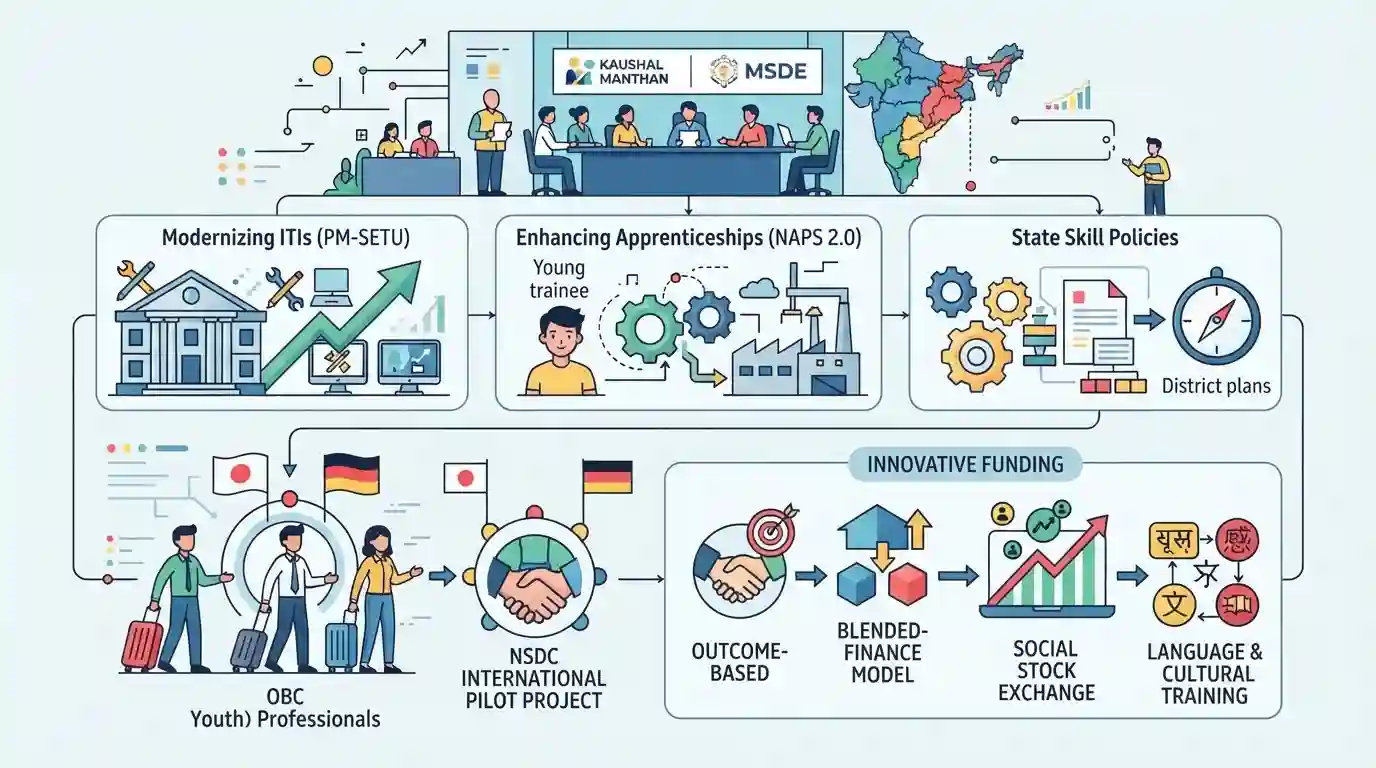
The Ministry of Skill Development and Entrepreneurship (MSDE) organized the 'Kaushal Manthan' Regional Conference in Kolkata to strategize skill development across Eastern states. Discussions centered on modernizing Industrial Training Institutes (ITIs) through the PM-SETU scheme, enhancing the apprenticeship ecosystem (NAPS 2.0), and drafting robust State Skill Policies aligned with District Skill Development Plans. A significant highlight was NSDC International's pilot project to facilitate overseas employment for OBC youth from Madhya Pradesh in countries like Japan and Germany. This mobility initiative represents an innovative approach to skilling by utilizing an outcome-based, blended-finance model channeled through the Social Stock Exchange to fund language and cultural training.
ముఖ్య అంశాలు
- The 'Kaushal Manthan' conference focused on revamping the skill ecosystem in Eastern states, particularly through the PM-SETU scheme to upgrade ITIs into centers of excellence aligned with industrial clusters.
- Emphasis was placed on integrating skilling into standard educational curriculums in line with NEP 2020 via District Skill Development Plans (DSDPs).
- The government is strongly pushing the National Apprenticeship Promotion Scheme (NAPS 2.0) to expand 'Earn while you learn' opportunities for the youth.
- NSDC International is executing a pilot project leveraging the Social Stock Exchange for an outcome-based, blended-finance model. This initiative will finance language and cultural training for OBC youth in Madhya Pradesh for overseas employment.
- Target sectors for international workforce mobility in countries like Japan and Germany include caregiving, hospitality, construction, and manufacturing.
ముఖ్యమైన పదాలు
PM-SETU

A centrally sponsored flagship initiative to upgrade 1,000 government Industrial Training Institutes (ITIs) into modern, industry-aligned skill hubs using a hub-and-spoke model.
UPSC context
GS Paper II & III: Government schemes, vocational education, and youth employability initiatives.
National Apprenticeship Promotion Scheme (NAPS 2.0)
A revamped central sector scheme that incentivizes on-the-job training by directly transferring 25% of the stipend (up to ₹1,500 monthly) to apprentices via Direct Benefit Transfer.
UPSC context
GS Paper III: Employment, labor reforms, demographic dividend, and skill development policies.
NSDC International Ltd (NSDCI)
A wholly owned subsidiary of NSDC established to facilitate international workforce mobility, harmonize skills training with global standards, and secure overseas job opportunities for Indian youth.
UPSC context
GS Paper II & III: Indian diaspora, international relations, and global workforce mobility.
Industrial Training Institutes (ITIs)
Post-secondary vocational schools in India operating under the Directorate General of Training (DGT) that deliver technical and trade-specific skills training.
UPSC context
GS Paper II & III: Education, human resource development, and industrial skill training.
Ministry of Skill Development and Entrepreneurship (MSDE)
The nodal Union Ministry responsible for coordinating skill development initiatives, setting national training standards, and promoting entrepreneurship across India.
UPSC context
GS Paper II: Welfare schemes, institutional governance, and human capital development.
ప్రిలిమ్స్ ఉచ్చు
"PM-SETU is an incubation and start-up promotion scheme launched by NITI Aayog."
Aspirants confuse MSDE's PM-SETU (modernizing ITIs) with NITI Aayog's older SETU (Self Employment and Talent Utilisation) scheme. PM-SETU strictly focuses on ITI infrastructure and employability.
అనుసంధానమైన స్థిర భావనలు
What is the Social Stock Exchange (SSE) framework under SEBI?
- Market segment: It is a separate segment on existing stock exchanges (like BSE/NSE) regulated by SEBI to help social enterprises raise funds.
- Eligible entities: Both Non-Profit Organizations (NPOs) and For-Profit Social Enterprises (FPEs) with a primary social intent can participate.
- Funding instruments: Funds are primarily raised through innovative instruments like Zero Coupon Zero Principal (ZCZP) bonds, mutual funds, or blended finance.
How does the National Apprenticeship Promotion Scheme (NAPS) function?
- Financial support: The government shares 25% of the prescribed stipend (up to ₹1,500 per month) per apprentice to incentivize employers.
- DBT integration: Under NAPS 2.0, the government's stipend share is transferred directly to the apprentice's bank account, bypassing the employer.
- Objective: It aims to formalize the 'earn while you learn' model across manufacturing and service sectors.
అంతర-అంశ నమూనాలు
Demographic divergence & global mobility
Skilling initiatives targeting Japan and Germany capitalize on the demographic divergence between India's youth bulge and the aging populations of developed nations, specifically addressing their critical shortages in caregiving and hospitality.
SSE blending capital with welfare schemes
Leveraging the SEBI-regulated Social Stock Exchange for skill programs demonstrates a governance shift from pure grant-based welfare to market-linked, outcome-based social impact financing.

Expect a multi-statement question blending SEBI's Social Stock Exchange regulations with its practical application in skill funding.
అనుసంధాన PYQలు · 4
అనుసంధాన PYQలు · 4
- 2014MainsGS3
While we flaunt India's demographic dividend, we ignore the dropping rates of employability. What are we missing while doing so? Where will the jobs that India desperately needs come from? Explain.
- 2023MainsGS2
Skill development programmes have succeeded in increasing human resources supply to various sectors. In the context of the statement analyse the linkages between education, skill and employment.
- 2021MainsGS2
“Earn while you learn' scheme needs to be strengthened to make vocational education and skill training meaningful.” Comment.
- 2026PrelimsGS1
A bond whose proceeds are used only to finance or refinance a combination of both environmental and social projects is called :
