Open Natural Ecosystems Conservation Guide and Grassland Policy
Source:PIB ↗
ఇది ఎందుకు ముఖ్యం
Historically, India's Open Natural Ecosystems (ONEs) have been neglected or targeted with incorrect tree-planting drives under the guise of afforestation. This new guide provides the scientific backing needed to protect India's open biomes as distinct ecological systems, bridging a critical gap in environmental conservation, climate mitigation, and pastoralist welfare.
సారాంశం
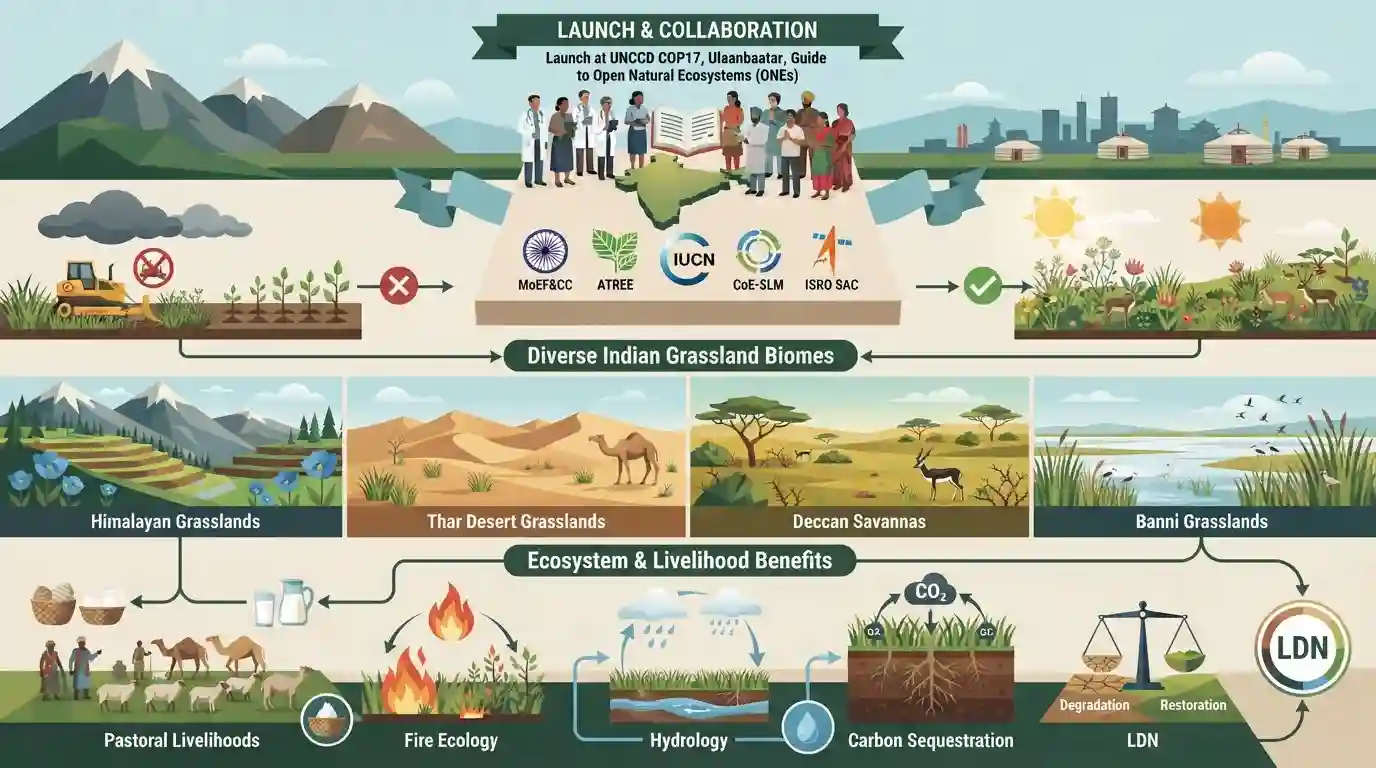
At the UNCCD COP17 in Ulaanbaatar, Mongolia, India launched its first-ever 'Guide to Grasslands and Other Open Natural Ecosystems (ONEs)'. This collaborative effort by MoEF&CC, ATREE, IUCN, CoE-SLM, and ISRO SAC offers a scientific framework to conserve and restore India's non-forest biomes (including Deccan savannas, Banni, Thar, and Himalayan grasslands). It represents a critical policy shift from treating these open biomes as 'wastelands' (which often led to damaging afforestation schemes) to recognizing their vital roles in carbon sequestration, hydrology, fire ecology, pastoral livelihoods, and fulfilling Land Degradation Neutrality (LDN) targets.
ముఖ్య అంశాలు
- India launched its first-ever 'Guide to Grasslands and Other Open Natural Ecosystems (ONEs)' during a side event at the UNCCD COP17 in Ulaanbaatar, Mongolia.
- The guide addresses the historical misclassification of Open Natural Ecosystems (ONEs)—such as the Thar desert, Banni grasslands, Deccan savannas, rocky plateaus, and ravines—as 'wastelands', which previously led to ecologically counterproductive afforestation projects.
- Developed via a multi-stakeholder partnership involving MoEF&CC, ATREE, IUCN, ICFRE's CoE-SLM, and ISRO's Space Applications Centre (SAC).
- The guide focuses on critical ecological themes including fire ecology, carbon sequestration potential, hydrology, and sustainable pastoralist and livestock livelihoods.
- The framework directly assists India in meeting its Land Degradation Neutrality (LDN) targets by promoting science-based restoration of non-forest open biomes instead of monoculture tree planting.
ముఖ్యమైన పదాలు
United Nations Convention to Combat Desertification (UNCCD)

A legally binding international agreement linking sustainable land management with environmental conservation. It focuses on addressing land degradation, desertification, and drought mitigation, primarily in arid and semi-arid regions.
UPSC context
Important for GS3 Environment. Tests knowledge of global environmental conventions and India's commitments to land restoration.
Land Degradation Neutrality (LDN)
A state where the amount and quality of land resources needed to support ecosystems and food security remain stable or increase, balancing land degradation with restoration efforts.
UPSC context
Essential for GS3 Environment. Key target under SDG 15.3 and central to India's national UNCCD strategies.
Centre of Excellence on Sustainable Land Management (CoE-SLM)
An institution established at ICFRE, Dehradun, to facilitate knowledge sharing, capacity building, and South-South cooperation. It provides technical support for mapping and addressing land degradation to achieve LDN targets.
UPSC context
GS3 Environment. Highly relevant as a specialized Indian institutional body executing UNCCD COP14 commitments.
Ashoka Trust for Research in Ecology and the Environment (ATREE)
A prominent Indian research institute and non-profit organization dedicated to generating interdisciplinary knowledge for biodiversity conservation, sustainable development, and shaping environmental policy and practice.
UPSC context
GS3 Environment. Tests awareness of major national NGOs collaborating on official ecological surveys and conservation guidelines.
Space Applications Centre (ISRO SAC)
An ISRO research center in Ahmedabad that develops space-borne instruments. It provides critical satellite imagery and remote sensing data used for mapping India's land degradation and desertification.
UPSC context
GS3 Science & Tech and Environment. Highlights the intersection of space technology and environmental monitoring.
International Union for Conservation of Nature (IUCN)
A global environmental organization comprising government and civil society groups. It provides scientific data, policy advice, and maintains the Red List of Threatened Species to guide conservation globally.
UPSC context
GS3 Environment. Constantly tested in Prelims regarding species status, protected areas, and international ecological initiatives.
ప్రిలిమ్స్ ఉచ్చు
Restoring degraded land under India's Bonn Challenge and UNCCD commitments always requires increasing tree canopy cover through afforestation.
In naturally treeless Open Natural Ecosystems (ONEs), tree-planting (afforestation) destroys native ecosystems, alters hydrology, and constitutes land degradation rather than restoration.
అనుసంధానమైన స్థిర భావనలు
What is Land Degradation Neutrality (LDN) under the UNCCD?
- Definition: State where the amount and quality of land resources needed to support ecosystem functions remain stable or increase.
- Global Goal: Formally adopted under SDG Target 15.3, aiming to halt and reverse land degradation globally by 2030.
- India's Pledge: India aims to restore 26 million hectares of degraded and deforested land by 2030.
Why is India's historical 'Wasteland' classification of grasslands ecologically problematic?
- Technical Origin: Built on the Wasteland Atlas of India, which historically labelled biologically rich, non-forested lands as unproductive.
- Ecological Impact: Led to planting invasive exotics (e.g., Prosopis juliflora), causing groundwater depletion, biodiversity loss, and displacement of pastoral communities.
- Carbon Storage: Grasslands sequester carbon primarily underground in roots and soil, making them highly resilient to surface forest fires.
అంతర-అంశ నమూనాలు
Grassland conservation + Pastoral rights
Restoring ONEs directly supports Community Forest Rights under the Forest Rights Act (FRA) 2006, securing traditional grazing grounds for nomadic pastoralists.
Fire ecology + Non-forest biomes
Unlike wet forests, seasonal fires in tropical savannas are essential ecological tools that maintain open canopies and prevent woody encroachment.

UNCCD targets paired with India's new ONEs guide likely to test why afforestation of semi-arid zones is ecologically counterproductive.
అనుసంధాన PYQలు · 2
అనుసంధాన PYQలు · 2
- 2016PrelimsGS1
What is/are the importance/importances of the United Nations Convention to Combat Desertification? 1. It aims to promote effective action through innovative national programmes and supportive international partnerships. 2. It has a special/particular focus on South Asia and North Africa regions, and its Secretariat facilitates the allocation of major portion of financial resources to these regions. 3. It is committed to bottom-up approach, encouraging the participation of local people in combating the desertification. Select the correct answer using the code given below.
- 2021PrelimsGS1
The vegetation of savannah consists of grassland with scattered small trees, but extensive areas have no trees. The forest development in such areas is generally kept in check by one or more or a combination of some conditions. Which of the following are such conditions? 1. Burrowing animals and termites 2. Fire 3. Grazing herbivores 4. Seasonal rainfall 5. Soil properties Select the correct answer using the code given below.
