Cooperative Sector Expansion and Rural Development Initiatives
Source:PIB ↗
हे का महत्त्वाचे आहे
This highlights the government's current strategy to boost rural income and development through a dual approach: strengthening grassroots cooperatives (PACS and dairy) and robust agricultural welfare schemes (MSP, PM-KISAN). It serves as an excellent case study for answers on agricultural finance, the cooperative movement, and livestock rearing.
सारांश
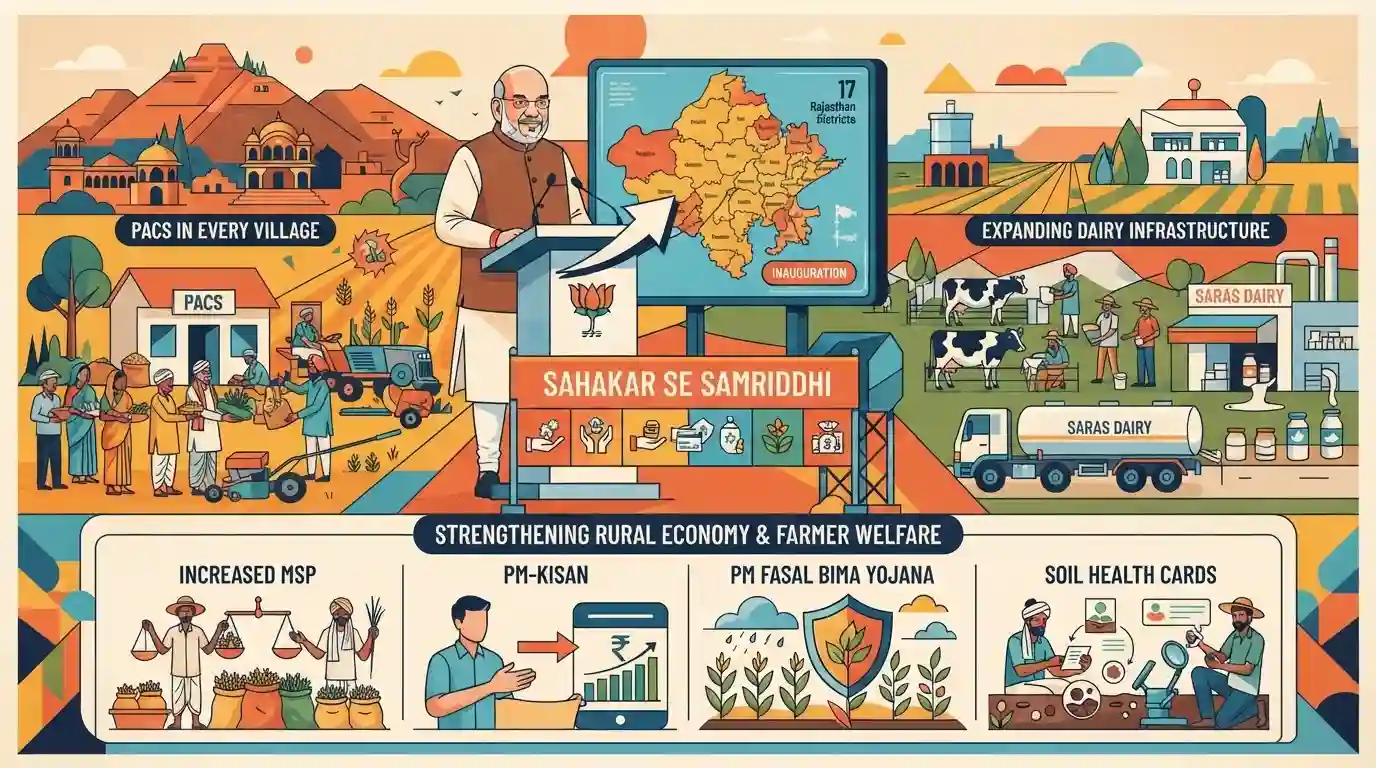
Union Home and Cooperation Minister Amit Shah inaugurated and laid the foundation for development projects worth ₹6,453 crore across 17 districts from Alwar, Rajasthan. The event highlighted the role of the cooperative sector, focusing on the 'Sahakar Se Samriddhi' initiative to establish Primary Agricultural Credit Societies (PACS) in every village and expanding dairy infrastructure like the Saras Dairy. The Minister also underscored the impact of agricultural policies such as increased Minimum Support Prices (MSP) and schemes like PM-KISAN, PM Fasal Bima Yojana, and Soil Health Cards in strengthening the rural economy and farmer welfare.
मुख्य मुद्दे
- Projects worth ₹6,453 crore were inaugurated or laid foundation for, covering 17 districts in Rajasthan.
- The processing capacity of Alwar's Saras Dairy will be expanded from 1 lakh to 2 lakh liters, boosting local dairy farming.
- The government is pushing the 'Sahakar Se Samriddhi' vision, aiming to establish multipurpose cooperative societies in every village nationwide.
- Highlighted significant hikes in Minimum Support Price (MSP) for agricultural commodities, claiming up to 135% increases for certain grains.
- Emphasized the success of various agricultural welfare initiatives, including PM-KISAN, PM Fasal Bima Yojana, and the distribution of Soil Health Cards, in supporting the rural economy.
महत्त्वाच्या संज्ञा
PM Kisan Samman Nidhi

A Central Sector scheme providing ₹6,000 annually in three direct benefit transfer (DBT) installments to eligible landholding farmer families, aimed at supplementing their financial needs for agricultural and domestic expenses.
UPSC context
GS Paper 2 & 3. Tests knowledge of DBT schemes, farmer welfare policies, and inclusive rural development strategies.
Pradhan Mantri Fasal Bima Yojana
India’s flagship crop insurance scheme providing comprehensive financial coverage against natural calamities, pests, and diseases from pre-sowing to post-harvest. It aims to stabilize farmer incomes and encourage the adoption of modern agricultural practices.
UPSC context
GS Paper 3 (Agriculture). Tests awareness of agricultural risk management, crop insurance mechanisms, and institutional support for farmers.
Soil Health Card
A scheme providing farmers with personalized reports on their soil's nutrient status across 12 parameters. It includes expert recommendations on appropriate fertilizer dosages and amendments to maintain long-term soil fertility and improve crop yields.
UPSC context
GS Paper 3 (Agriculture). Evaluates knowledge of sustainable farming, soil conservation, and policies promoting the judicious use of fertilizers.
Sahakar Se Samriddhi
Translating to 'Prosperity through Cooperation,' this is the government's core vision for revitalizing India's cooperative sector. It focuses on empowering grassroots societies like PACS to drive inclusive economic growth, rural development, and market integration.
UPSC context
GS Paper 2 & 3. Tests understanding of cooperative models, inclusive economic growth, and rural development frameworks.
Ministry of Cooperation
A Union ministry created in 2021 to provide a dedicated administrative and legal framework for India's cooperative movement. It aims to streamline operations, promote multi-state cooperatives, and deepen the grassroots reach of cooperative societies.
UPSC context
GS Paper 2 (Polity/Governance). Relevant for questions on government organization, the 97th Amendment, and the administrative backing for cooperatives.
पूर्वपरीक्षा सापळा
"Primary Agricultural Credit Societies (PACS) are regulated by the Reserve Bank of India and fall under the Banking Regulation Act."
While the RBI regulates District and State Cooperative Banks under the Banking Regulation Act, PACS are explicitly kept out of its purview and are regulated by the State Governments.
संबंधित स्थिर संकल्पना
What is the structural hierarchy of the short-term cooperative credit system in India?
- PACS (Village Level): Village-level societies dealing directly with rural borrowers for short-term agricultural credit. They operate outside the purview of the Banking Regulation Act.
- DCCBs (District Level): District Central Cooperative Banks act as a crucial financing link between grassroots PACS and apex state institutions.
- StCBs (State Level): State Cooperative Banks serve as apex institutions at the state level. Unlike PACS, both StCBs and DCCBs are regulated by the RBI.
How is the Minimum Support Price (MSP) calculated and finalized?
- CACP mandate: The Commission for Agricultural Costs & Prices (CACP) recommends MSP for 22 mandated crops and Fair & Remunerative Price (FRP) for sugarcane.
- Pricing formula: The government aims for at least 50% profit over the 'A2+FL' cost (actual paid-out costs plus imputed value of family labor), rather than the comprehensive C2 cost.
- CCEA approval: The final decision and approval on MSP implementation are strictly taken by the Cabinet Committee on Economic Affairs (CCEA), not the CACP.
आंतर-विषय नमुने
97th Amendment & Cooperatives Constitutionalism
Push for grassroots cooperatives intersects with the 97th Constitutional Amendment, establishing the fundamental right to form cooperative societies (Art 19(1)(c)) and adding DPSP (Art 43B) for their voluntary formation.
Allied Sectors & Doubling Farmers' Income
Dairy and livestock infrastructure expansion shifts the rural economy's reliance away from monsoon-dependent crop cycles, addressing the Ashok Dalwai Committee's focus on allied sectors for doubling farmers' income.

Expect a multi-statement question contrasting PACS regulation with DCCBs/StCBs, combined with recent PACS computerization initiatives.
संबंधित PYQ · 5
संबंधित PYQ · 5
- 2015MainsGS3
Livestock rearing has a big potential for providing non-farm employment and income in rural areas. Discuss suggesting suitable measures to promote this sector in India.
- 2014MainsGS3
In the villages itself no form of credit organization will be suitable except the cooperative society. -All India Rural Credit Survey. Discuss this statement in the background of agricultural finance in India. What constraints and challenges do financial institutions supplying agricultural finance face? How can technology be used to better reach and serve rural clients?
- 2018MainsGS3
What do you mean by Minimum Support Price (MSP)? How will MSP rescue the farmers from the low income trap?
- 2020PrelimsGS1
Consider the following statements: 1. In the case of all cereals, pulses and oil-seeds, the procurement at Minimum Support Price (MSP) is unlimited in any State/UT of India. 2. In the case of cereals and pulses, the MSP is fixed in any State/UT at a level to which the market price will never rise. Which of the statements given above is/are correct?
- 2019PrelimsGS1
The economic cost of food grains to the Food Corporation of India is Minimum Support Price and bonus (if any) paid to the farmers plus
