Critical and Strategic Mineral Block Auctions and Exploration Policy
Source:PIB ↗
কেন এটি গুরুত্বপূর্ণ
Securing a domestic supply of critical and strategic minerals is paramount for India's transition to clean energy, electric mobility, and advanced manufacturing. Understanding the auction frameworks, supportive schemes like NMEDT, and the classification of these minerals is crucial for both Prelims and Mains (GS1 Geography, GS3 Economy & Infrastructure).
সারসংক্ষেপ
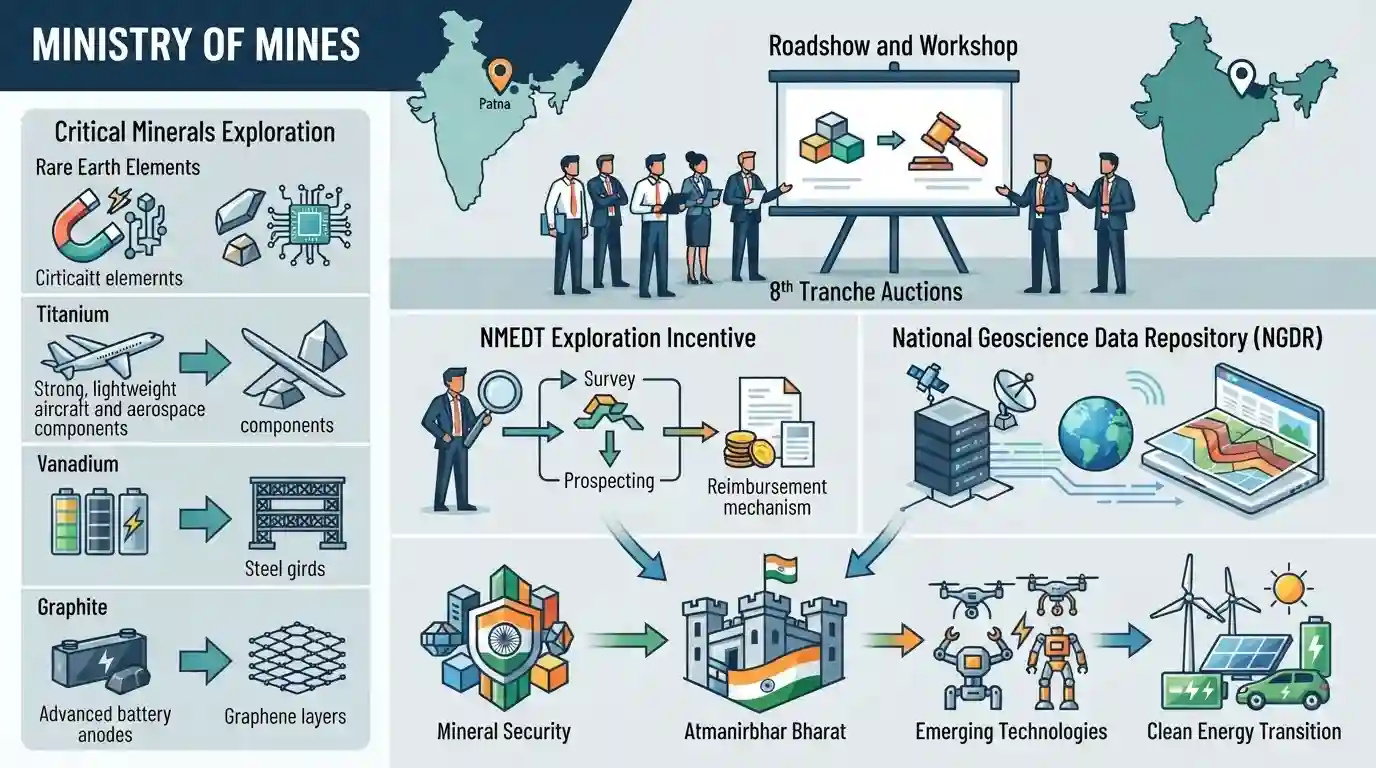
The Ministry of Mines organized a roadshow in Patna to promote the 8th tranche of critical and strategic mineral block auctions, aiming to boost domestic exploration and private sector involvement. This tranche offers 20 blocks containing critical minerals such as Rare Earth Elements, Titanium, Vanadium, and Graphite. The event also featured a workshop on the National Mineral Exploration and Development Trust (NMEDT), highlighting its scheme for partially reimbursing exploration costs, and showcased the National Geoscience Data Repository (NGDR). These initiatives are designed to enhance India's mineral security and support the Atmanirbhar Bharat vision, specifically catering to the needs of emerging technologies and the clean energy transition.
মূল বিষয়
- The Ministry of Mines held a roadshow in Patna for the 8th tranche of critical and strategic mineral block auctions, alongside a workshop on the NMEDT.
- The 8th auction tranche features 20 blocks covering essential minerals like Rare Earth Elements (REE), Graphite, Vanadium, Titanium, and Tungsten.
- The event detailed the NMEDT Scheme, which offers partial reimbursement of exploration expenses for composite licence holders to encourage private participation.
- Discussions included the use of the National Geoscience Data Repository (NGDR) for block preparation and highlighted efforts to strengthen India's mineral security for clean energy and emerging tech.
গুরুত্বপূর্ণ শব্দ
National Mineral Exploration and Development Trust (NMEDT)

A statutory trust established under the MMDR Act to expedite and fund mineral exploration in India. Financed by a levy on miners, it reimburses exploration costs to encourage private participation.
UPSC context
Relevant to GS-3 (Economy). Highlights institutional mechanisms designed to fund domestic critical mineral exploration and reduce India's import reliance.
National Geoscience Data Repository (NGDR)
A comprehensive online GIS platform conceptualized by the Ministry of Mines and implemented by the GSI. It centralizes and hosts baseline geoscientific data to democratize access and encourage private investment.
UPSC context
Significant for GS-3 (Technology). Tests knowledge of digital initiatives aimed at enhancing transparency, geospatial mapping, and resource management in mining.
Geological Survey of India (GSI)
Founded in 1851, the GSI is an attached office of the Ministry of Mines. It is India's premier scientific agency for geospatial mapping, mineral resource assessment, and earth science research.
UPSC context
Essential for GS-1 (Geography) and GS-3. Candidates must know its role in critical mineral discovery and implementing digital platforms like NGDR.
Mineral Exploration and Consultancy Limited (MECL)
A Miniratna-I Central Public Sector Enterprise under the Ministry of Mines. It provides geo-scientific services and executes both promotional and contractual mineral exploration projects across India.
UPSC context
Important for GS-3 (Economy). Highlights the operational framework of state-led geological exploration and mining consultancy services supporting domestic resource security.
Atmanirbhar Bharat
A central government vision aimed at making India economically self-reliant. In the mining sector, it focuses on securing domestic supply chains for critical minerals vital to clean energy and advanced technologies.
UPSC context
Highly relevant for GS-3 (Economy). It forms the foundational philosophy behind recent mining reforms and strategic mineral block auctions.
প্রিলিমস ফাঁদ
Revenue generated from critical mineral blocks auctioned exclusively by the Central Government accrues to the Consolidated Fund of India.
Although the Centre auctions 24 critical and strategic minerals under the MMDR Amendment Act 2023, the entire revenue and auction premium flows to the respective State Governments.
সংযুক্ত স্থির ধারণা
What are the recent MMDR Act reforms for critical and strategic minerals?
- Central Auctions: The Central Government is exclusively empowered to auction 24 critical and strategic minerals, but revenues accrue entirely to the host States.
- De-listed Minerals: Six minerals, including Lithium and Titanium, were removed from the restricted 'atomic minerals' list, opening them to private sector exploration and mining.
- NMEDT Contribution: Mandatory leaseholder financial contribution to the newly renamed NMEDT was increased from 2% to 3% of payable royalty for mine development.
What is the significance of the newly introduced 'Exploration Licences' (EL)?
- Deep-Seated Focus: Targeted specifically at 29 critical and deep-seated minerals (e.g., gold, PGE, lithium) which require advanced technology and are expensive to explore compared to surficial minerals.
- Private Incentives: Permits private entities to reconnoitre and prospect, rewarding the explorer with a share in the auction premium paid by the eventual mining leaseholder.
আন্তঃবিষয় প্যাটার্ন
Critical Minerals & Geopolitics
Domestic auctions of REEs and Titanium complement India's external engagements like the US-led Minerals Security Partnership (MSP) to de-risk clean energy supply chains from Chinese dominance.
Federalism in Resource Governance
The Centre holding exclusive auction powers for critical minerals while transferring 100% of the revenue to States highlights a unique cooperative federalism mechanism in resource governance.

Expect a multi-statement question on the MMDR Act testing the 3% NMEDT contribution, Exploration Licences, and Centre-State revenue rules.
সংযুক্ত PYQ · 4
সংযুক্ত PYQ · 4
- 2025MainsGS3
Mineral resources are fundamental to the country's economy and these are exploited by mining. Why is mining considered an environmental hazard? Explain the remedial measures required to reduce the environmental hazard due to mining.
- 2020PrelimsGS1
Consider the following minerals : 1. Bentonite 2. Chromite 3. Kyanite 4. Sillimanite In India, which of the above is/are officially designated as major minerals?
- 2022PrelimsGS1
With reference to India, consider the following statements: 1. Monazite is a source of rare earths. 2. Monazite contains thorium. 3. Monazite occurs naturally in the entire Indian coastal sands in India. 4. In India, Government bodies only can process or export monazite. Which of the statements given above are correct?
- 2023PrelimsGS1
Ilmenite and rutile, abundantly available in certain coastal tracts of India, are rich sources of which one of the following?
