NIELIT Cybersecurity Hackathon and AI Validation Standards
Source:PIB ↗
ఇది ఎందుకు ముఖ్యం
The hackathon marks a paradigm shift in cybersecurity training—moving from raw detection speed to analytical human judgment—which is vital as AI increasingly automates vulnerability scanning. It aligns with India's broader strategy to build advanced cybersecurity capacity for protecting critical digital infrastructure against complex threats.
సారాంశం
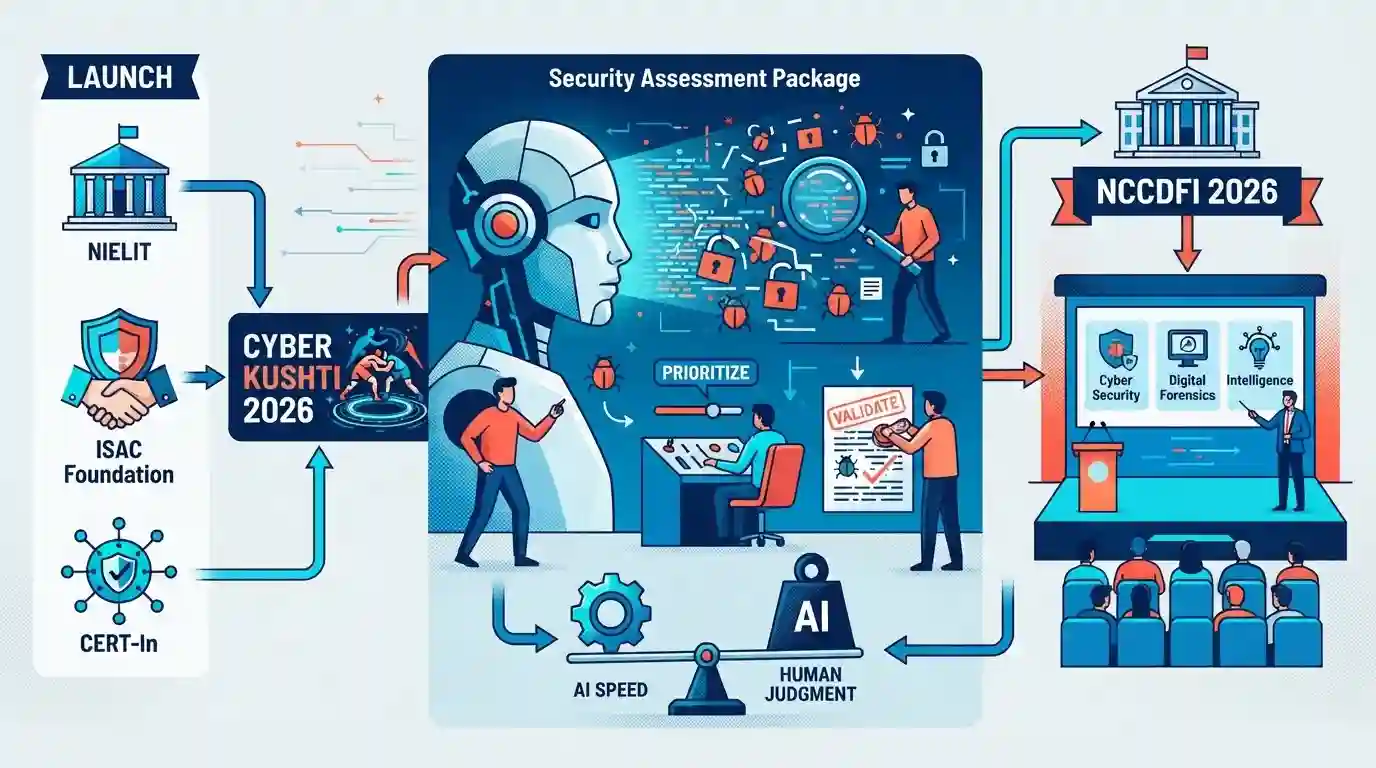
The National Institute of Electronics and Information Technology (NIELIT), under MeitY, launched the CYBER KUSHTI 2026 Hackathon in collaboration with the ISAC Foundation and CERT-In. Departing from traditional vulnerability discovery challenges, CYBER KUSHTI uniquely tests human judgment by requiring teams to correct and prioritize an imperfect, simulated AI-generated Security Assessment Package. The initiative emphasizes that while AI accelerates vulnerability detection, human expertise remains crucial for validation and strategic risk assessment. The event culminates at the 3rd National Conference on Cyber Security, Digital Forensics and Intelligence (NCCDFI 2026).
ముఖ్య అంశాలు
- CYBER KUSHTI 2026 is a National Cybersecurity & AI Hackathon launched by NIELIT (MeitY) in partnership with ISAC Foundation and CERT-In.
- Unlike traditional capture-the-flag competitions, it shifts the focus from vulnerability detection speed to evaluating human judgment, risk prioritization, and contextual understanding.
- Participants receive a flawed Security Assessment Package containing false positives, omitted vulnerabilities, and duplicate findings, which they must correct and prioritize.
- The hackathon highlights the growing need for skilled human intervention to evaluate and augment AI-driven cybersecurity tools, recognizing that human judgment is paramount in risk assessment.
ముఖ్యమైన పదాలు
CYBER KUSHTI 2026

A national cybersecurity and AI hackathon launched by NIELIT. It tests human judgment by requiring teams to evaluate, correct, and prioritize AI-generated security assessments, emphasizing strategic risk management over basic vulnerability discovery.
UPSC context
GS-3 (Cyber Security). Highlights India's evolving cyber defense strategy, transitioning from automated threat detection to critical human validation of AI-generated alerts.
National Institute of Electronics and Information Technology (NIELIT)
An autonomous scientific society under the Ministry of Electronics and Information Technology (MeitY). It pioneers capacity building, skill development, and digital empowerment in India's ICT and cybersecurity domains.
UPSC context
GS-2 (Government Bodies) & GS-3 (IT). Essential for understanding India's institutional framework for digital skilling and cyber workforce development.
National Conference on Cyber Security, Digital Forensics and Intelligence (NCCDFI)
A multidisciplinary platform organized by NIELIT uniting government, law enforcement, judiciary, and industry experts. It focuses on addressing emerging challenges in digital crimes, forensics, and national cyber resilience.
UPSC context
GS-3 (Internal Security). Crucial for multi-stakeholder coordination in combating cybercrimes and building robust digital forensic frameworks in India.
ISAC Foundation
A registered non-profit cybersecurity foundation in India operating as a Section 8 organization. It focuses on cybersecurity, AI, and professional ethics, and partners with government bodies for cyber capacity building.
UPSC context
GS-3 (Cyber Security). Illustrates public-private partnerships (PPP) enhancing India's digital defense and establishing standards for cybersecurity professionals.
National Security Database (NSD)
A professional recognition and certification project managed by the ISAC Foundation. It identifies and accredits competent information security practitioners to build a credible, government-recognized cyber workforce in India.
UPSC context
GS-3 (Cyber Security). Important for national capacity building, creating a reliable pool of certified experts to handle critical digital infrastructure.
ప్రిలిమ్స్ ఉచ్చు
Cyber Kushti is an offensive cyber warfare exercise conducted by the Defence Cyber Agency to detect vulnerabilities.
Cyber Kushti is a civilian hackathon organized by NIELIT and CERT-In (MeitY) testing human assessment of AI security flaws, not a military exercise.
అనుసంధానమైన స్థిర భావనలు
What is the statutory mandate of CERT-In under the IT Act, 2000?
- Nodal Agency: Functions as the national nodal agency for responding to computer security incidents as and when they occur.
- Statutory Backing: Established and operationalized under Section 70B of the Information Technology Act, 2000 (amended in 2008).
- Core Functions: Cyber incident forecasting, alerting, coordinating emergency response measures, and issuing vulnerability guidelines to organizations.
Why is the 'Human-in-the-Loop' (HITL) model critical in AI-driven cybersecurity?
- Filtering False Positives: AI threat detection systems often hallucinate or incorrectly flag benign network activity as malicious, requiring expert human validation.
- Contextual Risk Judgment: While AI excels at detection speed, strategic risk prioritization and evaluating the contextual impact of a vulnerability still require human intellect.
అంతర-అంశ నమూనాలు
CERT-In vs NCIIPC mandates
UPSC frequently tests institutional mandates. While CERT-In (MeitY) handles general cyber incident response, NCIIPC (NTRO) is strictly mandated to protect Critical Information Infrastructure under the IT Act.
AI Governance & Human Centricity
The emphasis on human judgment in Cyber Kushti reflects broader global AI frameworks (like the Bletchley Declaration) that prioritize strict human oversight (Human-in-the-Loop) over fully autonomous AI systems.

Expect a multi-statement question distinguishing CERT-In's statutory role under the IT Act from NCIIPC, infused with AI threat concepts.
అనుసంధాన PYQలు · 3
అనుసంధాన PYQలు · 3
- 2020MainsGS3
Discuss different types of cyber crimes and measures required to be taken to fight the menace.
- 2017MainsGS3
Discuss the potential threats of Cyber attack and the security framework to prevent it.
- 2021MainsGS3
Keeping in view India's internal security, analyse the impact of cross-border cyber attacks. Also discuss defensive measures against these sophisticated attacks.
