DRI Investigation Into SAFTA Misuse and Areca Nut Smuggling
Source:PIB ↗
हे का महत्त्वाचे आहे
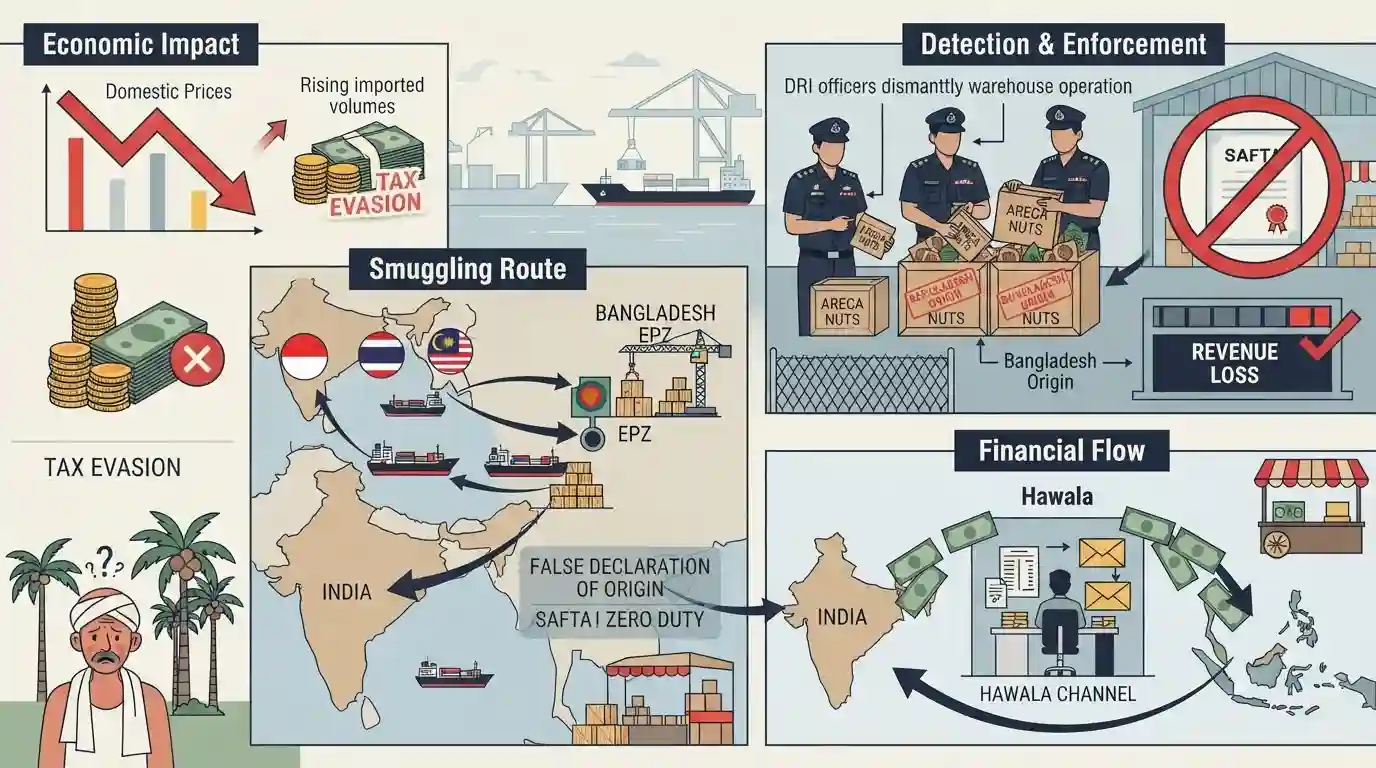
This case illustrates the vulnerabilities in Free Trade Agreements, specifically the misuse of 'Rules of Origin' clauses. It also highlights the broader threats to economic sovereignty posed by trade-based money laundering, hawala networks, and customs evasion, while emphasizing the negative impact of such smuggling on domestic agricultural producers.
सारांश
The Directorate of Revenue Intelligence (DRI) dismantled a large-scale smuggling syndicate that evaded over Rs. 2,500 crore in customs duty. The syndicate fraudulently imported areca nuts from South-East Asian nations (Indonesia, Thailand, Malaysia) by falsely declaring them as Bangladeshi origin. This allowed them to exploit the 100% Basic Customs Duty exemption under the South Asian Free Trade Area (SAFTA) agreement. To bypass SAFTA's 'Rules of Origin', the smugglers used Bangladesh's Export Processing Zones (EPZ) to repackage the goods and utilized hawala channels for financing. This illegal activity not only threatens India's economic security but also distorts domestic prices, severely impacting local areca nut growers.
मुख्य मुद्दे
- The DRI uncovered a major fraud involving the illegal import of areca nuts, resulting in a potential customs duty evasion of over Rs. 2,500 crore.
- Smugglers routed areca nuts from South-East Asian countries through Bangladesh to falsely claim origin and evade the 100% Basic Customs Duty.
- The syndicate exploited Bangladesh's Export Processing Zones (EPZ) to repackage the goods, fraudulently obtaining Certificates of Origin under the SAFTA agreement.
- The operation involved the extensive use of hawala channels to finance the illegal imports, highlighting significant economic security risks.
- Action has been taken, including the seizure of Rs. 75 lakh in cash, the suspension of a Customs Broker's license, and the arrest of nine individuals.
महत्त्वाच्या संज्ञा
South Asian Free Trade Area (SAFTA)

A 2004 free trade agreement among SAARC countries designed to promote regional economic integration by gradually reducing and eliminating customs duties on traded goods.
UPSC context
GS-2 (IR) & GS-3 (Economy). Tests knowledge of regional trade agreements and their implications for India's domestic industries.
Rules of Origin
Criteria used to determine the "economic nationality" or national source of a product. They ensure only eligible countries receive preferential tariff benefits under trade agreements, preventing third-party exploitation.
UPSC context
GS-3 (Economy). Crucial for understanding free trade agreements, commercial fraud, and the mechanisms used to evade customs duties.
Directorate of Revenue Intelligence (DRI)
India's apex anti-smuggling intelligence and investigative agency under the Central Board of Indirect Taxes and Customs (CBIC). It is responsible for combating commercial fraud, customs duty evasion, and trafficking.
UPSC context
GS-3 (Internal Security & Economy). Highly relevant for questions on economic offenses, border management, and agencies tackling organized crime.
Export Processing Zones (EPZ)
Specifically demarcated enclaves offering relaxed customs and tax regulations to encourage export-oriented manufacturing. While designed to boost exports, they can be exploited to repackage goods and mask their origin.
UPSC context
GS-3 (Economy). Tests knowledge of export promotion policies, industrial enclaves, and potential vulnerabilities in international trade supply chains.
Hawala
An informal, trust-based money transfer system operating outside formal banking networks. It is frequently exploited by smuggling syndicates for cross-border money laundering and tax evasion.
UPSC context
GS-3 (Internal Security & Economy). Essential for topics on money laundering, black money, and challenges to India's financial security framework.
पूर्वपरीक्षा सापळा
"A Certificate of Origin from the exporting nation is sufficient to claim tariff exemptions under FTAs."
Under CAROTAR 2020, mere presentation of a CoO is not enough. The Indian importer legally bears the burden to conduct due diligence and prove the value addition.
संबंधित स्थिर संकल्पना
What are 'Rules of Origin' and how does CAROTAR 2020 enforce them?
- Rules of Origin (RoO): Criteria used to determine the national source of a product, preventing third countries from dumping goods via a Free Trade Agreement (FTA) route.
- Value Addition thresholds: Goods must undergo sufficient processing. Under SAFTA, Least Developed Countries (LDCs) like Bangladesh get a relaxed domestic value-addition threshold of 30% versus 40% for non-LDCs.
- CAROTAR 2020: Customs rules introduced in 2020 mandating that Indian importers conduct strict due diligence and maintain origin-related data, rather than just relying on a foreign Certificate of Origin.
What is the geographical distribution and status of Areca nut cultivation in India?
- Global Status: India is the world's largest producer and consumer of areca nut (betel nut), making it a highly protected domestic crop.
- Top Producers: Karnataka dominates domestic production (accounting for over 70% of the total output), followed distantly by Kerala and Assam.
- Climatic Requirements: Requires a tropical climate, high rainfall (750-4500 mm), and temperatures between 14°C and 36°C to thrive.
आंतर-विषय नमुने
CAROTAR 2020 + ASEAN FTA misuse
Misuse of 'Rules of Origin' is a recurring theme. Similar rerouting happens with Chinese electronics evading duties by entering via the ASEAN-India FTA through Vietnam or Thailand.
Trade-Based Money Laundering (TBML) + High Tariffs
High import duties on cash crops (100% on areca nuts) create huge arbitrage, blending trade-based money laundering (TBML) via hawala with border and economic security challenges.

Expect a paired-statement question on CAROTAR 2020 importer obligations and SAFTA's differential Rules of Origin for LDCs like Bangladesh.
संबंधित PYQ · 3
संबंधित PYQ · 3
- 2013MainsGS3
Money laundering poses a serious security threat to a country's economic sovereignty. What is its significance for India and what steps are required to be taken to control this menace?
- 2021MainsGS3
Discuss how emerging technologies and globalisation contribute to money laundering. Elaborate measures to tackle the problem of money laundering both at national and international levels.
- 2018PrelimsGS1
Consider the following statements: 1. The quantity of imported edible oils is more than the domestic production of edible oils in the last five years. 2. The Government does not impose any customs duty on all the imported edible oils as a special case. Which of the statements given above is/are correct?
