BRICS Environment Working Group Meeting Priorities and Goals
Source:PIB ↗
हे का महत्त्वाचे आहे
The article highlights India's leadership in environmental multilateralism through the BRICS grouping. The four priority areas—Sustainable Lifestyles, Circular Economy (EPR), Climate Adaptation, and Disaster Resilience (Forest Fires)—are core components of the UPSC GS3 Environment and Disaster Management syllabus. Understanding these focus areas provides essential material for writing answers on international environmental cooperation and India's specific climate diplomacy goals.
सारांश
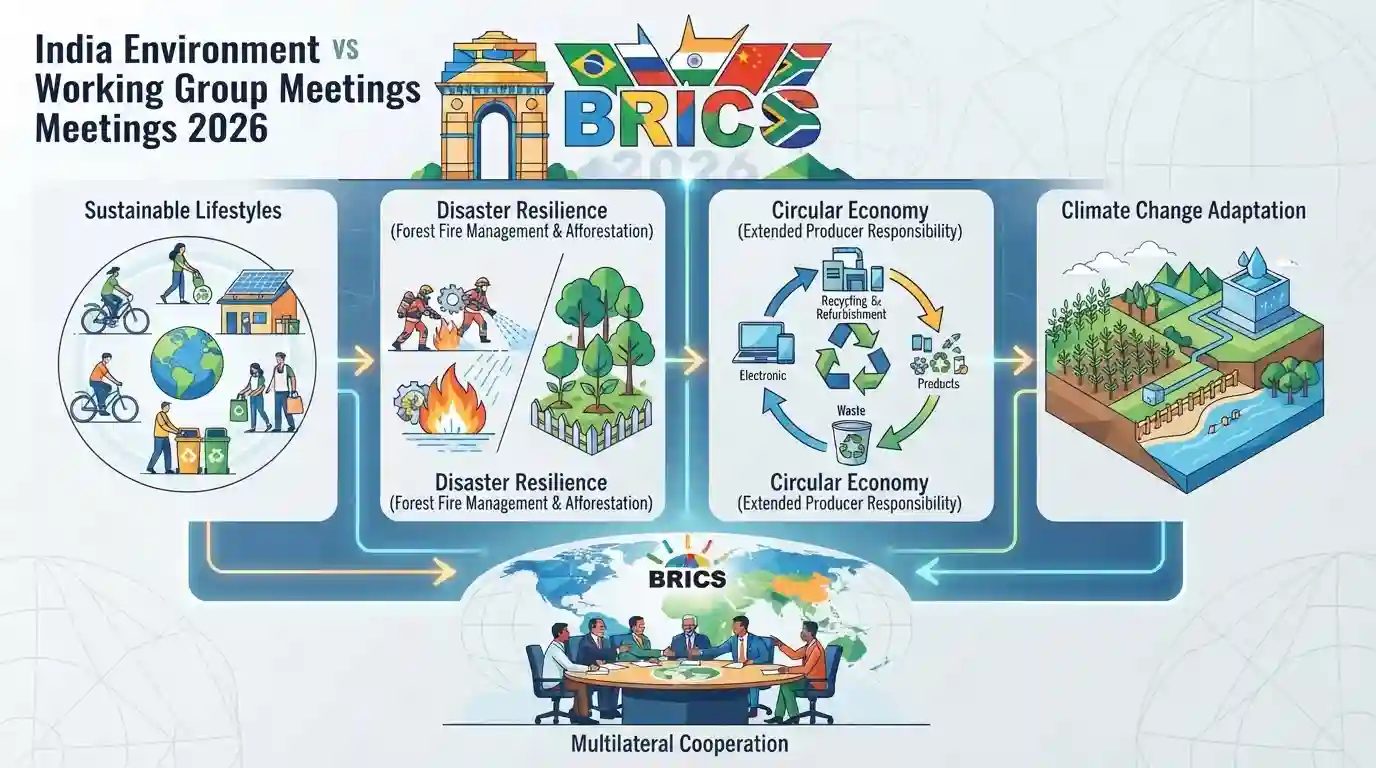
India is hosting the BRICS Environment Working Group Meetings, including the 12th BRICS Environment Ministers Meeting, in New Delhi as part of its BRICS Chairship 2026. Under the theme ‘Building for Resilience, Innovation, Cooperation and Sustainability’, the meetings will address four core environmental priorities: promoting sustainable lifestyles, enhancing disaster resilience through forest fire management and afforestation, accelerating the transition to a circular economy (with a focus on Extended Producer Responsibility), and advancing proactive climate change adaptation strategies. The gathering underscores the growing importance of multilateral cooperation within the BRICS framework to tackle global environmental and climate challenges.
मुख्य मुद्दे
- India is hosting the 12th BRICS Environment Ministers Meeting and Senior Officers' Meeting in New Delhi, under its BRICS Chairship for 2026.
- The theme for India's 2026 Chairship is ‘Building for Resilience, Innovation, Cooperation and Sustainability’.
- The meetings focus on four priority areas: Sustainable Lifestyles, Afforestation & Disaster Resilience, Circular Economy, and Climate Adaptation.
- Discussions on Circular Economy will emphasize Extended Producer Responsibility (EPR) and effective solid waste management.
- The Afforestation priority will cover mechanisms for forest fire management, rapid response, and land restoration.
- The BRICS Environment Working Group was formed in 2015, and expanded to include a Contact Group on Climate Change in 2024.
महत्त्वाच्या संज्ञा
Extended Producer Responsibility (EPR)

An environmental policy approach that holds manufacturers accountable for the entire lifecycle of their products, particularly focusing on post-consumer waste management, recycling, and safe disposal.
UPSC context
GS-3 (Environment). Essential concept for questions on the circular economy, e-waste, and plastic waste management rules.
BRICS Environment Working Group (EWG)
A multilateral platform established in 2015 to help BRICS nations address core environmental priorities, coordinate policies, share best practices, and strengthen collective action on ecological issues.
UPSC context
GS-2 & GS-3. Important for understanding India's role in global climate diplomacy and multilateral environmental cooperation.
Contact Group on Climate Change and Sustainable Development
A dedicated mechanism established by BRICS in 2024 to foster effective cooperation, dialogue, and collaborative action on global climate change and sustainable development challenges among member nations.
UPSC context
GS-2 & GS-3. Highly relevant for topics covering climate change adaptation strategies and international environmental agreements.
BRICS
A major intergovernmental organization functioning as a platform to promote economic cooperation, geopolitical coordination, and sustainable development among member states from the Global South.
UPSC context
GS-2 (Global Groupings). A foundational topic for India's foreign policy, multilateral interests, and global governance reform.
पूर्वपरीक्षा सापळा
"Mission LiFE and the Contact Group on Climate Change were established at the inception of the BRICS grouping."
Mission LiFE is an Indian initiative launched at COP26, not a BRICS invention. Furthermore, the BRICS Contact Group on Climate Change was recently established in 2024.
संबंधित स्थिर संकल्पना
What is Extended Producer Responsibility (EPR) in India's legal framework?
- Statutory Basis: Mandated primarily under the Plastic Waste Management Rules (2016) and E-Waste Management Rules, derived from the Environment (Protection) Act, 1986.
- Core Principle: Shifts the physical and financial responsibility of post-consumer waste management back to the manufacturer, importer, or brand owner to promote circularity.
What are the primary tools used for forest fire management in India?
- Early Warning Systems: The Forest Survey of India (FSI) uses MODIS and SNPP-VIIRS satellite data to disseminate near real-time fire alerts to state departments.
- Proactive Preparedness: The National Action Plan on Forest Fires (NAPFF) emphasizes proactive hazard preparedness, empowering local communities (Van Sanrakshan Samitis) rather than just reactive suppression.
आंतर-विषय नमुने
Mission LiFE + Multilateral Diplomacy
India consistently leverages its rotational presidencies (G20 in 2023, BRICS in 2026) to elevate domestic initiatives like Mission LiFE and CDRI into mainstream global environmental frameworks.
EPR + Circular Economy Treaties
Discussions on EPR at BRICS align closely with ongoing UN Global Plastics Treaty negotiations, bridging India's domestic waste management rules with international climate diplomacy.

Expect questions pairing BRICS environment priorities (like EPR) with India's domestic statutory waste management rules (EPA 1986).
संबंधित PYQ · 5
संबंधित PYQ · 5
- 2012MainsGS2
Compare the significance of IBSA and BRICS in the context of India's multilateral diplomacy.
- 2022MainsGS3
Discuss global warming and mention its effects on the global climate. Explain the control measures to bring down the level of greenhouse gases which cause global warming, in the light of the Kyoto Protocol, 1997.
- 2020MainsGS3
Discuss the recent measures initiated in disaster management by the Government of India departing from the earlier reactive approach.
- 2019PrelimsGS1
In India, 'extended producer responsibility' was introduced as an important feature in which of the following?
- 2019PrelimsGS1
As per the Solid Waste Management Rules, 2016 in India, which one of the following statements is correct?
