Observance of Partition Horrors Remembrance Day Heritage
Source:PIB ↗
ఇది ఎందుకు ముఖ్యం
This event highlights the state-led preservation of historical memory regarding the 1947 Partition. It is highly relevant for GS Paper 1 (Modern Indian History, Society, and Communalism) as it underscores the socio-emotional, cultural, and refugee aspects of the Partition, moving beyond purely political narratives to human-centric historical records.
సారాంశం
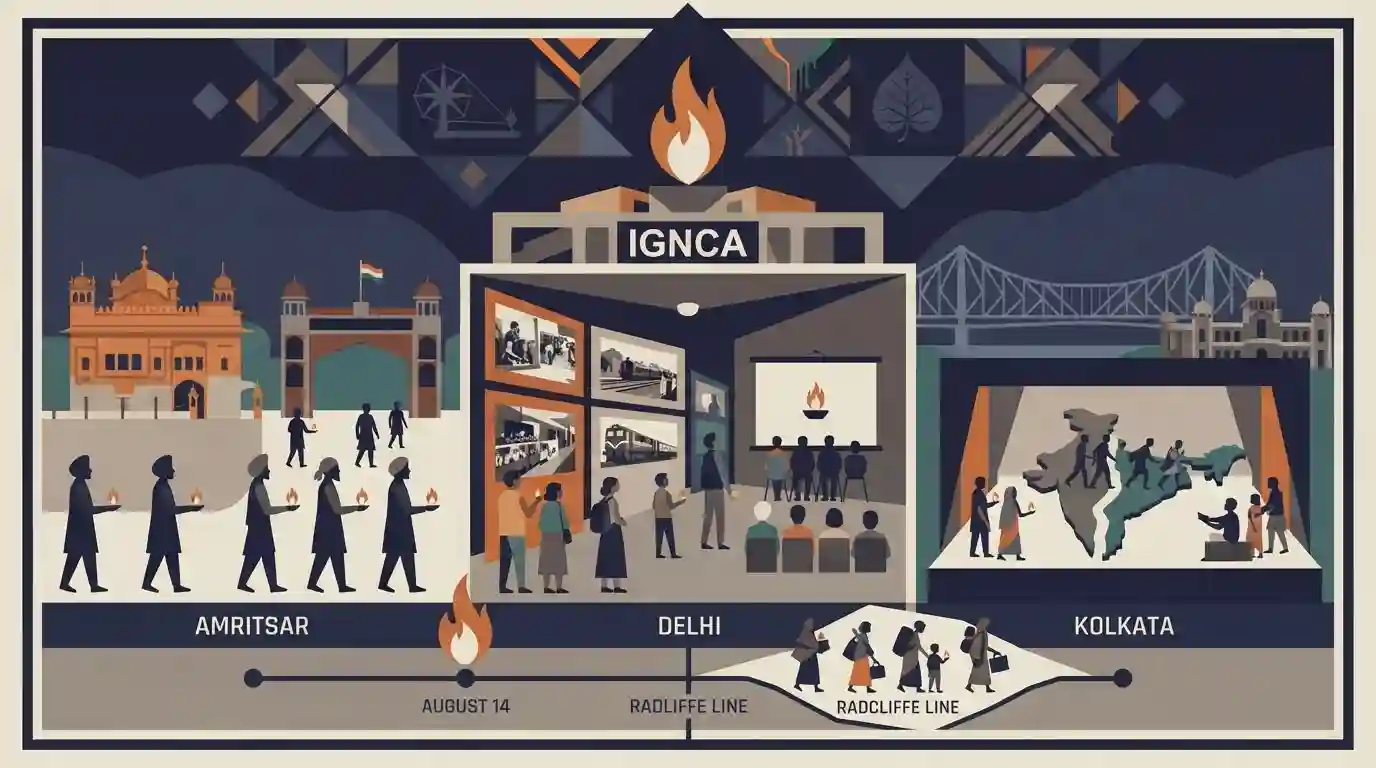
The Ministry of Culture observed Partition Horrors Remembrance Day (Vibhajan Vibhishika Smriti Diwas) on August 14 across Delhi, Amritsar, and Kolkata. Facilitated by the Indira Gandhi National Centre for the Arts (IGNCA), the programs included silent marches, exhibitions, screening of partition-themed documentaries, and theatrical performances designed to preserve the public memory of the human trauma, displacement, and resilience associated with the 1947 Partition of India.
ముఖ్య అంశాలు
- Partition Horrors Remembrance Day (Vibhajan Vibhishika Smriti Diwas) is observed annually on August 14 to commemorate the victims, struggles, and unprecedented displacement of millions during the 1947 Partition of India.
- In Delhi (Central Park, Connaught Place), key events organized by the Ministry of Culture included a silent march, exhibitions, and the release of a partition-themed poetry book titled 'देहरी भई विदेश'.
- In Amritsar (Guru Nanak Dev University), a silent march and a partition-themed exhibition were organized alongside the staging of the famous play 'Jis Lahore Nai Dekhya O Jamyai Nai'.
- In Kolkata (Newtown Convention Centre), the exhibition 'The Partition of India: Memory, Loss and Resilience' was curated, films were screened, and Dr. Syama Prasad Mookerjee's contributions during the partition era were highlighted.
- The Indira Gandhi National Centre for the Arts (IGNCA) coordinated decentralized exhibitions and programs across its regional centers, including Jammu & Kashmir, Bengaluru, and Ranchi, capturing localized histories of displacement and survival.
- The national observances aim to educate the younger generation about the immense human cost of the Partition, pay tribute to the resilience of victims, and promote national integration and communal harmony.
ముఖ్యమైన పదాలు
Partition Horrors Remembrance Day (Vibhajan Vibhishika Smriti Diwas)

An annual national observance on August 14 commemorating the victims, massive displacement, and immense human suffering caused by the 1947 Partition of India.
UPSC context
GS Paper 1 (Modern Indian History). Relevant for post-independence consolidation, communalism, and India's collective historical memory.
Indira Gandhi National Centre for the Arts (IGNCA)
An autonomous institution established in 1987 under the Ministry of Culture, serving as a premier national resource center for the research, preservation, and promotion of India's written, oral, and visual arts.
UPSC context
GS Paper 1 (Indian Heritage and Culture). Tests knowledge of national institutional frameworks for safeguarding heritage.
Ministry of Culture
The Government of India ministry responsible for preserving, promoting, and disseminating the nation's diverse art, culture, and heritage through specialized autonomous bodies, museums, and national observances.
UPSC context
GS Paper 2 (Governance) and GS 1 (Art & Culture). Crucial for heritage conservation policies, cultural diplomacy, and commemorative events.
ప్రిలిమ్స్ ఉచ్చు
Dr. Syama Prasad Mookerjee resigned from the Union Cabinet in 1950 over differences regarding the integration of Jammu and Kashmir.
Mookerjee resigned from Nehru's cabinet specifically over the Nehru-Liaquat Pact (1950) regarding minority rights, though he later led protests regarding Jammu and Kashmir's integration.
అనుసంధానమైన స్థిర భావనలు
What was the structure and mandate of the 1947 Boundary Commissions?
- Dual Commissions: Separate commissions were established for Punjab and Bengal, both chaired by British lawyer Sir Cyril Radcliffe.
- Indian Representation: Each commission contained four Indian judges (two nominated by the Indian National Congress, two by the Muslim League), not just British officials.
- Delayed Announcement: The boundary decision (Radcliffe Award) was finalized on August 12 but deliberately kept secret until August 17 to prevent pre-independence disruptions.
What were the key features and fallout of the Nehru-Liaquat Pact (1950)?
- Minority Rights: Signed to guarantee protection, citizenship, and basic human rights to minorities in both India and Pakistan after intense post-partition refugee crises.
- Refugee Redressal: Allowed migrants to return safely to sell properties, set up channels to recover abducted women, and established national Minority Commissions.
- Cabinet Resignations: Prompted the high-profile cabinet resignations of Dr. Syama Prasad Mookerjee and K.C. Neogy, who opposed compromising with Pakistan on minority treatment.
అంతర-అంశ నమూనాలు
Partition literature as historical source
Works like Wajahat's plays and Manto's stories bridge GS-I History and Art & Culture, acting as critical archives of the psychological and social trauma of displacement.
Enclaves and border security
The Radcliffe Line's rushed cartography created complex enclaves on the Bengal border, requiring the 100th Constitutional Amendment (2015) to resolve bilateral friction.

Analysis of early post-independence challenges, including the Radcliffe Commission's setup or cabinet resignations, are high-yield areas.
అనుసంధాన PYQలు · 4
అనుసంధాన PYQలు · 4
- 2014PrelimsGS1
The Partition of Bengal made by Lord Curzon in 1905 lasted until
- 2017MainsGS1
Distinguish between religiousness/religiosity and communalism giving one example of how the former has got transformed into the latter in independent India.
- 2018MainsGS1
Communalism arises either due to power struggle or relative deprivation.' Argue by giving suitable illustrations.
- 2025MainsGS1
Trace India's consolidation process during early phase of independence in terms of polity, economy, education and international relations.
