National Framework for Strengthening Tribal Development Agencies
Source:PIB ↗
આ શા માટે મહત્વનું છે
It highlights a crucial governance pivot from basic welfare funding to outcome-based, data-driven administrative monitoring in tribal areas. For UPSC aspirants, understanding how mechanisms like the Aspirational Districts model are being replicated to reform 5th/6th schedule administration and Tribal Sub-Plans (like ITDPs) is vital for GS2 answers on inclusive growth, vulnerable sections, and decentralized governance.
સારાંશ
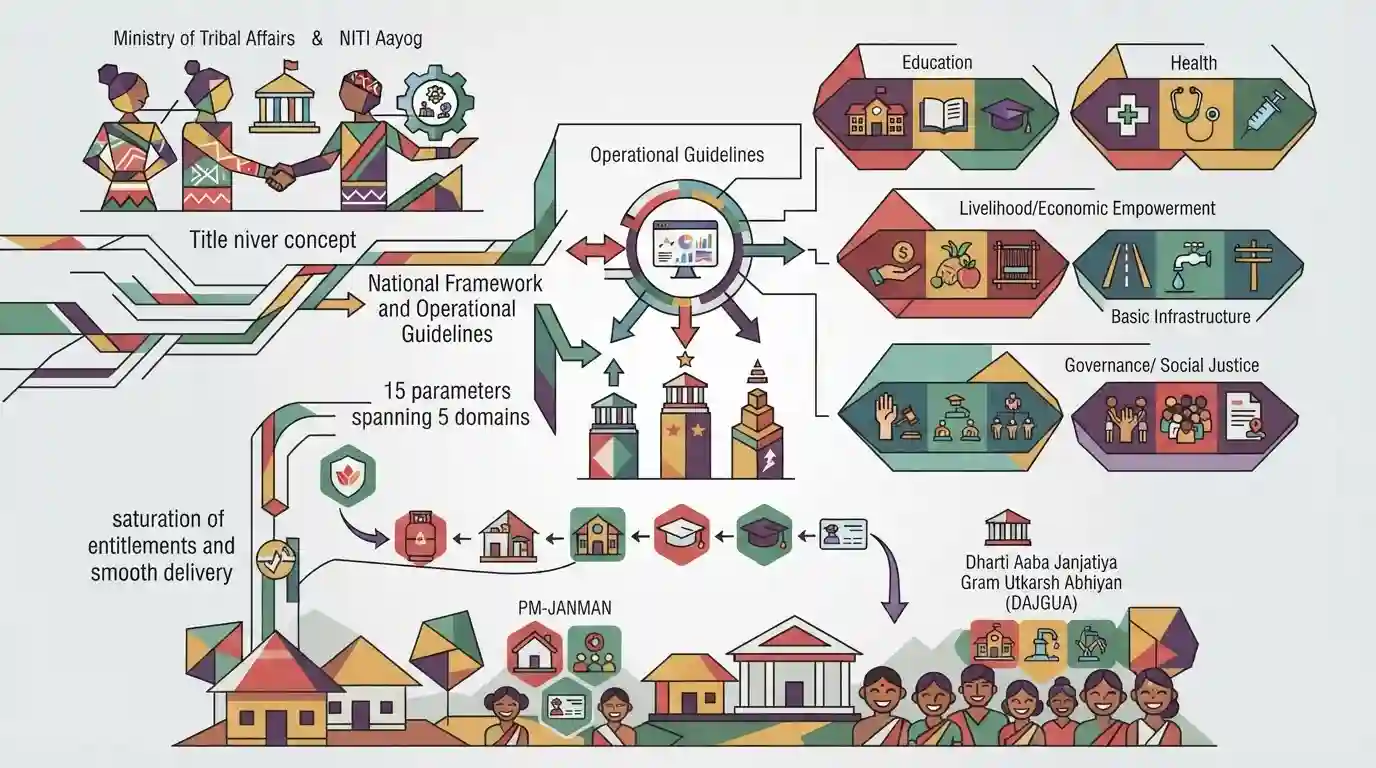
The Ministry of Tribal Affairs, in collaboration with NITI Aayog, has launched the "National Framework and Operational Guidelines for Strengthening of Integrated Tribal Development Agencies (ITDAs) and Integrated Tribal Development Projects (ITDPs)." This strategic reform aims to transform ITDAs and ITDPs into highly capable, field-level institutions driving socio-economic development in tribal areas. By adopting real-time data-driven monitoring, multi-sectoral convergence, and quarterly institutional ranking—much like the successful Aspirational Districts Programme—the framework ensures that agencies are evaluated across 15 parameters spanning 5 domains. Ultimately, it seeks to guarantee the saturation of entitlements and smooth delivery of critical schemes like PM-JANMAN and the Dharti Aaba Janjatiya Gram Utkarsh Abhiyan (DAJGUA) to vulnerable tribal populations while boosting local-level governance through Panchayati Raj Institutions.
મુખ્ય મુદ્દા
- The Ministry of Tribal Affairs and NITI Aayog jointly released a comprehensive National Framework and Operational Guidelines to strengthen Integrated Tribal Development Agencies (ITDAs) and Integrated Tribal Development Projects (ITDPs).
- ITDAs and ITDPs will be revamped using data-driven monitoring, institutional ranking, and convergence principles, directly inspired by NITI Aayog's Aspirational Districts and Blocks Programmes.
- The evaluation methodology tracks 15 specific parameters across 5 domains to measure institutional improvement and efficient fund flow.
- A key objective is ensuring the last-mile delivery and saturation of welfare entitlements under major tribal initiatives like PM-JANMAN and the newly launched Dharti Aaba Janjatiya Gram Utkarsh Abhiyan (DAJGUA).
- The framework emphasizes enhancing technical manpower at the field level and augmenting the active participation of Panchayati Raj Institutions (PRIs) in the governing councils of tribal agencies.
મહત્વપૂર્ણ શબ્દો
National Framework for Strengthening of ITDAs and ITDPs

A reform roadmap by the Ministry of Tribal Affairs and NITI Aayog to transform ITDAs and ITDPs. It establishes data-driven monitoring, institutional rankings, and multi-sectoral convergence to ensure effective delivery of tribal welfare schemes.
UPSC context
GS Paper 2 (Governance). Tests knowledge of administrative reforms, institutional capacity building, and data-driven delivery for vulnerable sections.
Integrated Tribal Development Agencies (ITDA) and Projects (ITDP)
Field-level administrative units created under the Tribal Sub-Plan strategy for contiguous areas with over 50% tribal population. They serve as nodal institutions coordinating targeted socio-economic development and welfare schemes at the grassroots.
UPSC context
GS Paper 2 (Governance). Essential for understanding decentralized tribal administration, the Tribal Sub-Plan, and local service delivery mechanisms.
Dharti Aaba Janjatiya Gram Utkarsh Abhiyan (DAJGUA)
A comprehensive government program covering over 63,000 tribal-majority villages. It aims to saturate critical gaps in health, education, and livelihoods through 25 targeted interventions coordinated across 17 line ministries over five years.
UPSC context
GS Paper 2 (Welfare Schemes). Important for tribal empowerment, addressing Schedule V/VI developmental deficits, and the whole-of-government approach.
Pradhan Mantri Janjati Adivasi Nyaya Maha Abhiyan (PM-JANMAN)
A targeted developmental scheme designed to uplift 75 Particularly Vulnerable Tribal Groups (PVTGs). It delivers 11 critical interventions, including safe housing, clean drinking water, education, and healthcare, to address extreme socio-economic marginalization.
UPSC context
GS Paper 2 (Vulnerable Sections). Vital for questions on PVTG welfare, inclusive growth, and addressing historical inequalities in tribal populations.
Aspirational Districts Programme (ADP)
A NITI Aayog initiative to rapidly transform underdeveloped districts. It relies on a framework of real-time monitoring, convergence of central and state schemes, and competitive rankings to improve key socio-economic indicators.
UPSC context
GS Paper 2 (Governance). Often cited as a successful model for competitive federalism, data-driven governance, and targeted regional development.
પ્રિલિમ્સ ટ્રેપ
Dharti Aaba Janjatiya Gram Utkarsh Abhiyan (DAJGUA) is designed specifically to saturate developmental gaps for PVTGs.
DAJGUA targets 63,000 tribal-majority villages broadly, whereas PM-JANMAN is the dedicated scheme targeting the 75 PVTGs.
સંલગ્ન સ્થિર ખ્યાલો
What is the Development Action Plan for Scheduled Tribes (DAPST)?
- Origin: Conceptualized as the Tribal Sub-Plan (TSP) during the Fifth Five-Year Plan (1974–78) to fast-track tribal socio-economic development.
- Funding Mandate: Mandates allocation of central and state plan outlays at least proportional to the Scheduled Tribe population percentage.
- Financial Safeguard: DAPST allocations are non-divertible and non-lapsable, ensuring dedicated expenditure on target tribal populations.
How do Fifth and Sixth Schedule administrative organs differ?
- Fifth Schedule TAC: Establishes Tribes Advisory Councils (TAC) in 10 states with purely advisory functions to the Governor.
- Sixth Schedule ADC: Establishes Autonomous District Councils (ADC) in four Northeastern states with extensive legislative, administrative, judicial, and financial powers.
- ITDA/ITDP Role: Function as administrative field units of the state government to implement schemes, lacking the constitutional legislative autonomy of ADCs.
આંતર-વિષય પેટર્ન
Cooperative Federalism + Tribal Administration
NITI Aayog’s competitive ranking model is adapted to reform ITDAs, shifting tribal welfare from input-based spending to outcome-oriented performance tracking.
Decentralized Governance + PRI Integration
Integrating Panchayati Raj Institutions (PRIs) into ITDA governing councils harmonizes grassroot democratic bodies with Fifth Schedule tribal administrative structures.

Expect questions mapping PM-JANMAN and DAJGUA targets alongside the administrative differences of Fifth and Sixth Schedule bodies.
સંલગ્ન PYQ · 5
સંલગ્ન PYQ · 5
- 2023MainsGS2
“Development and welfare schemes for the vulnerable, by its nature, are discriminatory in approach.” Do you agree? Give reasons for your answer.
- 2019MainsGS2
Performance of welfare schemes that are implemented for vulnerable sections is not so effective due to absence of their awareness and active involvement at all stages of policy process. Discuss.
- 2015PrelimsGS1
The provisions in Fifth Schedule and Sixth Schedule in the Constitution of India are made in order to
- 2019PrelimsGS1
Under which Schedule of the Constitution of India can the transfer of tribal land to private parties for mining be declared null and void?
- 2019MainsGS2
‘In the context of neo-liberal paradigm of development planning, multi-level planning is expected to make operations cost-effective and remove many implementation blockages.’ - Discuss.
