Eradicating Left Wing Extremism Mindset and Civil Defence
Source:PIB ↗
हे का महत्त्वाचे आहे
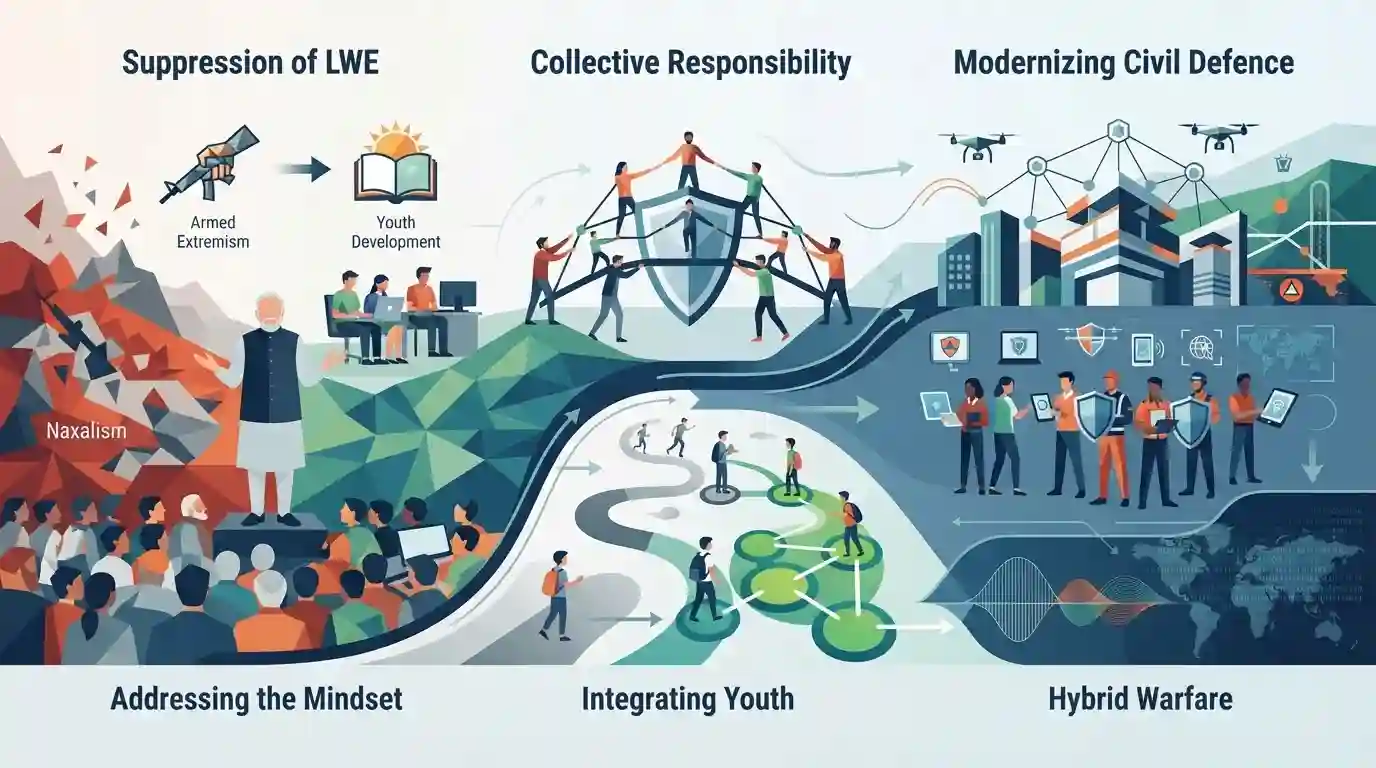
This address outlines a vital transition in India's internal security strategy—shifting from tactical counter-insurgency against LWE to countering its ideological dimensions, while simultaneously modernizing civil defence mechanisms to withstand hybrid, non-traditional warfare.
सारांश
In his address on the 80th Independence Day, Prime Minister Narendra Modi declared that securing the nation is a collective responsibility. He highlighted the successful suppression of armed Naxalism, turning previous strongholds into Naxal-free zones, but cautioned that the 'Naxal mindset' still persists. To tackle this, he advocated for integrating youth into development. Pointing out the changing nature of warfare beyond traditional borders, the PM announced the establishment of a modernized and vibrant Civil Defence Network to equip citizens and civil defence personnel with contemporary systems and preparedness.
मुख्य मुद्दे
- PM Narendra Modi delivered his 80th Independence Day address from the Red Fort, emphasizing that securing India is a shared responsibility of all citizens.
- He stated that while armed Left Wing Extremism (LWE) has been defeated and many regions are now Naxal-free, the 'Naxal mindset' still persists and needs to be actively countered.
- To counter the ideological threat of Naxalism, the government will focus on identifying this mindset and integrating local youth into mainstream socio-economic development.
- The PM paid tribute to over 3,500 police and security personnel who sacrificed their lives in the fight against Left Wing Extremism.
- Modi highlighted the evolving nature of warfare, noting that conflicts are no longer restricted to traditional borders or battlefields, but extend to modern, non-traditional domains.
- He announced the creation of a 'vibrant civil defence network' to equip citizens and civil defence forces with modern systems, technologies, and disaster/crisis preparedness.
महत्त्वाच्या संज्ञा
Civil Defence Network

A nationwide voluntary force initiative announced in 2026 to modernize civilian preparedness, equipping citizens and volunteers with modern systems to protect critical infrastructure against contemporary security threats.
UPSC context
GS Paper III (Internal Security); tests preparedness against non-traditional security threats and the role of community-based resilience.
Left Wing Extremism (LWE)
A violent Maoist/Naxalite insurgency in India rooted in radical far-left ideology that wages armed struggle to overthrow the democratic state, historically concentrated in the underdeveloped tribal "Red Corridor" region.
UPSC context
GS Paper III (Internal Security); tests understanding of linkages between development deficits, extremism, and state counter-insurgency strategies.
Hybrid Warfare
An evolving conflict strategy blending conventional military tactics with cyber warfare, economic subversion, information operations, and targeted attacks on critical civilian infrastructure like financial systems and data networks.
UPSC context
GS Paper III (Internal Security); tests understanding of non-traditional, borderless security threats and modern technological vulnerabilities of domestic infrastructure.
Civil Defence Act, 1968
The legislative framework in India that governs non-combat protection measures for citizens and property during hostile attacks, amended in 2009 to incorporate disaster management responsibilities.
UPSC context
GS Paper III (Internal Security/Disaster Management); tests awareness of legal frameworks for civilian protection and community volunteer mobilization.
पूर्वपरीक्षा सापळा
The Civil Defence Corps in India is governed by the Ministry of Defence and acts exclusively during times of external conventional aggression.
Civil Defence falls under the Ministry of Home Affairs (MHA), and its mandate was legally expanded in 2009 to include natural and man-made disaster management during peacetime.
संबंधित स्थिर संकल्पना
What is the SAMADHAN doctrine used to counter Left-Wing Extremism (LWE)?
- Leadership and Strategy: Focuses on Smart Leadership, Aggressive Strategy, and Motivation/Training to optimize tactical field operations against LWE cadres.
- Intelligence and Tech: Relies on Actionable Intelligence, Dashboard-based KPIs, and Harnessing Technology like drones and tracking systems to coordinate operations.
- Financing and Actions: Formulates custom Action Plans for each theater while strictly ensuring No access to financing for insurgent groups.
What is the legislative and functional mandate of the Civil Defence Corps in India?
- Legislative Framework: Established under Civil Defence Act 1968, originally designed only to protect civilians during external military hostilities.
- Mandate Expansion: Amended in 2009 to formally incorporate disaster management tasks for both natural and man-made crises.
- Administrative Control: Operates under the Ministry of Home Affairs, utilizing community-based volunteers to augment state administrative capacities.
आंतर-विषय नमुने
Hybrid warfare + Critical Infrastructure protection
Shifting from kinetic borders to asymmetric domains links security with national cybersecurity policies, targeting the resilience of critical civilian grids, financial systems, and communication networks.
Tribal self-governance + Extremism containment
Securing post-Naxal zones permanently requires integrating physical pacification with local governance mechanisms like PESA and the Forest Rights Act to resolve historic economic alienation.

Declining Red Corridor stats and Civil Defence Act amendments are prime targets for multi-statement prelims questions on internal security.
संबंधित PYQ · 4
संबंधित PYQ · 4
- 2022MainsGS3
Naxalism is a social, economic and developmental issue manifesting as a violent internal security threat. In this context, discuss the emerging issues and suggest a multilayered strategy to tackle the menace of Naxalism.
- 2018MainsGS3
Left Wing Extremism (LWE) is showing a downward trend, but still affects many parts of the country. Briefly explain the Government of India's approach to counter the challenges posed by LWE.
- 2020MainsGS3
What are the determinants of left-wing extremism in Eastern part of India? What strategy should Government of India, civil administration and security forces adopt to counter the threat in the affected areas?
- 2021MainsGS3
Analyse the multidimensional challenges posed by external state and non-state actors, to the internal security of India. Also discuss measures required to be taken to combat these threats.
