DAE Nurturing of Science Olympiad Achievers and Youth
Source:PIB ↗
ఇది ఎందుకు ముఖ్యం
The article serves as an excellent case study for Mains answers regarding Human Resource Development, efforts to stem brain drain, and promoting scientific temper (Article 51A(h)). It highlights institutional mechanisms (like DAE and HBCSE) that nurture grassroots STEM talent, addressing the UPSC theme of declining interest in basic scientific research in India.
సారాంశం
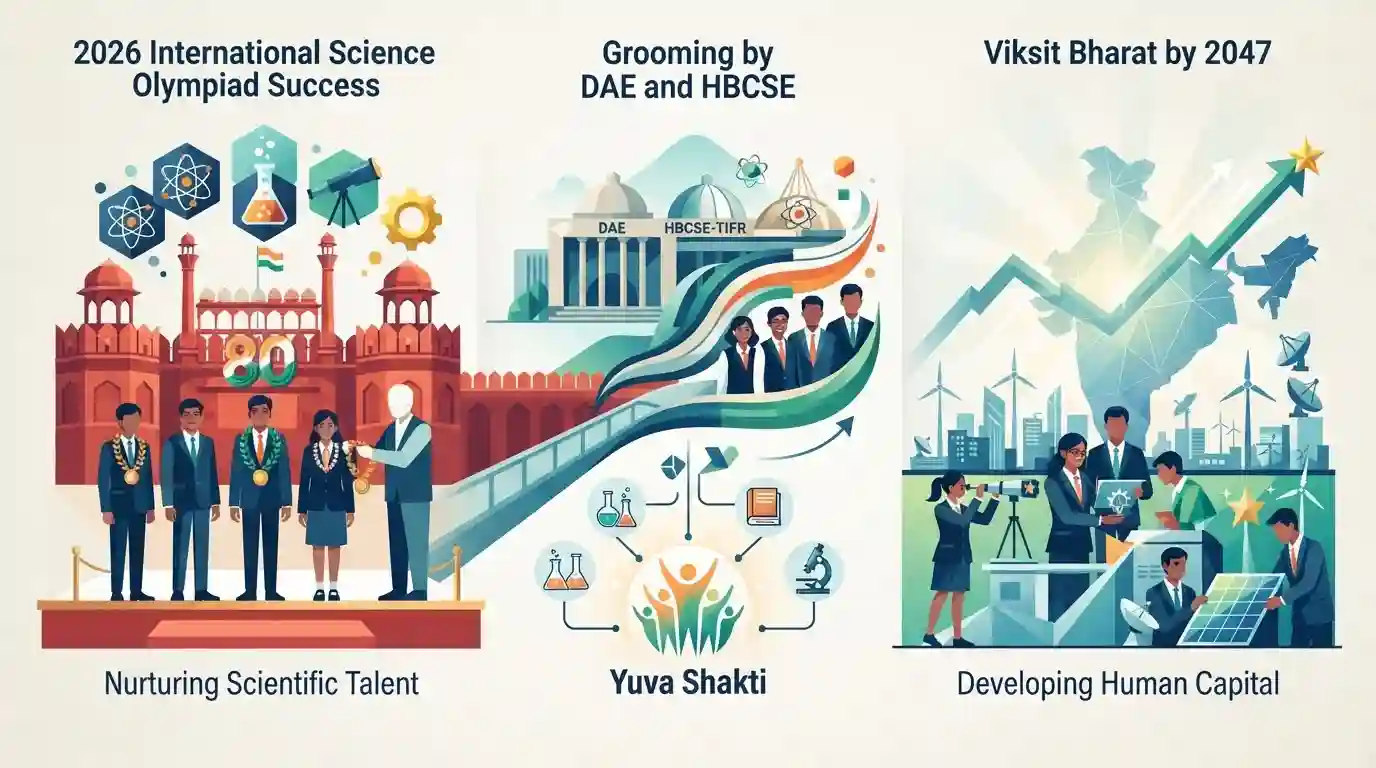
Students who achieved success in the 2026 International Science Olympiads were honored as Special Guests during the 80th Independence Day celebrations at the Red Fort. Groomed under the aegis of the Department of Atomic Energy (DAE) through the Homi Bhabha Centre for Science Education (HBCSE-TIFR), these students represent the potential of India's 'Yuva Shakti'. The recognition underscores the government's commitment to nurturing scientific talent, promoting basic sciences, and developing human capital crucial for the vision of a Viksit Bharat by 2047.
ముఖ్య అంశాలు
- International Science Olympiad Achievers of 2026 were invited as Special Guests to the 80th Independence Day celebrations at the Red Fort.
- The students were nurtured by the Department of Atomic Energy (DAE) through the Homi Bhabha Centre for Science Education (HBCSE-TIFR), which is the nodal centre for Olympiads in India.
- The recognition highlights the government's focus on harnessing 'Yuva Shakti' (youth power) as a driving force for achieving Viksit Bharat by 2047.
- Such initiatives aim to promote scientific temper and encourage the youth to pursue long-term careers in basic sciences and research, building robust human capital.
ముఖ్యమైన పదాలు
Viksit Bharat 2047

India's strategic vision to become a developed, self-reliant, high-income nation by the 100th anniversary of independence in 2047. It targets a USD 30–40 trillion economy, zero poverty, inclusive development, and net-zero emissions.
UPSC context
Crucial for GS Paper 3 (Economic Development). Tests understanding of demographic dividend, high-income transition, and sustainable inclusive growth strategies.
International Science Olympiads
Annual global academic competitions for pre-university students in basic sciences. In India, the Homi Bhabha Centre for Science Education (HBCSE) acts as the nodal agency, responsible for selecting, training, and mentoring the national contingent.
UPSC context
Relevant for GS Paper 2 (Education) and GS Paper 3 (Basic Sciences). Highlights government interventions fostering youth excellence in STEM.
Department of Atomic Energy (DAE)
A nodal government department directly under the Prime Minister, overseeing nuclear technology and research. It strategically funds and supports premier basic science institutes like TIFR, playing a key role in developing India's scientific human capital.
UPSC context
Important for GS Paper 3 (Science & Technology Institutions). Tests knowledge of India's foundational research ecosystem and administrative structure.
Homi Bhabha Centre for Science Education (HBCSE)
A national center of TIFR operating under the DAE, headquartered in Mumbai. Its core mandate is promoting equity and excellence in science and mathematics education, notably serving as India's premier node for the Science Olympiads.
UPSC context
Connects to GS Paper 2 (Education/Social Justice). Tests awareness of specialized institutions driving scientific literacy, curriculum reform, and talent nurturing.
Tata Institute of Fundamental Research (TIFR)
A premier deemed university and research institution funded by the DAE. It focuses on advanced fundamental research in physics, chemistry, biology, and mathematics, playing a foundational role in India's basic sciences ecosystem and education.
UPSC context
Relevant for GS Paper 3 (Achievements of Indians in S&T). Tests awareness of pivotal scientific institutions driving fundamental basic research.
ప్రిలిమ్స్ ఉచ్చు
The Ministry of Education is the sole nodal agency administering and funding all International Science and Mathematical Olympiads in India.
HBCSE (under DAE/TIFR) is the apex nodal center. The Mathematical Olympiad is funded exclusively by the National Board for Higher Mathematics under the Department of Atomic Energy.
అనుసంధానమైన స్థిర భావనలు
What is the structure and funding mandate of the Anusandhan National Research Foundation (ANRF)?
- Apex Leadership: Chaired by the Prime Minister, with the Ministers of Science & Technology and Education acting as Vice-Presidents.
- Financing Mix: Targets ₹50,000 crore (2023-28), relying on non-government and private sources for 72% (₹36,000 crore) of the corpus.
- SERB Subsumption: Formally dissolved and integrated the Science and Engineering Research Board (SERB) to cover basic sciences, social sciences, and humanities.
What are the key structural challenges in India's Gross Expenditure on R&D (GERD)?
- Stagnant Outlay: India's GERD is low at 0.6%-0.7% of GDP, contrasted with countries like the US (3.5%) and China (2.4%).
- Public Sector Dominance: Public sector drives over 60% of India's R&D, whereas private enterprises lead funding in developed economic models.
- Structural Asymmetry: Over 90% of central R&D funds go to elite IITs and central labs, leaving state universities financially marginalized.
అంతర-అంశ నమూనాలు
Scientific Human Capital & Patent Output
Nurturing basic science talent (like Olympiad achievers) is key to reversing India's low patent-to-GDP conversion rate and building a self-reliant high-tech manufacturing base.
Democratizing R&D under Co-operative Federalism
Redirecting central R&D funds through the ANRF to state universities bridges the developmental divide between elite national institutes and regional educational systems.

ANRF's funding split, SERB's dissolution, and institutional imbalance in India's GERD are highly likely targets for multi-statement MCQs.
అనుసంధాన PYQలు · 3
అనుసంధాన PYQలు · 3
- 2014MainsGS3
Scientific rescarch in Indian universities is declining, because a career in science is not as attractive as are business professions, engineering or administration, and the universities are becoming consumer-oriented. Critically comment.
- 2023MainsGS2
The crucial aspect of development process has been the inadequate attention paid to Human Resource Development in India. Suggest measures that can address this inadequacy.
- 2024MainsGS2
Poverty and malnutrition create a vicious cycle, adversely affecting human capital formation. What steps can be taken to break the cycle ?
