Cultural Akademies Commemorate Independence Day Milestones
Source:PIB ↗
কেন এটি গুরুত্বপূর্ণ
The article provides a comprehensive overview of the roles played by major cultural institutions (Sahitya Akademi, Sangeet Natak Akademi, NSD) which are frequently tested in UPSC Prelims. It also touches upon important historical landmarks, such as the 150th anniversary of 'Vande Mataram' (composed by Bankim Chandra Chattopadhyay) and Partition Horrors Remembrance Day, making it highly relevant for GS Paper 1 questions on Indian heritage, literature, and the freedom struggle.
সারসংক্ষেপ
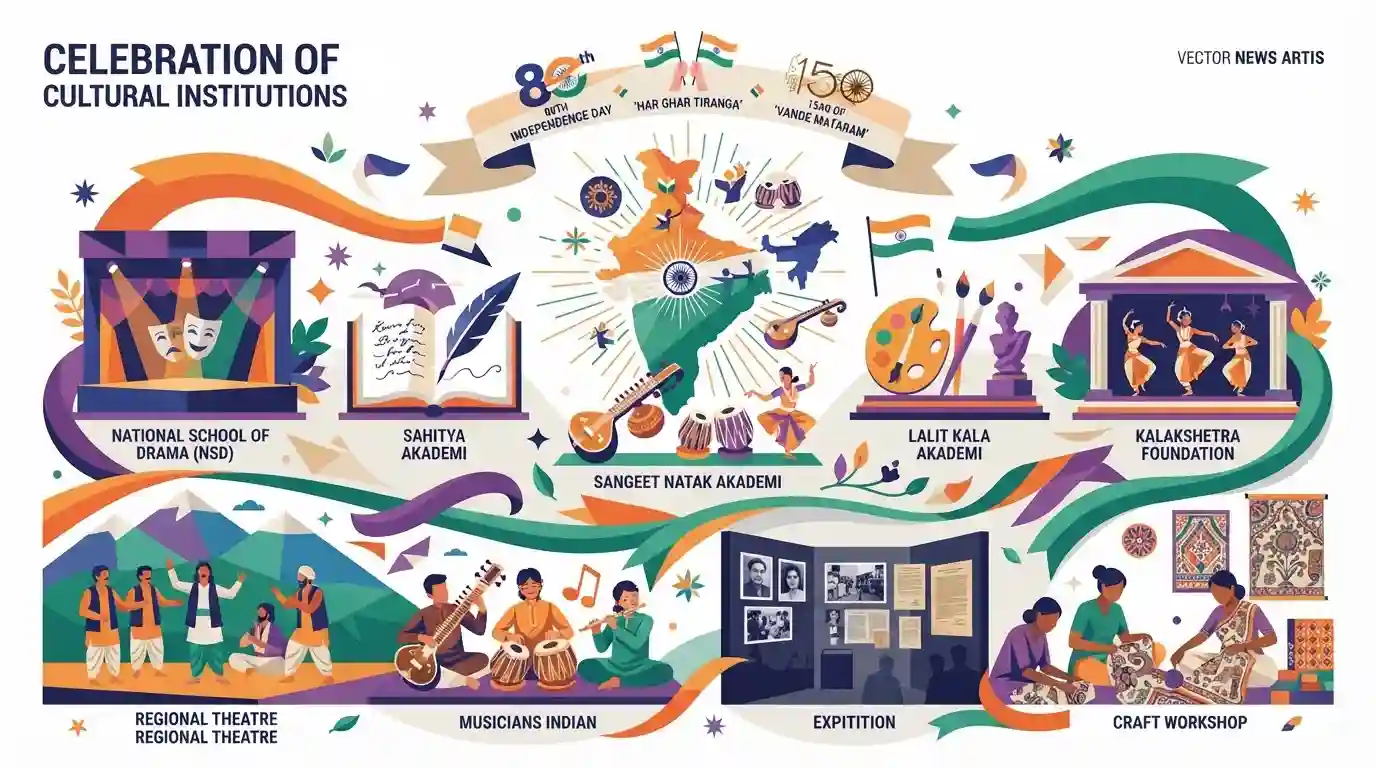
Various autonomous bodies under the Ministry of Culture—including the National School of Drama, Sahitya Akademi, Sangeet Natak Akademi, Lalit Kala Akademi, and Kalakshetra Foundation—organized nationwide cultural programmes to celebrate the 80th Independence Day, the 'Har Ghar Tiranga' campaign, and 150 years of 'Vande Mataram'. The celebrations featured a wide array of activities such as regional theatre performances in Kashmir, traditional musical showcases, exhibitions remembering the horrors of Partition, and workshops on indigenous crafts like Kalamkari. These events collectively highlight the proactive role of national cultural institutions in preserving and promoting India's diverse heritage and historical milestones.
মূল বিষয়
- The Ministry of Culture, through its autonomous Akademies, commemorated the 80th Independence Day alongside the 150th anniversary of the national song 'Vande Mataram'.
- The National School of Drama (NSD) organized regional theatre festivals in Srinagar, featuring Kashmiri traditional performing arts such as Bhand Pather and Lal Ded Vak.
- Sahitya Akademi observed 'Vibhajan Vibhishika Smriti Diwas' (Partition Horrors Remembrance Day) to reflect upon the historical and literary legacy of the Partition.
- Sangeet Natak Akademi showcased folk and traditional musical heritage from multiple states, utilizing indigenous instruments like the Tutari, Tasha, and Shankh.
- Kalakshetra Foundation and Lalit Kala Akademi promoted traditional Indian crafts—including Kalamkari painting, tricolour weaving, and clay modelling—aligning with the 'Viksit Bharat 2047' vision.
গুরুত্বপূর্ণ শব্দ
Har Ghar Tiranga

A public campaign launched in 2022 by the Ministry of Culture, encouraging citizens to hoist the National Flag at home to foster a personal connection with the tricolor.
UPSC context
GS Paper I and II; tests national symbols, civic participation, and patriotic initiatives.
Ministry of Culture
The Union Ministry responsible for the preservation, promotion, and conservation of India's tangible, intangible, and knowledge-based cultural heritage, operating several autonomous bodies.
UPSC context
GS Paper I and II; tests cultural policies, schemes, and heritage conservation frameworks.
National School of Drama (NSD)
A premier theatre training institution in New Delhi, established in 1959 by Sangeet Natak Akademi and later becoming an autonomous body under the Ministry of Culture in 1975.
UPSC context
GS Paper I (Art and Culture); tests performing arts, institutional history, and theatre traditions.
Sahitya Akademi
India's National Academy of Letters, established in 1954 as an autonomous organization, dedicated to promoting literature across 24 recognized Indian languages (including English and Rajasthani).
UPSC context
GS Paper I (Indian Literature); tests literary honors, languages, and institutional contributions.
Sangeet Natak Akademi
Established in 1953, it is the National Academy of Music, Dance, and Drama, acting as the apex body for performing arts and the nodal agency for UNESCO Intangible Cultural Heritage.
UPSC context
GS Paper I (Art and Culture); tests classical dance, music, awards, and UNESCO listings.
Lalit Kala Akademi
Established in 1954, it is India’s National Academy of Fine Arts, an autonomous body under the Ministry of Culture focusing on the promotion, development, and research of visual arts.
UPSC context
GS Paper I (Art and Culture); tests the development, promotion, and national awards of visual arts.
Kalakshetra Foundation
Founded in 1936 by Rukmini Devi Arundale, this Chennai-based academy is a premier center for fine arts and was recognized as an Institute of National Importance in 1993.
UPSC context
GS Paper I (Art and Culture); tests classical dance forms (Bharatanatyam) and revivalist art movements.
প্রিলিমস ফাঁদ
Vande Mataram was composed specifically for the novel Anandamath to depict the Sannyasi Rebellion.
Bankim Chandra Chattopadhyay wrote the song in 1875 as an independent poem, only later incorporating it into his 1882 novel.
সংযুক্ত স্থির ধারণা
What are the features of Bhand Pather theatre?
- Origin & Performers: It is the traditional folk theatre of Kashmir, historically performed by Muslim agricultural communities.
- Style & Themes: It is highly satirical, combining acting, dance, and music to critique social, economic, and political realities.
- Musical Elements: Performances rely on traditional instruments like the Surnai (a double-reed wind instrument) and various drums.
How do Srikalahasti and Machilipatnam Kalamkari styles differ?
- Srikalahasti Style: This style uses a bamboo pen (kalam) for free-hand drawing of mythological characters and temple stories.
- Machilipatnam Style: This style heavily employs hand-carved wooden blocks for printing outlines, featuring Persian-influenced floral motifs.
- Common Attributes: Both styles exclusively use natural, vegetable-based dyes and are registered Geographical Indications (GIs) of Andhra Pradesh.
আন্তঃবিষয় প্যাটার্ন
Literary nationalism and colonial resistance
Vernacular poems and novels like Anandamath transformed regional languages into vehicles for anti-colonial mobilization, bridging cultural expression with hard political resistance.
GI crafts and cultural diplomacy
Promoting regional crafts like Kalamkari via national academies aligns with India's foreign policy goal of leveraging geographical indications (GIs) for cultural branding.

GS-1 may pair 19th-century literary milestones like Vande Mataram with specific GI-craft techniques and regional theatre forms.
সংযুক্ত PYQ · 4
সংযুক্ত PYQ · 4
- 2009PrelimsGS1
Consider the following statements: 1. The National School of Drama was set up by Sangeet Natak Akademi in 1959. 2. The highest honour conferred by the Sahitya Akademi on a writer is by electing him its Fellow. Which of the statements given above is/are correct?
- 2006PrelimsGS1
Which one of the following revolts was made famous by Bankim Chandra Chatterjee in his novel Anand Math?
- 2015PrelimsGS1
Kalamkari painting refers to
- 2021PrelimsGS1
With reference to Madanapalle of Andhra Pradesh, which one of the following statements is correct?
