Viksit Bharat Roadmap and Governance Reforms Vision
Source:PIB ↗
কেন এটি গুরুত্বপূর্ণ
The Prime Minister's Independence Day address is a primary source for understanding the Union Government's long-term vision, policy priorities, and upcoming legislative agenda. Themes such as simultaneous elections, civil codes, and women's economic empowerment via SHGs are highly probable topics for both Prelims and GS2/GS3 Mains.
সারসংক্ষেপ
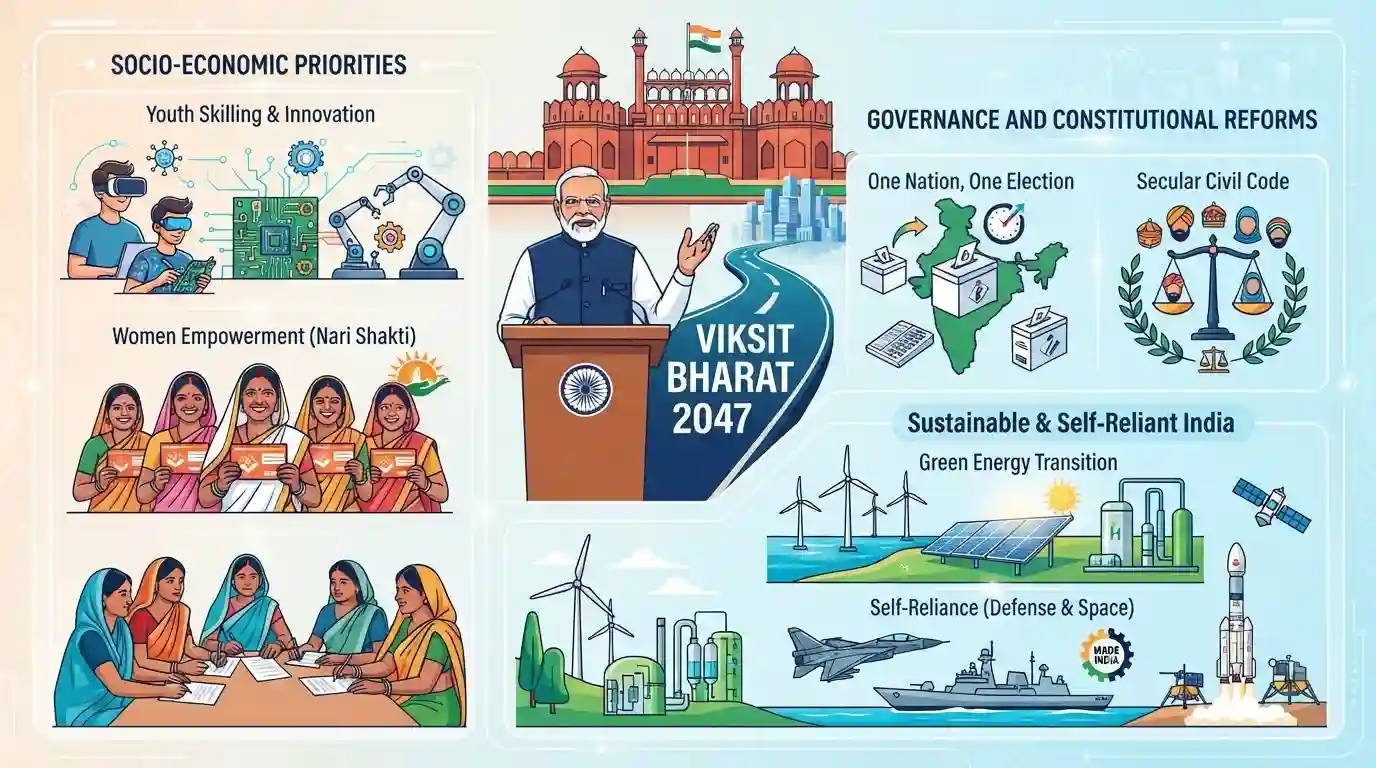
Prime Minister Narendra Modi’s address on the 80th Independence Day from the Red Fort outlined a comprehensive vision for a 'Viksit Bharat' (Developed India) by 2047. The speech served as a declaration of the government’s socio-economic and political priorities, focusing heavily on youth skilling, technological innovation, and 'Nari Shakti' (Women Empowerment) via the expansion of rural Self-Help Groups (SHGs) and the Lakhpati Didi scheme. On the governance and constitutional fronts, the Prime Minister strongly advocated for "One Nation, One Election" to streamline democratic processes and called for a Secular Civil Code to ensure justice and equality. Furthermore, the address highlighted India's strides in the green energy transition—specifically through the National Green Hydrogen Mission and solar initiatives—as well as ongoing efforts toward self-reliance in defense and space exploration.
মূল বিষয়
- Reiterated the roadmap for achieving 'Viksit Bharat' (Developed India) by 2047, emphasizing youth empowerment, skill development, and harnessing the demographic dividend.
- Highlighted the critical role of 'Nari Shakti' (Women Empowerment) in nation-building, with a focus on empowering rural women through Self-Help Groups (SHGs) and the 'Lakhpati Didi' initiative.
- Advocated for crucial constitutional and democratic reforms, specifically urging national consensus on "One Nation, One Election" and a Secular Civil Code to replace discriminatory colonial-era laws.
- Underscored India's commitment to climate action and self-reliance in energy through the National Green Hydrogen Mission and rooftop solar schemes like PM Surya Ghar.
- Emphasized self-reliance (Atmanirbhar Bharat) in defense manufacturing, technological innovation in the space sector (Gaganyaan), and modernizing agricultural practices.
গুরুত্বপূর্ণ শব্দ
Lakhpati Didi Scheme

A Ministry of Rural Development initiative under DAY-NRLM aiming to enable women Self-Help Group (SHG) members to achieve an annual household income of at least ₹1 lakh through skill training and financial support.
UPSC context
GS Paper II (Social Justice/Women Empowerment) and GS Paper III (Inclusive Growth), testing grassroots poverty alleviation.
National Green Hydrogen Mission
A flagship initiative launched in 2023 to develop green hydrogen production capacity of 5 MMT per annum by 2030, establishing India as a global hub for its production, utilization, and export.
UPSC context
GS Paper III (Infrastructure: Energy & Environment), testing clean energy transition and climate change mitigation strategies.
PM Surya Ghar: Muft Bijli Yojana
A government rooftop solar scheme launched in February 2024 to provide 300 units of free monthly electricity to one crore households via subsidized, collateral-free solar installations.
UPSC context
GS Paper III (Infrastructure & Energy), testing decentralized renewable energy and fiscal subsidy management.
Uniform Civil Code (Secular Civil Code)
A proposed common set of civil laws governing personal matters like marriage, divorce, and inheritance for all citizens, envisaged under Article 44 (Directive Principles of State Policy) of the Constitution.
UPSC context
GS Paper II (Indian Constitution, DPSP, & Secularism), testing legal equality and federal-social reform.
One Nation One Election
A proposal to synchronize Lok Sabha and State Legislative Assembly elections into a single cycle to reduce electoral expenses, administrative burdens, and interruptions from the Model Code of Conduct.
UPSC context
GS Paper II (Electoral Reforms & Federalism), testing structural challenges, constitutional feasibility, and systemic democratic reforms.
Self-Help Groups (SHGs)
Informal, voluntary associations of people (mostly women) from similar socio-economic backgrounds who pool savings to provide collateral-free microloans and foster joint entrepreneurship.
UPSC context
GS Paper II (Governance: SHGs role in development) and GS Paper III (Inclusive Growth), testing community-led empowerment.
Indian Space Research Organisation (ISRO)
India's premier space agency, established in 1969, responsible for satellite development, launch vehicles, deep-space planetary missions, and leveraging space technology for national development and public benefit.
UPSC context
GS Paper III (Science & Technology), testing indigenous space capabilities, interplanetary missions, and international collaborations.
প্রিলিমস ফাঁদ
The Kovind Committee recommends simultaneous voting for Lok Sabha, State Assemblies, and local bodies on the exact same day.
The Kovind Committee proposes a two-phase rollout. Phase 1 aligns Lok Sabha and State Assemblies. Phase 2 aligns local bodies (Panchayats and Municipalities) within 100 days of Phase 1, not simultaneously.
সংযুক্ত স্থির ধারণা
Which Constitutional Articles require amendment to implement 'One Nation, One Election'?
- Article 83: Deals with the duration of Houses of Parliament (Lok Sabha).
- Article 85: Relates to the sessions of Parliament, prorogation, and dissolution of the Lok Sabha.
- Articles 172 & 174: Govern the duration (172) and the dissolution (174) of State Legislatures.
- Article 356: Provisions relating to the imposition of President's Rule in states, which disrupts synchronized electoral cycles.
What is the constitutional mandate and nature of the Uniform Civil Code (UCC)?
- Article 44: Mandates that the State shall endeavor to secure for the citizens a uniform civil code throughout the territory of India.
- Non-justiciable (Article 37): As a Directive Principle of State Policy (DPSP), the UCC is fundamental in governance but not enforceable by any court.
- Concurrent List: Legislating a UCC falls under the Concurrent List (Entry 5), allowing both Parliament and State legislatures to frame civil laws.
আন্তঃবিষয় প্যাটার্ন
DPSP implementation vs Fundamental Rights
The push for a 'Secular Civil Code' (Article 44) reignites the classic UPSC debate over DPSP enforcement versus the fundamental right to freely profess and practice religion (Article 25).
Climate Action + Financial Inclusion
Programs like PM Surya Ghar and Lakhpati Didi converge, shifting rural women from passive welfare beneficiaries to active economic participants in India's decentralized green energy transition.

The nomenclature shift to 'Secular Civil Code' and the Kovind Committee's 2-phase ONOE rollout are high-probability fodder for Polity MCQs.
সংযুক্ত PYQ · 5
সংযুক্ত PYQ · 5
- 2024MainsGS2
Examine the need for electoral reforms as suggested by various committees with particular reference to "one nation one election" principle.
- 2015MainsGS2
Discuss the possible factors that inhibit India from enacting for its citizens a uniform civil code as provided for in the Directive Principles of State Policy.
- 2021MainsGS2
Can the vicious cycle of gender inequality, poverty and malnutrition be broken through microfinancing of women SHGs? Explain with examples.
- 2020MainsGS2
Micro-Finance as an anti-poverty vaccine, is aimed at asset creation and income security of the rural poor in India". Evaluate the role of the Self Help Groups in achieving the twin objectives along with empowering women in rural India.
- 2026PrelimsGS1
Which of the following statements with regard to Green Hydrogen is/are correct ? 1. It is decarbonized hydrogen obtained from natural gas reforming combined with carbon capture and storage (CCS). 2. It is produced using electrolysis of water with electricity generated by renewable energy. 3. National Green Hydrogen Mission of India aims for abatement of nearly 50 MMT of annual greenhouse gas emissions by 2030. Select the answer using the code given below :
