NABARD RSVC AMRIT Platform for Rural Technology Transfer
Source:PIB ↗
কেন এটি গুরুত্বপূর্ণ
Provides a concrete example for Mains answers regarding e-technology in agriculture, ICT-led rural development, and collaborative governance models (government-NABARD-corporate CSR) aiming at bridging the rural-urban technological divide.
সারসংক্ষেপ
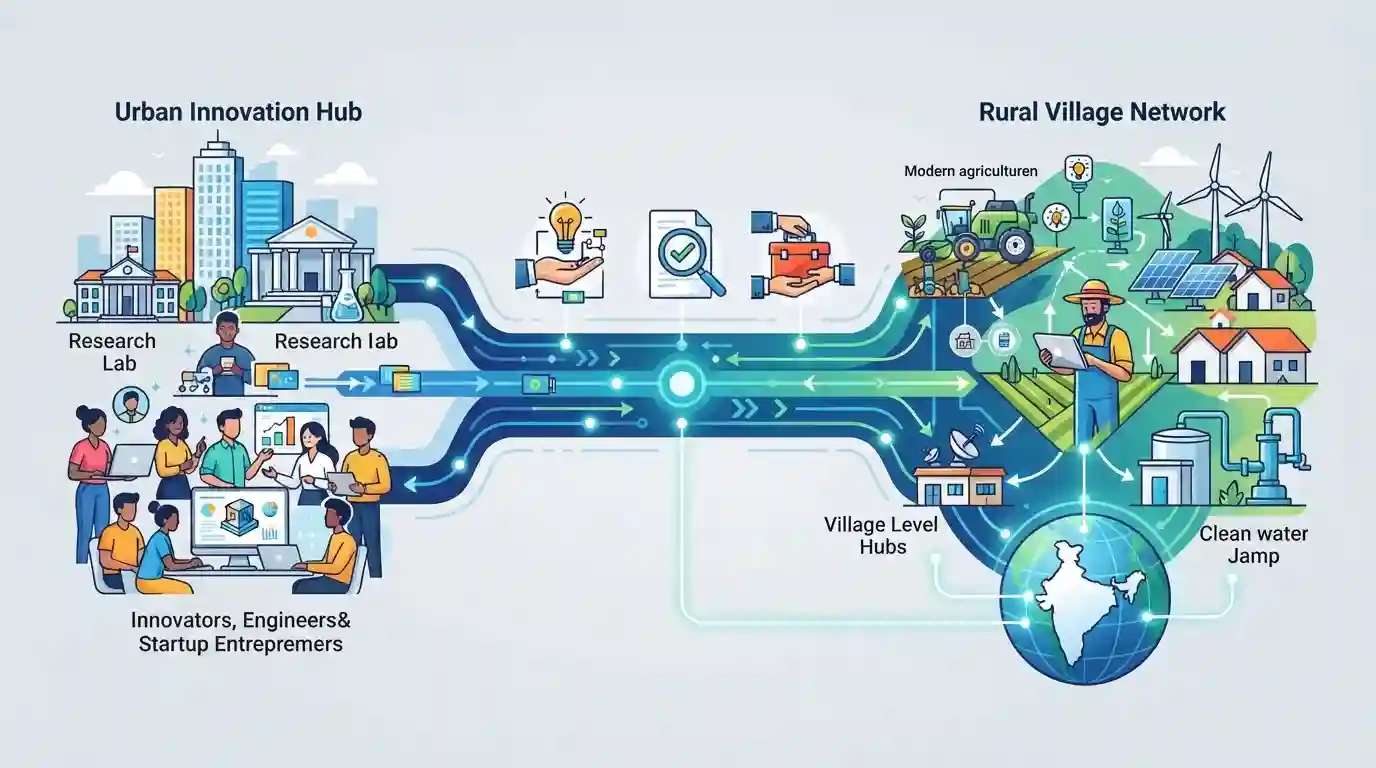
The Principal Scientific Adviser to the Government of India has launched the RSVC-AMRIT platform, an initiative developed by NABARD in collaboration with the Office of the Principal Scientific Adviser (OPSA). Designed to serve as the digital backbone for the RuTAGe Smart Village Centre (RSVC) ecosystem, the platform connects innovators, academic institutions, and startups directly with rural communities. Its goal is to streamline the discovery, validation, and transfer of appropriate technologies in critical areas such as agriculture, renewable energy, and sanitation. Backed by physical village-level hubs and corporate CSR partnerships led by NABFOUNDATION, the initiative aims to bridge the rural-urban technological divide, driving inclusive grassroots innovation and aiding the vision of Viksit Bharat 2047.
মূল বিষয়
- The Principal Scientific Adviser to the Government of India launched the RSVC-AMRIT platform on August 15, 2025, to strengthen technology-led rural development.
- Developed by NABARD, AMRIT serves as the digital backbone of the RuTAGe Smart Village Centre (RSVC) ecosystem, managing the lifecycle from technology discovery to deployment and knowledge management.
- The platform bridges the gap between India's scientific institutions or startups and rural communities by facilitating the transfer of technologies in agriculture, renewable energy, and citizen services.
- NABARD and NABFOUNDATION will establish physical RSVCs in collaboration with corporates via CSR initiatives, augmenting the digital AMRIT ecosystem.
গুরুত্বপূর্ণ শব্দ
RSVC-AMRIT platform

A digital platform developed by NABARD in collaboration with the OPSA, serving as the digital backbone of the RuTAGe Smart Village Centre ecosystem to streamline rural technology discovery, validation, and deployment.
UPSC context
GS Paper III: E-governance, agricultural innovations, and inclusive rural development.
RuTAGe Smart Village Centre (RSVC)
Village-level technology hubs conceptualized by the OPSA to translate scientific innovations into practical solutions at the Panchayat level, facilitating last-mile technology transfer in rural sectors.
UPSC context
GS Paper II & III: Governance and grassroots scientific dissemination in rural areas.
Office of the Principal Scientific Adviser (OPSA)
The apex advisory body established in 1999 to provide objective, pragmatic advice to the Prime Minister and Cabinet on scientific policies, cross-sectoral synergies, and technology missions.
UPSC context
GS Paper II & III: Science and technology policy, and administration.
NABARD
National Bank for Agriculture and Rural Development, India's apex development bank established in 1982 to promote sustainable agriculture and rural prosperity through credit and technology initiatives.
UPSC context
GS Paper III: Indian Economy, agricultural finance, and rural infrastructure development.
NABFOUNDATION
A non-profit subsidiary of NABARD established to design and execute impactful, innovative development projects in rural India by leveraging public, private, and corporate CSR partnerships.
UPSC context
GS Paper II & III: Social justice, rural livelihoods, and development.
Viksit Bharat 2047
The Government of India's vision to transform the nation into a completely developed country by 2047, focusing on economic growth, social progress, and technology-led self-reliance.
UPSC context
GS Paper III: Long-term economic development planning and national visions.
প্রিলিমস ফাঁদ
"The RSVC-AMRIT platform is an initiative under the Ministry of Rural Development."
RSVC-AMRIT is a collaborative initiative of the Office of the Principal Scientific Adviser (OPSA) and NABARD. It is not under the Ministry of Rural Development.
সংযুক্ত স্থির ধারণা
What is the mandate and structure of the Office of the Principal Scientific Adviser (PSA)?
- Establishment: Created in 1999 to provide pragmatic and objective advice to the Prime Minister and Cabinet on matters related to science, technology, and innovation.
- PM-STIAC Leadership: The PSA chairs the Prime Minister's Science, Technology, and Innovation Advisory Council (PM-STIAC), which drives critical national missions.
- Key Missions: Oversees flagship initiatives like the National Quantum Mission, National AI portal, and AGNIi (Accelerating Growth of New India's Innovations).
How does NABARD function beyond its role as an apex agricultural refinancing agency?
- Direct Interventions: Manages dedicated infrastructure and rural funds like the Rural Infrastructure Development Fund (RIDF) and the Micro Irrigation Fund.
- Capacity Building: Pioneered the SHG-Bank Linkage Programme and plays a vital role in capacity building for Farmer Producer Organisations (FPOs).
- Subsidiaries & CSR: Operates via specialized subsidiaries like NABFOUNDATION to execute ground-level development projects by leveraging private CSR funds.
আন্তঃবিষয় প্যাটার্ন
Tech-Transfer via CSR funding
Blending public science (OPSA) and rural finance (NABARD) with private CSR funds creates a new hybrid model for grassroots tech scaling, moving beyond traditional government grants.
DPI expanding to Rural Innovation
AMRIT acts as a digital backbone for intellectual property and technology deployment, expanding India's DPI role from direct benefit delivery to structural R&D transfer.

Expect a multi-statement question contrasting RSVC-AMRIT (PSA + NABARD) with AMRUT (MoHUA) or AGNIi to test institutional memory.
সংযুক্ত PYQ · 4
সংযুক্ত PYQ · 4
- 2023MainsGS3
How does e-Technology help farmers in production and marketing of agricultural produce? Explain it.
- 2021MainsGS2
Has digital illiteracy, particularly in rural areas, coupled with lack of Information and Communication Technology (ICT) accessibility hindered socio-economic development? Examine with justification.
- 2019MainsGS2
Implementation of Information and Communication Technology (ICT) based Projects/Programmes usually suffers in terms of certain vital factors. Identify these factors, and suggest measures for their effective implementation.
- 2025MainsGS2
e-governance projects have a built-in bias towards technology and back-end integration than user-centric designs. Examine.
