Handloom Haat and Promotion of Traditional Indian Weaving Sector
Source:PIB ↗
ఇది ఎందుకు ముఖ్యం
India's handloom sector is both a repository of its intangible cultural heritage and a major pillar of rural employment. Knowledge of specific regional weaves (e.g., Bomkai, Ikat) is critical for Prelims Art & Culture questions. Furthermore, government interventions to formalize and provide market access to handloom enterprises are highly relevant for Mains GS3 discussions on MSMEs, sustainable manufacturing, and rural livelihoods.
సారాంశం
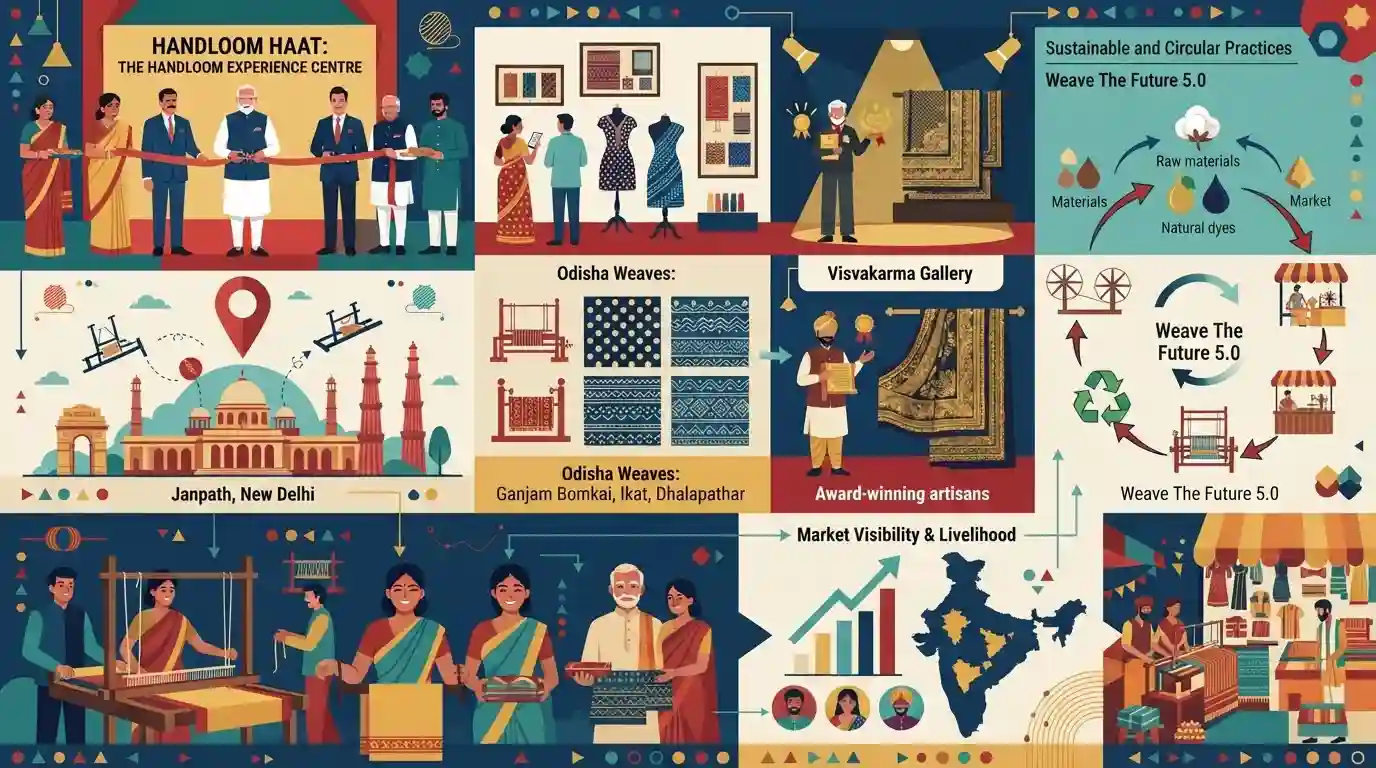
Union Minister of Textiles Shri Giriraj Singh inaugurated the 'Handloom Haat: The Handloom Experience Centre' at Janpath, New Delhi, a significant initiative to promote India's rich textile heritage and support the handloom enterprise sector. Organized with the National Handloom Development Corporation (NHDC), the center features multiple galleries, including an exhibition of traditional Odisha weaves (such as Ganjam Bomkai, Ikat, and Dhalapathar Tapestry) and the 'Visvakarma Gallery' displaying rare textiles from award-winning artisans. The initiative also focuses on sustainable and circular textile practices through platforms like 'Weave The Future 5.0', aiming to boost market visibility and livelihood opportunities for weavers across the country.
ముఖ్య అంశాలు
- The 'Handloom Haat: The Handloom Experience Centre' was inaugurated at Janpath, New Delhi, to showcase India's living textile heritage and promote handloom enterprises.
- The event highlighted traditional Odisha weaving techniques, including Ganjam Bomkai, Dhalapathar Tapestry, Ikat, Jaala, and Phoda weaving, under the 'Reimagining Odisha Weaves' exhibition.
- The National Handloom Development Corporation (NHDC) organized showcases featuring award-winning weavers, including Sant Kabir and Padma Shri awardees.
- The 'Weave The Future 5.0' initiative emphasized sustainable, circular, and craft-led textile practices using indigenous fibers and material innovation.
- The Haat aims to provide greater visibility, market linkage, and economic opportunities for rural weavers, strengthening the MSME textile sector.
ముఖ్యమైన పదాలు
Sant Kabir Award

A prestigious national award conferred by the Government of India to outstanding master weavers for their exceptional contributions to preserving and promoting traditional handloom heritage.
UPSC context
GS Paper I (Art & Culture) and Paper III (MSMEs). Tests knowledge of national recognitions supporting traditional craftsmanship.
National Handloom Development Corporation (NHDC)
A Public Sector Undertaking established in 1983 under the Ministry of Textiles to facilitate the handloom sector by ensuring yarn supply and enhancing market opportunities.
UPSC context
GS Paper III (Indian Economy & MSMEs). Tests knowledge of institutional bodies driving rural economy and artisan support.
Ministry of Textiles
The apex administrative central body of the Government of India responsible for policy formulation, planning, development, and export promotion of the textile and handloom sectors.
UPSC context
GS Paper III (Industrial Growth & Employment). Tests understanding of state apparatus managing key labor-intensive manufacturing sectors.
Handloom Haat
A specialized experience and retail destination in New Delhi designed to promote India’s living textile heritage, empower artisans, and provide direct market access.
UPSC context
GS Paper I (Art & Culture) and Paper III (MSMEs). Tests initiatives boosting the visibility and economy of indigenous weavers.
Weave The Future 5.0
The fifth edition of a sustainable exhibition series showcasing circular, regenerative textile practices, material innovations, and the environmental benefits of handloom production.
UPSC context
GS Paper III (Environment and Sustainable Development). Tests knowledge of eco-conscious and circular models in traditional industries.
Vriksh Designs
An Odisha-focused social design studio that collaborates with local artisans to preserve, innovate, and revitalize endangered regional textile heritages like Bomkai and Ikat.
UPSC context
GS Paper I (Art & Culture). Useful case study on collaborative conservation and contemporary revival of traditional crafts.
ప్రిలిమ్స్ ఉచ్చు
"National Handloom Day (August 7) commemorates the anniversary of the Quit India Movement."
August 7 commemorates the 1905 Swadeshi Movement (which championed indigenous goods and boycotted foreign cloth), not the 1942 Quit India Movement (August 8).
అనుసంధానమైన స్థిర భావనలు
What are the key characteristics of traditional Odisha handloom weaves?
- Bomkai Weaving: A traditional extra-weft technique woven on a pit loom, merging ikat with intricate, embroidery-like patterns, historically produced in Ganjam and Subarnapur.
- Dhalapathar Tapestry: Woven by the Rangani community without jacquard or dobby devices, known for heavy, durable fabrics with sharp contrasting colors and indigenous motifs.
- GI Protection: Both crafts are protected under the Geographical Indications of Goods Act, 1999, ensuring artisans retain exclusive rights to these traditional techniques.
How does the National Handloom Development Corporation (NHDC) support India's weavers?
- Corporate Status: Formed in 1983 as a Central Public Sector Undertaking (CPSU), fully owned by the Government of India under the Ministry of Textiles.
- Raw Material Supply: Acts as the nodal agency for the Raw Material Supply Scheme (RMSS), ensuring artisans get continuous access to quality yarn and dyes at reasonable prices.
- Direct Market Linkage: Organizes platforms like Handloom Haats and national expos to bypass middlemen, directly connecting rural artisans to urban consumer markets.
అంతర-అంశ నమూనాలు
Textiles + Circular Economy
Projects like 'Weave the Future' connect traditional MSME crafts with GS3 climate goals, focusing on upcycling and repair (marammat) to manage India's 7.8 million tonnes of annual textile waste.
Swadeshi to Atmanirbhar Bharat
Linking GS1 Modern History (the 1905 Swadeshi boycott) to modern GS3 self-reliance policies, underscoring the historical continuity behind declaring August 7 as National Handloom Day.

Expect a 'Pairs Matching' Prelims question mapping regional weaves (Ganjam Bomkai, Dhalapathar) to their respective states or GI status.
అనుసంధాన PYQలు · 3
అనుసంధాన PYQలు · 3
- 2015PrelimsGS1
Kalamkari painting refers to
- 2026PrelimsGS1
Which of the following is/are the most significant implication(s) of obtaining Oeko-Tex certification for Eri Silk in the global textile industry ? 1. It allows Indian exporters to compete in high-end markets that prioritise chemical-free products. 2. It confirms that Eri Silk meets international safety, environmental, and quality standards, enabling its entry into premium eco-conscious markets. Select the answer using the code given below :
- 2023MainsGS3
Faster economic growth requires increased share of the manufacturing sector in GDP, particularly of MSMEs. Comment on the present policies of the Government in this regard.
