Television Broadcasting Advertisement Duration Cap Removal
Source:PIB ↗
ఇది ఎందుకు ముఖ్యం
It illustrates the necessity of updating regulatory frameworks to keep pace with technological advancements (the transition from analog to digital) and highlights the ongoing governance challenge of creating a level playing field between traditional broadcasting and emerging digital media platforms.
సారాంశం
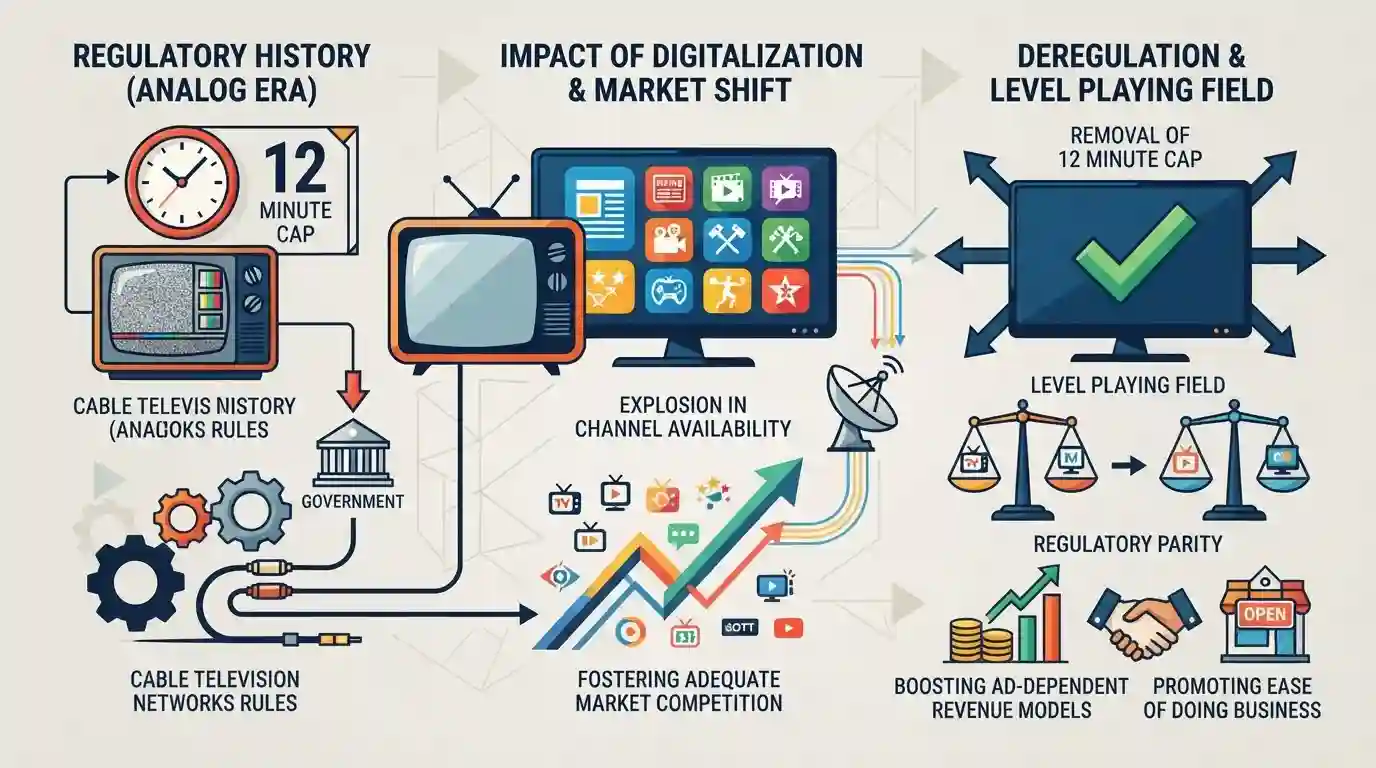
The Ministry of Information and Broadcasting has removed the 12-minute per hour advertisement duration cap for television channels. Originally introduced in 2006 under the Cable Television Networks Rules, 1994, the cap was meant to address the limited channel capacity and viewer choices of the analog era. However, the subsequent digitalization of TV networks has led to an explosion in channel availability, fostering adequate market competition. The removal of the cap addresses the regulatory disparity between traditional broadcasting and unregulated digital/OTT media, thereby ensuring a level playing field, boosting ad-dependent revenue models, and promoting ease of doing business in the sector.
ముఖ్య అంశాలు
- The 12-minute per hour cap on television advertisements, introduced in 2006, has been removed by the I&B Ministry.
- The repeal was prompted by the complete digitalization of TV distribution platforms (DTH, Cable TV, HITS, IPTV), which expanded capacity from 62 channels in 2006 to over 900 channels today.
- The policy change ensures a 'level playing field' between traditional television broadcasting and digital/OTT media, which operate without such advertising constraints.
- The deregulation aims to promote 'ease of doing business' in a broadcasting sector that is heavily dependent on advertising revenue.
- The decision takes legal effect upon its official notification as an amendment to the Cable Television Networks Rules, 1994.
ముఖ్యమైన పదాలు
Cable Television Networks Rules, 1994

A statutory framework governing India's cable TV networks. It regulates operations through strict programming and advertisement codes, including historical rules capping TV ad durations at 12 minutes per hour.
UPSC context
GS Paper 2 (Governance & Media Regulation). Tests understanding of broadcast policy evolution, deregulation, and statutory media oversight.
Ministry of Information and Broadcasting (I&B)
The nodal Union ministry responsible for formulating and administering policies, rules, and laws related to broadcasting, press, cinema, and digital media content in India.
UPSC context
GS Paper 2 (Governance). Tests knowledge of government ministries, regulatory mandates over traditional versus digital media, and content censorship authorities.
Over-The-Top (OTT) Media
Streaming services that deliver film and television content directly to viewers over the Internet, bypassing traditional cable or satellite platforms. They are subject to lighter co-regulatory frameworks in India.
UPSC context
GS Paper 2 & 3 (Governance/Technology). Tests issues of digital media regulation, IT Rules 2021 compliance, and market competition parity.
ప్రిలిమ్స్ ఉచ్చు
"OTT platforms and traditional TV are now both regulated by TRAI to ensure a level playing field."
OTT platforms are regulated under the IT Rules, 2021. The 'level playing field' was achieved by deregulating legacy TV, not by bringing OTTs under TRAI.
అనుసంధానమైన స్థిర భావనలు
What is TRAI's jurisdiction over the broadcasting and cable TV sector?
- Statutory Origin: Established under the TRAI Act, 1997, it was originally meant to regulate the telecommunications sector.
- Expanded Scope: In 2004, the government notified broadcasting and cable TV as 'telecommunication services', bringing them squarely under TRAI's regulatory ambit.
- Functions: TRAI regulates tariffs, interconnection, and quality of service (QoS) standards, while MIB handles licensing and administrative rules.
How does the regulatory framework differ for traditional TV versus OTT platforms?
- Legacy TV: Traditional broadcasters operate under the Cable Television Networks (Regulation) Act, 1995, which involves strict carriage and ad-cap rules.
- Digital Media: OTT and digital media are governed by the IT (Intermediary Guidelines and Digital Media Ethics Code) Rules, 2021.
- Deregulation: OTT platforms operate under a self-regulatory three-tier grievance redressal mechanism with no statutory caps on advertisement durations.
అంతర-అంశ నమూనాలు
EoDB through the Jan Vishwas Act
The ad-cap removal aligns with the Jan Vishwas Act, 2023, which replaced imprisonment with civil penalties under the Cable TV Act, highlighting a broader governance push for Ease of Doing Business.
Regulatory asymmetry: Legacy vs Tech
The broadcaster vs OTT debate mirrors the ongoing telecom vs OTT communication apps (e.g., WhatsApp) dispute, where legacy players demand regulatory parity with unregulated digital tech platforms.

A 2026 prelims question will likely test TRAI's statutory jurisdiction over traditional broadcasting vs MIB's IT Rules oversight of OTT.
అనుసంధాన PYQలు · 2
అనుసంధాన PYQలు · 2
- 2023MainsGS3
What is the status of digitalization in the Indian economy? Examine the problems faced in this regard and suggest improvements.
- 2016PrelimsGS1
India's ranking in the 'Ease of Doing Business Index' is sometimes seen in the news. Which of the following has declared that ranking?
