Mines and Minerals Amendment Bill and Fiscal Federalism Impact
Source:PIB ↗
हे का महत्त्वाचे आहे
The article touches upon a crucial interface of Cooperative Federalism, legislative policy, and resource economics. The balance between national economic cohesion (reducing a ₹10.12 lakh crore import bill) and state sovereignty over mineral taxation is a central debate in Indian polity (especially following recent landmark Supreme Court rulings on state mineral tax rights). This case study serves as excellent material for GS-2 (Federalism) and GS-3 (Infrastructure/Energy Security/Economic growth).
सारांश
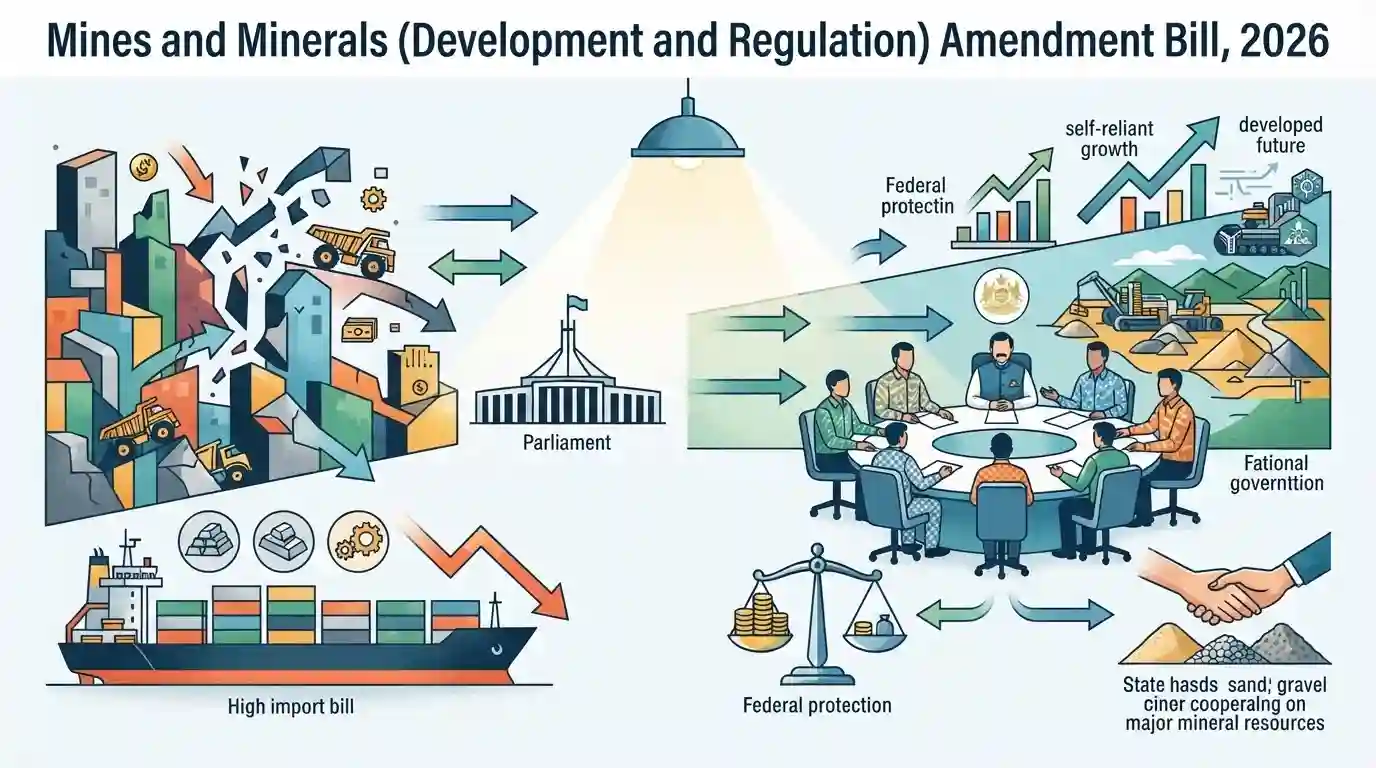
The Mines and Minerals (Development and Regulation) Amendment Bill, 2026, passed by Parliament on August 13, 2026, seeks to introduce long-term fiscal stability and predictability into India's major minerals sector to encourage mining investment and advance the goals of Atmanirbhar Bharat and Viksit Bharat 2047. The legislation addresses key systemic concerns where unconstrained and uneven state-level levies fragment the domestic market and drive up India's massive mineral import bill (which reached ₹10.12 lakh crore in FY 2025-26). Crucially, the bill protects the federal fiscal architecture; states continue to receive approximately 90% of mining revenues and retain full control over minor mineral regulation and taxation.
मुख्य मुद्दे
- The Mines and Minerals (Development and Regulation) Amendment Bill, 2026 was passed by Parliament on August 13, 2026, to bring stability, predictability, and fiscal certainty to India's major minerals sector.
- The bill preserves the federal structure; it does not take away states' rights over land and minerals, nor does it impact their authority to regulate and tax minor minerals.
- Around 90% of total mining revenues and statutory payments accrue directly to State Governments, a ratio that remains unchanged after the 2026 amendment.
- Between FY 2015-16 and FY 2025-26, major mining states accumulated over ₹5 lakh crore from mining operations (with ₹96,000+ crore from auction premiums alone between FY 2020-21 and FY 2025-26), compared to only ₹82,000 crore received by the Centre.
- Currently, states levy about 14 different taxes and fees (such as royalty, auction premium, dead rent, transit fee, and District Mineral Foundation contributions) on major minerals.
- Unchecked regional disparities in state taxation inflate domestic costs and make local minerals uncompetitive, incentivizing imports (which stood at ₹10.12 lakh crore in FY 2025-26) and stressing the national exchequer.
महत्त्वाच्या संज्ञा
Mines and Minerals (Development and Regulation) Amendment Bill, 2026

A 2026 legislation designed to create a uniform fiscal framework for India's mineral sector by restricting unconstrained state-level levies on mineral rights and lands, thereby promoting predictable investment.
UPSC context
GS-2 & GS-3: Tests federalism, Centre-State fiscal relations, and reforms in India's mining sector.
Mines and Minerals (Development and Regulation) Act, 1957 (MMDR Act)
The principal statutory framework governing the development, regulation, and extraction of minerals in India. It establishes federal and state jurisdictions over mining allocations, leases, and royalties.
UPSC context
GS-2 & GS-3: Foundational legislation for resource management, often tested regarding mineral policies and regulatory frameworks.
District Mineral Foundation (DMF)
A statutory non-profit trust established under the MMDR Act in mining-affected districts. Funded by miners, it implements welfare and development projects to protect and benefit local communities and environments.
UPSC context
GS-2 & Prelims: Highly important for tribal welfare, mining impacts, inclusive growth, and local governance.
Atmanirbhar Bharat
A flagship government initiative aimed at making India self-reliant across economic sectors by reducing import dependency, strengthening domestic supply chains, and boosting domestic manufacturing.
UPSC context
GS-3: Central to industrial policies, trade strategies, and indigenous resource management.
Viksit Bharat 2047
The Government of India's overarching vision and roadmap to transform the country into a fully developed nation by the 100th anniversary of its independence in 2047.
UPSC context
GS-2 & Essay: Vital for analyzing long-term national developmental goals and strategic public policy planning.
पूर्वपरीक्षा सापळा
State Governments have the exclusive power to classify and notify a mineral as a 'minor mineral' under their jurisdiction.
Under Section 3(e) of the MMDR Act, only the Central Government has the statutory power to notify and declare a mineral as a 'minor mineral'. States only possess regulatory and rule-making authority once it is declared.
संबंधित स्थिर संकल्पना
How does the Constitution distribute power over mineral development and taxation?
- Union List Entry 54: Under Entry 54, Parliament regulates mines and mineral development to the extent declared by law to be in the public interest.
- State List Entry 23: Grants states power to regulate mines, but explicitly makes this authority 'subject to' the provisions of the Union List (Entry 54).
- State List Entry 50: Empowers states to tax mineral rights, but explicitly subjects this taxing power to any limitations imposed by Parliament by law.
What is the regulatory divide between major and minor minerals in India?
- Notification Authority: The Central Government has sole authority to notify a mineral as 'minor' (e.g., sand, gravel, building stones) under Section 3(e).
- State Rule-making: State Governments have complete power to frame rules for concessions, royalties, and preventing illegal mining of minor minerals.
- Revenue and Governance: Major minerals are primarily governed by Central rules, though states collect approximately 90% of the generated revenues and auction premiums.
आंतर-विषय नमुने
Judicial federalism vs legislative overrides
The 2026 amendment directly curtails the fiscal space cleared for states by the Supreme Court's landmark 2024 ruling, highlighting the ongoing institutional tussle over resource federalism.
Mineral taxation and common market dynamics
By capping uncoordinated state levies, the Centre aims to integrate the domestic mineral market, mirroring the fiscal-neutrality logic of the Goods and Services Tax (GST).

The constitutional friction between State List Entry 50 and Union List Entry 54 over mineral taxation will dominate GS-2/GS-3 in 2026.
संबंधित PYQ · 4
संबंधित PYQ · 4
- 2016PrelimsGS1
What is/are the purpose/purposes of 'District Mineral Foundations' in India? 1. Promoting mineral exploration activities in mineral-rich districts 2. Protecting the interests of the persons affected by mining operations 3. Authorizing State Governments to issue licences for mineral exploration Select the correct answer using the code given below.
- 2019PrelimsGS1
With reference to the management of minor minerals in India, consider the following statements: 1. Sand is a 'minor mineral' according to the prevailing law in the country. 2. State Governments have the power to grant mining leases of minor minerals, but the powers regarding the formation of rules related to the grant of minor minerals lie with the Central Government. 3. State Governments have the power to frame rules to prevent illegal mining of minor minerals. Which of the statements given above is/are correct?
- 2025MainsGS2
Examine the evolving pattern of Centre-State financial relations in the context of planned development in India. How far have the recent reforms impacted the fiscal federalism in India?
- 2021MainsGS1
Despite India being one of the countries of the Gondwanaland, its mining industry contributes much less to its Gross Domestic Product (GDP) in percentage. Discuss.
