National Council for Senior Citizens Review of Welfare Schemes
Source:PIB ↗
ఇది ఎందుకు ముఖ్యం
With India's demographic transition leading to a rapidly rising elderly population, geriatric care, institutional support, and digital integration are crucial for ensuring 'Ageing with Dignity'. This article provides highly specific current affairs facts (such as the JEEVAN App, SHATAYU platform, and AVYAY) that can serve as excellent case studies or examples in GS2 Mains answers on social development, vulnerable sections, and healthcare.
సారాంశం
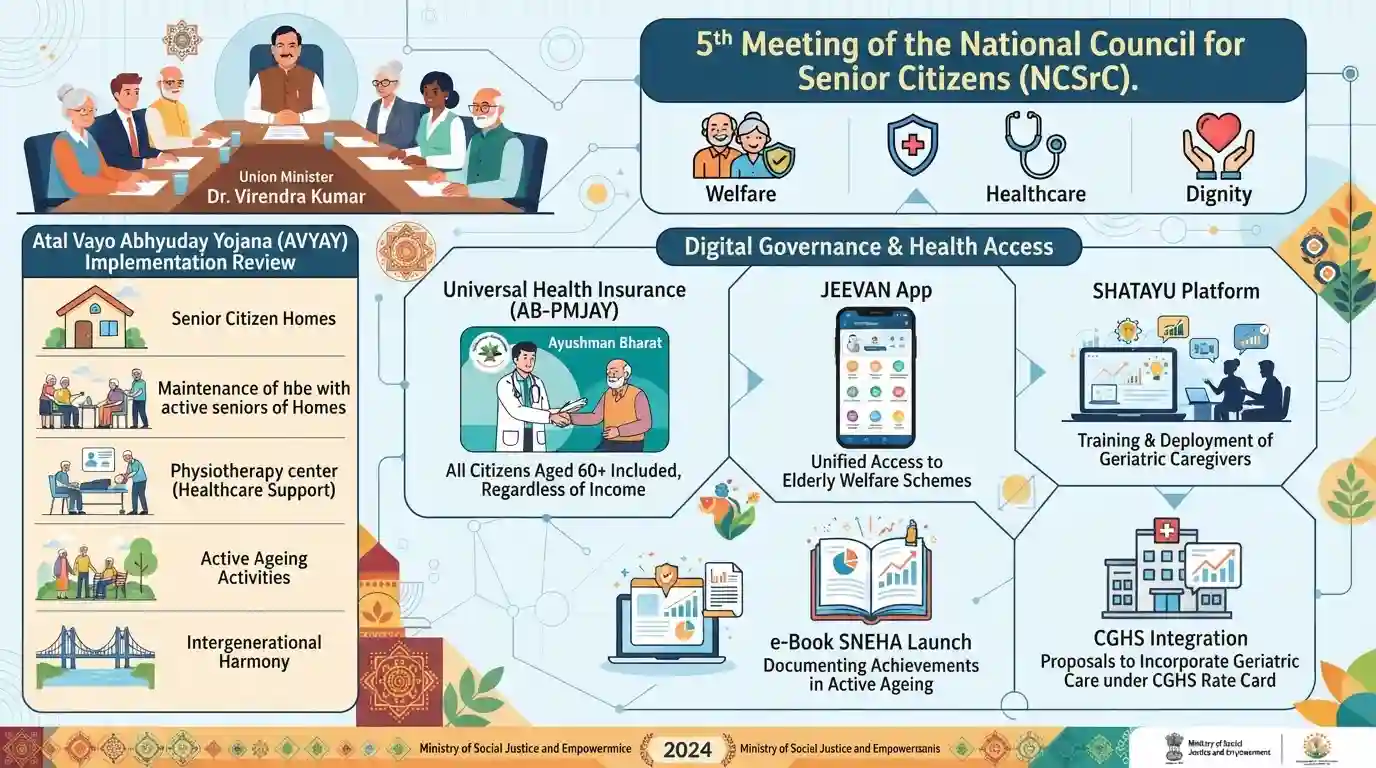
The 5th Meeting of the National Council for Senior Citizens (NCSrC), chaired by Union Minister Dr. Virendra Kumar, focused on the welfare, healthcare, and dignity of the elderly in India. The council reviewed the implementation of the Atal Vayo Abhyuday Yojana (AVYAY) and the extension of Ayushman Bharat (AB-PMJAY) health insurance to all citizens aged 60 and above, regardless of income. Key digital governance tools were unveiled, including the JEEVAN App for unified access to elderly welfare schemes and the SHATAYU platform for training and deploying geriatric caregivers. Additionally, an e-book titled SNEHA was launched to document achievements in active ageing, and proposals were discussed to incorporate geriatric care under the CGHS rate card.
ముఖ్య అంశాలు
- Union Minister Dr. Virendra Kumar chaired the 5th Meeting of the National Council for Senior Citizens (NCSrC) to review policy issues concerning the welfare, healthcare, and active participation of India's elderly.
- The Council reviewed the landmark initiative extending health insurance coverage under Ayushman Bharat - PMJAY to all senior citizens aged 60 years and above, irrespective of their financial or economic background.
- Two new digital governance initiatives were launched: the JEEVAN App (unified, seamless access to welfare schemes for senior citizens) and the SHATAYU platform (a digital system to source services from trained geriatric caregivers, enabling 'ageing at place').
- The e-book 'SNEHA' was launched, documenting the 21-month journey (from October 2024 to June 2026) of the Ministry\'s active ageing and dignity-centric initiatives.
- The Council discussed a proposal to include Geriatric Caregiver services in the Central Government Health Scheme (CGHS) rate card.
- The Council also carried out a comprehensive assessment of the implementation, outreach, and impact of the Atal Vayo Abhyuday Yojana (AVYAY) in alignment with Viksit Bharat @2047.
ముఖ్యమైన పదాలు
National Council for Senior Citizens (NCSrC)

The apex advisory body in India, chaired by the Minister for Social Justice and Empowerment, advising the government on formulating policies, legislation, and programmes for senior citizens' welfare and active ageing.
UPSC context
GS Paper II (Social Justice/Vulnerable Sections); tests institutional frameworks, advisory bodies, and policy formulation for India's ageing population.
Atal Vayo Abhyuday Yojana (AVYAY)
An umbrella central sector scheme of the Ministry of Social Justice and Empowerment aimed at improving senior citizens' life quality through shelter, healthcare, nutrition, and assistive devices for underprivileged elders.
UPSC context
GS Paper II (Social Justice/Welfare Schemes); tests knowledge of social security, target-group-focused interventions, and welfare delivery mechanisms for the elderly.
Ayushman Bharat - Pradhan Mantri Jan Arogya Yojana (AB-PMJAY)
India's flagship health insurance scheme providing ₹5 lakh cashless secondary and tertiary hospitalization cover per family annually, recently extended to cover all senior citizens aged 70 and above, regardless of income.
UPSC context
GS Paper II (Health/Social Sector); tests understanding of universal healthcare coverage, social insurance models, and major public health interventions.
JEEVAN App (Joint Elderly Empowerment & Virtual Assistance Network)
A dedicated, elder-centric mobile application developed by the Department of Social Justice and Empowerment, serving as a single-window gateway for elderly welfare schemes, pensions, healthcare information, and emergency SOS support.
UPSC context
GS Paper II (E-Governance/Social Welfare); tests knowledge of digital governance tools deployed to enhance healthcare and safety access for senior citizens.
SHATAYU Digital Platform (Senior Holistic Care Assistance and Training for Your Utility)
A centralized national digital dashboard managed by the National Institute of Social Defence (NISD) to register, certify, map, and deploy trained geriatric caregivers, formalizing India's elderly care segment of the care economy.
UPSC context
GS Paper II (Social Sector/Healthcare); tests understanding of initiatives targeting the care economy, skill development, and professionalized geriatric care infrastructure.
SNEHA E-Book (Stories of Nurturing, Engagement, Happiness & Active Ageing)
An official digital publication launched by the Ministry of Social Justice and Empowerment to document, showcase, and evaluate active ageing initiatives and achievements of the Senior Citizen Division.
UPSC context
GS Paper II (Welfare/Social Sector); tests awareness of government reporting tools, indicators of active ageing, and monitoring of social development goals.
ప్రిలిమ్స్ ఉచ్చు
Health insurance benefits under AB-PMJAY for citizens aged 60 and above remain restricted by income thresholds or SECC categorization.
The recent expansion of AB-PMJAY to seniors aged 60+ is entirely universal and income-independent, breaking from the traditional SECC-based targeted model.
అనుసంధానమైన స్థిర భావనలు
What are the key institutional and legal frameworks for senior citizens in India?
- Constitutional Mandate: Article 41 (DPSP) directs the State to secure public assistance in old age within its economic capacity.
- Maintenance Act 2007: Legally obligates children/heirs to provide maintenance to senior citizens, monitored via dedicated tribunals.
- NCSrC Chairmanship: Apex advisory body chaired by the Minister of Social Justice and Empowerment, not the Prime Minister.
What is the structure of the Atal Vayo Abhyuday Yojana (AVYAY)?
- Scheme Nature: It is a Central Sector Umbrella Scheme designed for the welfare of senior citizens across India.
- Sub-Scheme Integration: Includes the Integrated Programme for Senior Citizens (IPSrC) and the Rashtriya Vayoshri Yojana (RVY).
- Rashtriya Vayoshri Yojana: Provides physical aids and assisted-living devices to senior citizens suffering from age-related disabilities.
అంతర-అంశ నమూనాలు
Demographics + Care Economy Formalization
The SHATAYU platform connects India's rising 'silver economy' with employment, transforming geriatric care into a structured, formal service sector to address the demographic transition.
Universal Welfare vs Targeted Schemes
Extending AB-PMJAY to all senior citizens marks a structural policy shift, transitioning Indian welfare architecture from targeted SECC databases to universal, age-based entitlements.

AB-PMJAY 60+ universalization and AVYAY's sub-schemes like Rashtriya Vayoshri Yojana are prime targets for welfare-policy MCQ statements in 2026.
అనుసంధాన PYQలు · 3
అనుసంధాన PYQలు · 3
- 2020MainsGS2
In order to enhance the prospects of social development, sound and adequate health care policies are needed particularly in the fields of geriatric and maternal health care. Discuss.
- 2022PrelimsGS1
With reference to Ayushman Bharat Digital Mission, consider the following statements: 1. Private and public hospitals must adopt it. 2. As it aims to achieve universal health coverage, every citizen of India should be part of it ultimately. 3. It has seamless portability across the country. Which of the statements given above is/are correct?
- 2024PrelimsGS1
With reference to the Pradhan Mantri Shram Yogi Maan-dhan (PM-SYM) Yojana, consider the following statements : 1. The entry age group for enrolment in the scheme is 21 to 40 years. 2. Age specific contribution shall be made by the beneficiary. 3. Each subscriber under the scheme shall receive a minimum pension of ₹ 3,000 per month after attaining the age of 60 years. 4. Family pension is applicable to the spouse and unmarried daughters. Which of the statements given above is/are correct?
