Manufacturing sector growth and structural reforms in India
Source:PIB ↗
આ શા માટે મહત્વનું છે
This article serves as an essential repository of up-to-date, highly specific economic data and policy schemes for GS Paper 3. It details the tangible achievements of PLI schemes, semiconductor missions, defence indigenisation, and domestic maritime container manufacturing, providing key statistics and qualitative arguments for answers regarding industrial growth, self-reliance, and manufacturing GDP share.
સારાંશ
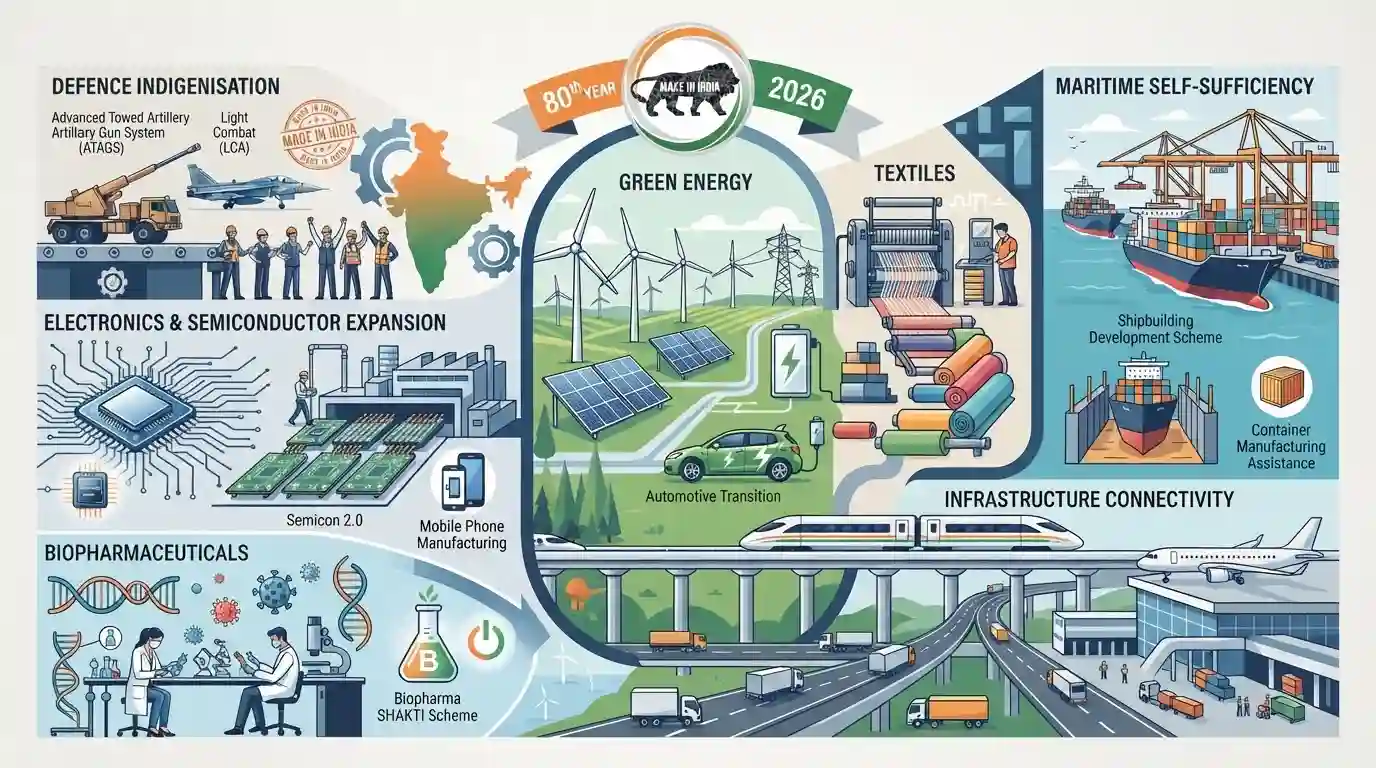
This comprehensive PIB Backgrounder details the rapid progress and structural reforms in India's manufacturing sector under 'Make in India' as of its 80th Independence Day in 2026. It highlights crucial policy developments, budget outlays, and output growth across strategic sectors, including defence indigenisation, electronics and semiconductor expansion (launch of Semicon 2.0 and Mobile Phone Manufacturing Scheme), biopharmaceuticals (launch of Biopharma SHAKTI Scheme), textiles, green energy, automotive transition, and maritime self-sufficiency (Shipbuilding Development Scheme and Container Manufacturing Assistance Scheme).
મુખ્ય મુદ્દા
- Manufacturing Macroeconomic Metrics: The manufacturing sector contributes 16–17% of India's GDP, employing over 27 million workers. The sector achieved a compound annual growth rate (CAGR) in GVA of 10.88% (2022–23 to 2025–26) and a 7.8% output growth in June 2026.
- Defence Indigenisation & Exports: Indigenous defence production hit a record ₹1.78 lakh crore in FY 2025–26. Defence exports surged over 5,500% over the last 12 years to reach ₹38,424 crore. Security self-reliance is supported by 10 Positive Indigenisation Lists (covering 5,521 items) and the Srijan Defence Equipment Empowerment Platform (DEEP) digital repository.
- Electronics and Semiconductor Ecosystem: Electronics production grew 15.8% YoY to ₹13.11 lakh crore in FY 2025–26, with India becoming the world's second-largest mobile manufacturer. To sustain this, the government approved Semicon 2.0 in July 2026 (outlay of ₹1,27,500 crore) and a new ₹62,500 crore Mobile Phone Manufacturing Scheme (FY 2026–27 to FY 2030–31).
- Pharmaceutical & Health Infrastructure: India ranks 3rd globally in pharma volume. The newly announced Biopharma SHAKTI Scheme (Budget 2026–27) has a ₹10,000 crore outlay over 5 years. Active Pharmaceutical Ingredients (APIs) and bulk drug self-sufficiency are boosted by three Bulk Drug Parks approved in Andhra Pradesh, Gujarat, and Himachal Pradesh.
- Maritime, Shipbuilding & Containers: A massive ₹69,725 crore package was introduced to enhance domestic shipbuilding. It comprises the Shipbuilding Development Scheme (SbDS), Maritime Development Fund (MDF), and SBFAS. Crucially, the Container Manufacturing Assistance Scheme (CMAS) with an outlay of ₹10,000 crore targets 7.5 lakh TEUs, culminating in the July 2026 rollout of India’s first domestic EXIM shipping container.
- Automotive & Solar Energy Transition: PM E-DRIVE (outlay of ₹10,900 crore) accelerates electric mobility, while the ₹24,000 crore high-efficiency Solar PV PLI scheme has increased Approved List of Models and Manufacturers (ALMM) module capacity to 100 GW as of August 2025 (up from 2.3 GW in 2014).
મહત્વપૂર્ણ શબ્દો
Production Linked Incentive (PLI) Scheme

A central government initiative providing financial incentives (typically 4%-6%) to manufacturers on incremental sales of goods produced in India, aimed at boosting domestic production across 14 key strategic sectors.
UPSC context
GS Paper III: Indian Economy. Tests strategies for manufacturing-led growth, employment generation, and import substitution.
Semicon India Programme (Semicon 1.0 & 2.0)
A flagship initiative to develop India's semiconductor ecosystem; Phase 2.0, approved in 2026 with a ₹1.275 lakh crore budget, focuses on domestic chip design, raw materials, heavy equipment, and packaging.
UPSC context
GS Paper III: Science and Technology. Tests awareness of strategic technology self-reliance, electronic manufacturing, and supply chains.
Biopharma SHAKTI Scheme
A ₹10,000 crore initiative launched in the FY 2026–27 budget to transition India's pharmaceutical sector from generic volume to high-value biologics and biosimilars, utilizing AI-driven drug discovery and non-animal testing models.
UPSC context
GS Paper III: Science and Technology. Tests bio-manufacturing transition, clinical trials ecosystem, and pharmaceutical regulatory reforms.
Maritime Development Fund (MDF)
A ₹25,000 crore strategic fund set up in Union Budget 2025–26 to offer long-term, low-cost financing for India's domestic shipbuilding, ship repair, and maritime infrastructure projects.
UPSC context
GS Paper III: Infrastructure. Tests financial mechanisms for port development, maritime logistics, and boosting coastal economies.
Shipbuilding Development Scheme (SbDS)
A ₹19,989 crore scheme targeted at expanding India's annual shipbuilding capacity to 4.5 million Gross Tonnage by providing capital support for greenfield clusters and existing brownfield yard upgrades.
UPSC context
GS Paper III: Industrial Policy & Infrastructure. Tests measures to build heavy engineering capability and maritime self-sufficiency.
Container Manufacturing Assistance Scheme (CMAS)
A ₹10,000 crore program launched in the FY 2026–27 budget to scale domestic cargo container manufacturing to 7.5 lakh TEUs annually, strengthening global logistics and reducing import dependence.
UPSC context
GS Paper III: Infrastructure & Logistics. Tests supply chain resilience, EXIM trade dynamics, and reducing logistics vulnerabilities.
PM E-DRIVE Scheme
A central sector scheme (extended to 2028 with an ₹11,900 crore outlay) replacing FAME-II to boost EV adoption, subsidize public/commercial e-vehicles, and establish nationwide charging infrastructure.
UPSC context
GS Paper III: Infrastructure & Environment. Tests policy pathways to green mobility, carbon footprint reduction, and EV manufacturing.
પ્રિલિમ્સ ટ્રેપ
"Positive Indigenisation Lists mandate compulsory export targets for defence PSUs."
PIL enforces progressive import bans on specific military hardware after fixed dates to ensure domestic procurement. It does not mandate or relate to export targets.
સંલગ્ન સ્થિર ખ્યાલો
What is the difference between APIs and Finished Formulations?
- Active Pharmaceutical Ingredients (APIs): The biologically active component or raw material of a drug that produces the intended therapeutic health effects.
- Finished Formulations: The final consumable product (tablet, capsule, syrup) containing APIs combined with inactive excipients (binders, fillers).
- Import Dependency: India is a world leader in generic formulation volume but relies heavily on China for bulk APIs (hence the Bulk Drug Parks scheme).
How does the Production Linked Incentive (PLI) scheme structurally work?
- Incentive Base: Offers financial cash incentives calculated as a percentage (usually 4-6%) of incremental sales of goods manufactured in India over a base year.
- Core Objective: Focuses on capital-intensive sectors to achieve economies of scale, substitute critical imports, and integrate India into global supply chains.
- Strict Conditionality: Requires stringent minimum thresholds of cumulative incremental investment and production output before any funds are disbursed.
આંતર-વિષય પેટર્ન
CMAS & National Logistics Policy
The new Container Manufacturing Assistance Scheme (CMAS) directly aligns with the National Logistics Policy's macroeconomic goal to reduce logistics costs from 13-14% of GDP to global benchmarks of around 8%.
Defence indigenisation & MSME integration
The Srijan portal and Positive Indigenisation Lists force DPSUs to localize supply chains, structurally channeling India's massive defense capital procurement budget directly into domestic MSME growth.

Expect a multi-statement question linking Container Manufacturing (CMAS) to logistics costs and Bulk Drug Parks to API import reduction.
સંલગ્ન PYQ · 4
સંલગ્ન PYQ · 4
- 2025MainsGS3
Discuss the rationale of the Production Linked Incentive (PLI) scheme. What are its achievements? In what way can the functioning and outcomes of the scheme be improved?
- 2025MainsGS3
India aims to become a semiconductor manufacturing hub. What are the challenges faced by the semiconductor industry in India? Mention the salient features of the India Semiconductor Mission.
- 2023MainsGS3
Faster economic growth requires increased share of the manufacturing sector in GDP, particularly of MSMEs. Comment on the present policies of the Government in this regard.
- 2026PrelimsGS1
Which of the following items of defence hardware is/are manufactured in India ? 1. Su-30 MKI Fighter Jets 2. T-90 MK-III Tanks 3. Akula Class Submarine Select the answer using the code given below :
