Revamped India Code Portal Enhances Legal Access via AI
Source:PIB ↗
কেন এটি গুরুত্বপূর্ণ
The India Code Portal is a prime example of user-centric e-governance applications in the legal domain. It demonstrates how AI and digital repositories can enhance transparency and democratize access to justice by bridging language barriers. Relevant for GS2 Mains questions on e-governance service models and GS1 Prelims on constitutional schedules.
সারসংক্ষেপ
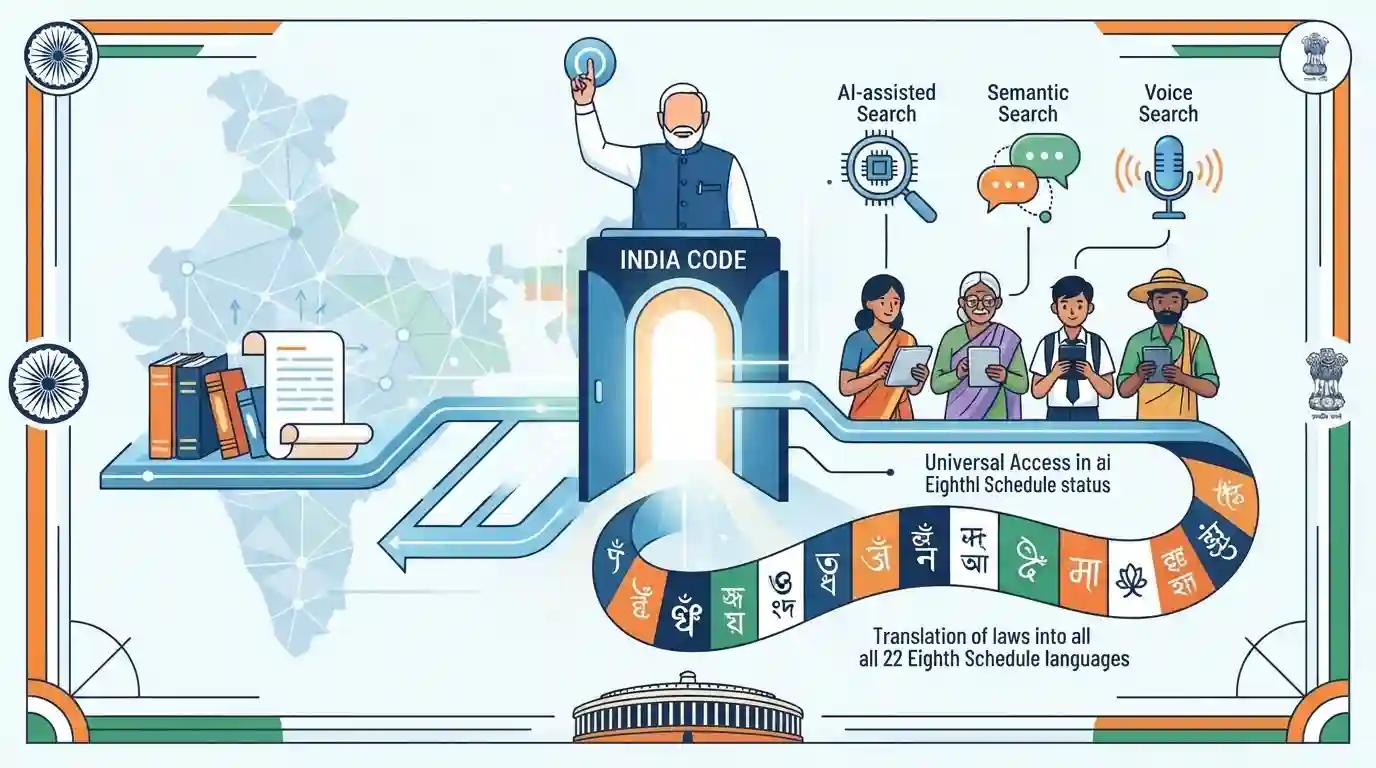
Union Minister of State for Law and Justice (I/C) Shri Arjun Ram Meghwal launched the revamped India Code Portal at the Legislative Department. Developed in collaboration with the National Informatics Centre (NIC), the portal acts as a citizen-centric, interconnected digital gateway to legal statutes across India. It leverages AI-assisted search, semantic search, and voice features to democratize access to legal information. A major highlight is its multilingual approach, ensuring central laws are translated into all 22 languages recognized under the Eighth Schedule of the Constitution, furthering the goals of Digital India and promoting access to justice.
মূল বিষয়
- The revamped India Code Portal serves as a unified digital repository for Central Acts, State Acts, Subordinate Legislations, and Union Territory laws.
- It features advanced capabilities including AI-assisted search, semantic search, and voice search to improve navigation and accessibility.
- The initiative aims to translate all central legislations into the 22 official languages listed in the Eighth Schedule, enhancing citizen-centric access to laws.
- By integrating with the e-Gazette and offering historical legislative tracking, the portal improves transparency, regulatory compliance, and overall e-governance in the judicial domain.
গুরুত্বপূর্ণ শব্দ
India Code Portal

A comprehensive digital repository of Central and State legislations, recently revamped with AI-assisted search, voice recognition, and multilingual access. It functions as a citizen-centric gateway to easily discover and navigate legal statutes.
UPSC context
GS-2 (E-Governance): Highlights the application of digital technology to enhance transparency, legal awareness, and access to justice.
Eighth Schedule of the Constitution
A constitutional provision (Articles 344 and 351) that lists 22 officially recognized Indian languages. It promotes linguistic diversity and is used as the baseline for translating central laws to ensure inclusive access.
UPSC context
GS-2 (Indian Polity): Tests constitutional provisions protecting linguistic diversity, official languages, and equitable governance through multilingual initiatives.
Legislative Department
A department under the Ministry of Law and Justice responsible for drafting principal legislation, ordinances, and regulations for the Central Government. It oversees election laws and maintains legislative records like the India Code.
UPSC context
GS-2 (Governance): Essential for understanding the executive's role in law-making, the functioning of ministries, and legislative administration.
National Informatics Centre (NIC)
Established in 1976 under MeitY, the NIC is the Indian government's premier technology arm. It builds and maintains nationwide ICT infrastructure, network services, and digital platforms to drive e-governance and Digital India initiatives.
UPSC context
GS-2 (E-Governance) & GS-3 (Technology): Crucial for topics on digital administration, cyber infrastructure, and the implementation of state-led technology projects.
প্রিলিমস ফাঁদ
Translations of Central Acts on the India Code portal hold the status of authoritative constitutional texts.
Under Article 348, the authoritative text of all Bills/Acts passed by Parliament remains in English. Regional language translations are for informational access, not primary legal interpretation.
সংযুক্ত স্থির ধারণা
What is the constitutional mandate for language in legislation and higher judiciary?
- Article 348(1): Mandates that all proceedings in the Supreme Court and High Courts, along with authoritative texts of Central Bills and Acts, must be in English.
- Article 348(3): Allows States to use official state languages for Bills/Acts, but an English translation must be published which serves as the legally authoritative text.
How is the Ministry of Law and Justice functionally divided?
- Legislative Department: Drafts central legislations and ordinances, publishes laws, and maintains the India Code Portal.
- Department of Legal Affairs: Advises central government ministries on legal matters and manages Government of India litigation.
- Department of Justice: Oversees appointments of Supreme Court and High Court judges and implements the e-Courts Mission Mode Project.
আন্তঃবিষয় প্যাটার্ন
AI in Judicial Governance
AI semantic search in India Code parallels the Supreme Court's SUVAS tool for translating judgments, linking AI technology (Sci & Tech) directly with access to justice (Polity).
Eighth Schedule and Digital India
Translating statutes into 22 scheduled languages aligns with India's broader push for digital linguistic inclusion, mirroring initiatives like the Bhashini mission under Digital India.

Expect a Prelims question pairing Article 348 (authoritative text in English) with recent legal e-governance portals like India Code.
সংযুক্ত PYQ · 5
সংযুক্ত PYQ · 5
- 2024MainsGS2
e-governance is not just about the routine application of digital technology in service delivery process. It is as much about multifarious interactions for ensuring transparency and accountability. In this context evaluate the role of the 'Interactive Service Model' of e-governance.
- 2025MainsGS2
e-governance projects have a built-in bias towards technology and back-end integration than user-centric designs. Examine.
- 2023MainsGS2
e-governance, as a critical tool of governance, has ushered in effectiveness, transparency and accountability in governments. What inadequacies hamper the enhancement of these features ?
- 2024PrelimsGS1
The Constitution (71st Amendment) Act, 1992 amends the Eighth Schedule to the Constitution to include which of the following languages? 1. Konkani 2. Manipuri 3. Nepali 4. Maithili Select the correct answer using the code given below:
- 2008PrelimsGS1
Under which one of the following Constitution Amendment Acts, four languages were added to the languages under the Eighth Schedule of the Constitution of India, thereby raising their number to 22?
