India Progresses on Nationally Determined Contributions Targets
Source:PIB ↗
কেন এটি গুরুত্বপূর্ণ
Understanding India's concrete achievements in its climate goals is essential for evaluating its role in international environmental diplomacy and its national transition towards renewable energy. The specific quantitative targets and achievements frequently feature in both Prelims and Mains (GS-3).
সারসংক্ষেপ
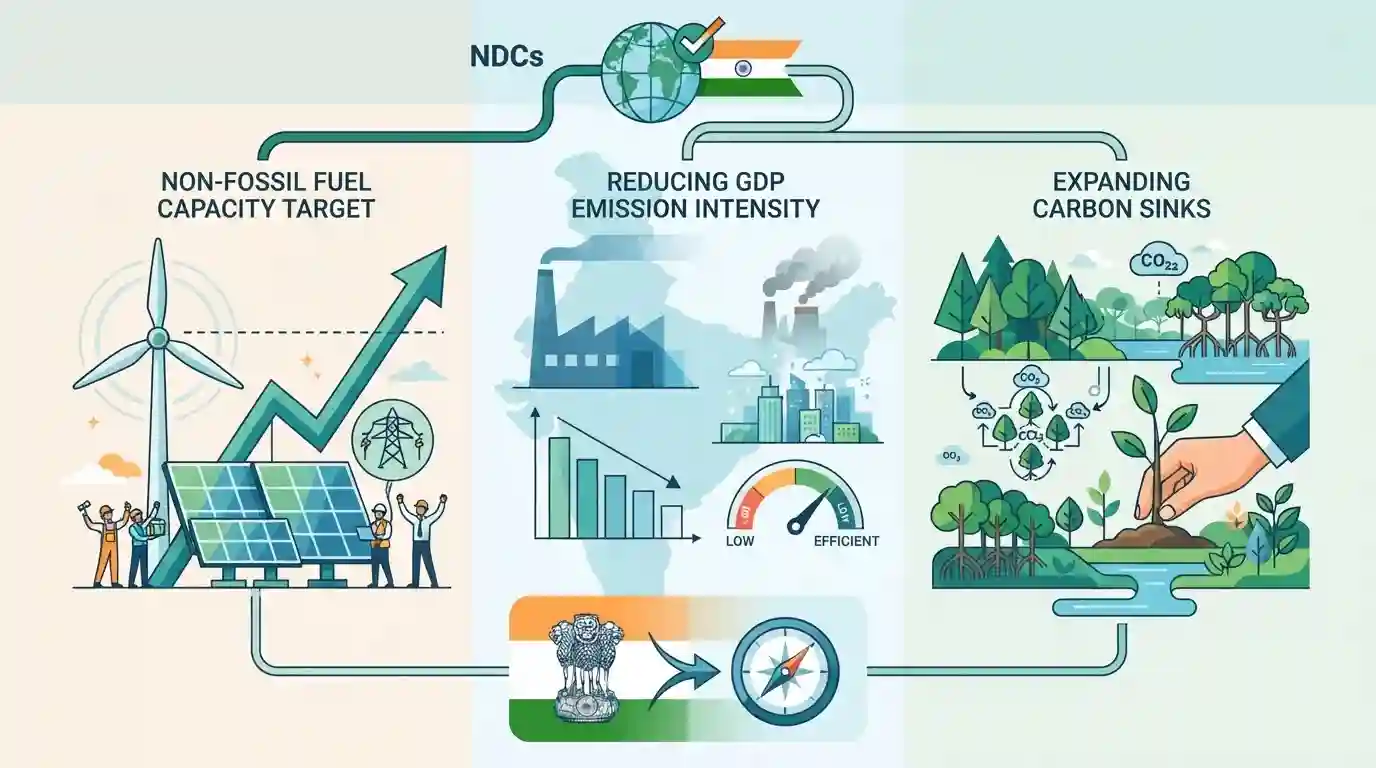
This update details India's significant progress in meeting and exceeding its Nationally Determined Contributions (NDCs) under the Paris Agreement. By achieving its non-fossil fuel capacity target years ahead of schedule and showing measurable progress in reducing GDP emission intensity and expanding carbon sinks, India demonstrates strong commitment to climate change mitigation. These metrics are vital for GS-3 Environment and Ecology preparations, particularly for questions concerning India's global climate commitments and energy transition.
মূল বিষয়
- India's NDCs under the UNFCCC aim to reduce emission intensity of its GDP by 45% by 2030 from 2005 levels; as of 2022, a 37.38% reduction has been achieved.
- India surpassed its target of achieving 50% non-fossil fuel installed electric capacity ahead of the 2030 deadline, reaching 54.18% by June 2026.
- India targets creating an additional carbon sink of 2.5 to 3.0 billion tonnes of CO2 equivalent by 2030; it has already created 2.44 billion tonnes between 2005 and 2022.
- Looking ahead, India has outlined 2035 targets including a 47% reduction in emissions intensity from 2005 levels and reaching a 60% cumulative non-fossil electricity capacity.
গুরুত্বপূর্ণ শব্দ
Paris Agreement

A legally binding international treaty adopted in 2015 under the UNFCCC. It aims to limit global temperature rise to well below 2°C, preferably 1.5°C, above pre-industrial levels through voluntary national emission reduction targets.
UPSC context
GS-3 Environment. Key to questions on global climate architecture, environmental diplomacy, and India's multilateral climate obligations.
Nationally Determined Contributions (NDCs)
Voluntary, country-specific climate action plans submitted every five years under the Paris Agreement. They detail a nation's targets for reducing greenhouse gas emissions and adapting to climate impacts, with progressively ambitious goals over time.
UPSC context
GS-3 Environment. Essential for assessing India’s specific climate targets, emission intensity reduction, and progress toward net-zero by 2070.
Biennial Transparency Report (BTR)
A mandatory compliance report submitted every two years under the Paris Agreement's Enhanced Transparency Framework. It provides updated data on a country's greenhouse gas inventories, NDC progress, climate adaptation efforts, and financial support.
UPSC context
GS-3 Environment. Evaluates understanding of international climate accountability, global stocktakes, and reporting mechanisms for developing nations.
UNFCCC
A foundational 1992 international environmental treaty designed to combat dangerous human interference with the climate system. It provides the core framework for global climate negotiations, including the adoption of the Kyoto Protocol and Paris Agreement.
UPSC context
GS-3 Environment. Foundational for topics involving global climate change governance, COP summits, and international environmental treaties.
Rajya Sabha
The permanent upper house of India's bicameral Parliament, officially known as the Council of States. It represents states and union territories, functioning to ensure federal balance, review legislation, and provide continuity in national policy-making.
UPSC context
GS-2 Polity. Tests knowledge of India's federal structure, parliamentary systems, legislative processes, and centre-state relations.
প্রিলিমস ফাঁদ
India’s updated NDC includes mandatory, sector-specific emission reduction targets for heavy manufacturing and thermal power industries to achieve the 2030 goals.
India’s NDC is strictly economy-wide and does not prescribe sector-specific emission reduction targets or roadmaps for individual sectors like manufacturing or heavy industries.
সংযুক্ত স্থির ধারণা
What is the Enhanced Transparency Framework (ETF) under the Paris Agreement?
- Core mandate: Established under Article 13 of the Paris Agreement to build international trust and track national climate progress systematically.
- Reporting tool: Requires parties to submit Biennial Transparency Reports (BTRs) detailing climate mitigation, adaptation actions, and support needed or received.
- BUR transition: BTRs officially replace the earlier Biennial Update Reports (BURs), representing a more rigorous, standardized tracking system for all countries.
What are the core pillars of India’s National Action Plan on Climate Change (NAPCC)?
- Original eight: Launched in 2008 covering Solar, Energy Efficiency, Sustainable Habitat, Water, Himalayan Ecosystem, Green India, Sustainable Agriculture, and Strategic Knowledge.
- Ninth addition: Expanded to nine missions with the addition of the National Mission on Climate Change and Human Health (NMCCH) to address climate-induced health risks.
আন্তঃবিষয় প্যাটার্ন
Clean energy targets + WTO trade friction
India’s overachievement of non-fossil targets shifts focus to WTO compliance of domestic content requirements (DCR) in solar manufacturing initiatives like the PLI scheme.
Carbon sinks + Tribal forest rights
Expanding additional carbon sinks to 4 billion tonnes by 2035 requires balancing large-scale afforestation targets with tribal land-tenure security under the Forest Rights Act, 2006.

With India submitting its first BTR in 2026 and expanding NAPCC to 9 missions, expect questions on the exact metrics of the revised 2035 NDCs.
সংযুক্ত PYQ · 4
সংযুক্ত PYQ · 4
- 2025MainsGS3
Write a review on India's climate commitments under the Paris Agreement (2015) and mention how these have been further strengthened in COP26 (2021). In this direction, how has the first Nationally Determined Contribution intended by India been updated in 2022?
- 2021MainsGS3
Describe the major outcomes of the 26th session of the Conference of the Parties (COP) to the United Nations Framework Convention on Climate Change (UNFCCC). What are the commitments made by India in this conference?
- 2016PrelimsGS1
The term 'Intended Nationally Determined Contributions' is sometimes seen in the news in the context of
- 2025PrelimsGS1
Consider the following statements : Statement I: Article 6 of the Paris Agreement on climate change is frequently discussed in global discussions on sustainable development and climate change. Statement II: Article 6 of the Paris Agreement on climate change sets out the principles of carbon markets. Statement III : Article 6 of the Paris Agreement on climate change intends to promote inter-country non-market strategies to reach their climate targets. Which one of the following is correct in respect of the above statements?
