Senior Citizen Welfare and Social Security Initiatives
Source:PIB ↗
हे का महत्त्वाचे आहे
With India's elderly demographic projected to grow from 8.4% to 14.9% by 2036, understanding the intersection of welfare schemes, geriatric healthcare, and financial security is crucial for civil services aspirants answering questions on vulnerable sections and demographic transitions.
सारांश
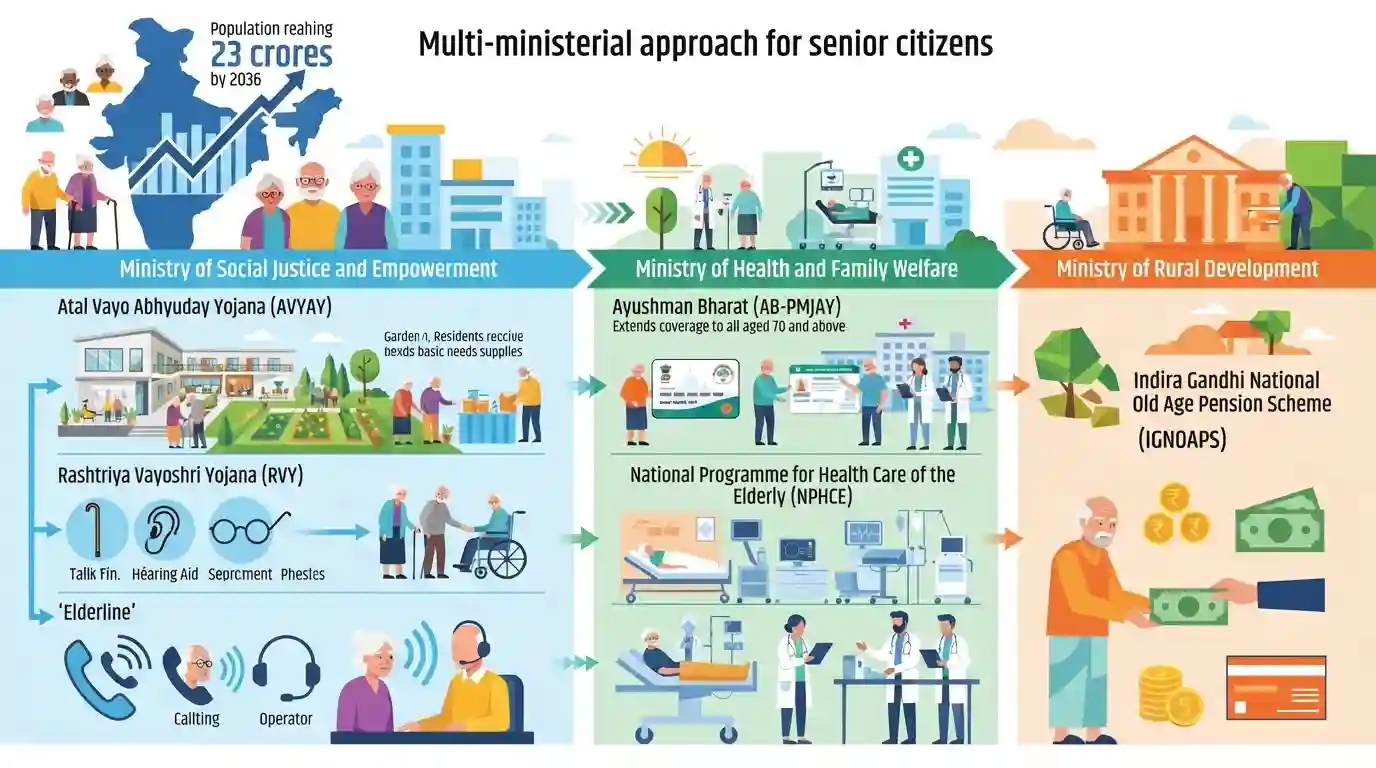
The Government of India has outlined a multi-ministerial approach to strengthen welfare, healthcare, and social security for the country's rapidly growing senior citizen population, which is projected to reach 23 crores by 2036. The Ministry of Social Justice and Empowerment is leading efforts with the Atal Vayo Abhyuday Yojana (AVYAY) for shelter and basic needs, alongside the Rashtriya Vayoshri Yojana (RVY) for living aids and the 'Elderline' toll-free helpline (14567). The Ministry of Health and Family Welfare has significantly boosted healthcare access by extending Ayushman Bharat (AB-PMJAY) to all citizens aged 70 and above and operating the National Programme for Health Care of the Elderly (NPHCE) for specialized geriatric care. Additionally, the Ministry of Rural Development continues to provide financial security through the Indira Gandhi National Old Age Pension Scheme (IGNOAPS).
मुख्य मुद्दे
- India's elderly population is projected to more than double from 10 crore (8.4%) in 2011 to 23 crore (14.9%) by 2036, necessitating comprehensive welfare frameworks.
- The Atal Vayo Abhyuday Yojana (AVYAY) is an umbrella scheme covering shelter, food, and healthcare for senior citizens through sub-schemes like IPSrC and SAPSrC.
- Ayushman Bharat (AB-PMJAY) has been expanded to cover all senior citizens aged 70 and above, irrespective of their income status, providing ₹5 lakh health insurance cover.
- The Rashtriya Vayoshri Yojana (RVY) assists elderly citizens suffering from age-related infirmities by providing them with free assisted living devices.
- Under the National Social Assistance Programme (NSAP), BPL elders receive a monthly pension, which is often supplemented by individual state governments.
महत्त्वाच्या संज्ञा
Atal Vayo Abhyuday Yojana (AVYAY)

A flagship umbrella scheme of the Ministry of Social Justice and Empowerment focused on improving the quality of life, financial security, and social inclusion of India's rapidly growing senior citizen population.
UPSC context
GS Paper II: Welfare schemes for vulnerable sections of the population and mechanisms for their protection.
Rashtriya Vayoshri Yojana (RVY)
A Central Sector Scheme under the Ministry of Social Justice and Empowerment that distributes physical aids and assisted-living devices free of cost to senior citizens belonging to the Below Poverty Line (BPL) category.
UPSC context
GS Paper II: Welfare schemes and physical rehabilitation interventions for vulnerable and elderly populations.
Ayushman Bharat-Pradhan Mantri Jan Arogya Yojana (AB-PMJAY)
A flagship national health insurance scheme expanded to offer free cashless healthcare coverage of up to ₹5 lakh per year to all Indian senior citizens aged 70 and above, regardless of their economic status.
UPSC context
GS Paper II: Social sector services relating to Health and governmental interventions in geriatric healthcare.
Seniorcare Ageing Growth Engine (SAGE)
An initiative launched by the Ministry of Social Justice and Empowerment to identify and support innovative startups developing products, solutions, and services to promote the 'Silver Economy' for eldercare in India.
UPSC context
GS Paper II & III: Inclusive development, entrepreneurial growth in social sectors, and elder welfare.
National Programme for Health Care of the Elderly (NPHCE)
A comprehensive health programme of the Ministry of Health and Family Welfare dedicated to providing specialized, accessible, and high-quality preventive, curative, and rehabilitative geriatric care services across primary, secondary, and tertiary health levels.
UPSC context
GS Paper II: Issues relating to development and management of Social Sector/Services relating to Health.
National Social Assistance Programme (NSAP)
A Centrally Sponsored Scheme of the Ministry of Rural Development that provides social security pensions and financial assistance to vulnerable groups, including the elderly, widows, and persons with disabilities living below the poverty line.
UPSC context
GS Paper II: Welfare schemes for vulnerable sections; social security and poverty alleviation measures.
Indira Gandhi National Old Age Pension Scheme (IGNOAPS)
A key sub-scheme under NSAP that provides non-contributory monthly pensions to senior citizens aged 60 and above who belong to households living below the poverty line.
UPSC context
GS Paper II: Financial security measures and social welfare schemes for vulnerable, low-income elderly populations.
पूर्वपरीक्षा सापळा
"Ayushman Bharat coverage for citizens aged 70 and above is restricted to families identified in the SECC database or BPL list."
The recent AB-PMJAY expansion explicitly covers ALL senior citizens aged 70 and above, completely independent of income status, BPL tags, or SECC parameters.
संबंधित स्थिर संकल्पना
Which Constitutional provisions mandate state support for the elderly?
- Article 41 (DPSP): Directs the State to make effective provision for securing the right to work, education, and public assistance in cases of old age, sickness, and disablement.
- Concurrent List (Entry 23): Social security, social insurance, and invalid/old-age pensions fall under the Concurrent List, empowering both Center and States to enact welfare legislation.
What defines the demographic transition to an "ageing population"?
- UN Threshold: A society is generally considered "ageing" when the proportion of its population aged 65 and older crosses the 7% threshold.
- Ageing Index: Calculated as the number of elderly people (aged 60 and over) per 100 children (aged 0-14). India's index is rapidly rising.
- Drivers of Ageing: Ageing is primarily driven by two concurrent demographic trends: declining Total Fertility Rates (TFR) and rising life expectancy at birth.
आंतर-विषय नमुने
Ageing Population & The Care Economy
The shift to 23 crore elderly by 2036 links to the growing demand for formal 'care economy' infrastructure, increasingly highlighted by the ILO as a major engine for female workforce participation.
Pension Outlays and Fiscal Federalism
Funding welfare schemes like IGNOAPS relies heavily on state supplements, connecting demographic ageing directly to state debt burdens and Finance Commission devolution logic.

Expect a multi-statement Prelims question in 2026 combining AB-PMJAY's universal 70+ expansion with demographic transition or Article 41.
संबंधित PYQ · 4
संबंधित PYQ · 4
- 2013MainsGS1
Critically examine the effect of globalization on the aged population in India.
- 2019MainsGS2
Performance of welfare schemes that are implemented for vulnerable sections is not so effective due to absence of their awareness and active involvement at all stages of policy process. Discuss.
- 2023MainsGS2
“Development and welfare schemes for the vulnerable, by its nature, are discriminatory in approach.” Do you agree? Give reasons for your answer.
- 2024MainsGS1
What is the concept of a 'demographic winter'? Is the world moving towards such a situation? Elaborate.
