REPM Scheme Receives Bids for Rare Earth Magnet Manufacturing
Source:PIB ↗
આ શા માટે મહત્વનું છે
Securing the supply chain for Rare Earth Elements and their downstream components (like permanent magnets) is critical for India's clean energy transition, e-mobility, and defense indigenization. It directly links to GS3 themes of industrial policy, import substitution, and critical technologies.
સારાંશ
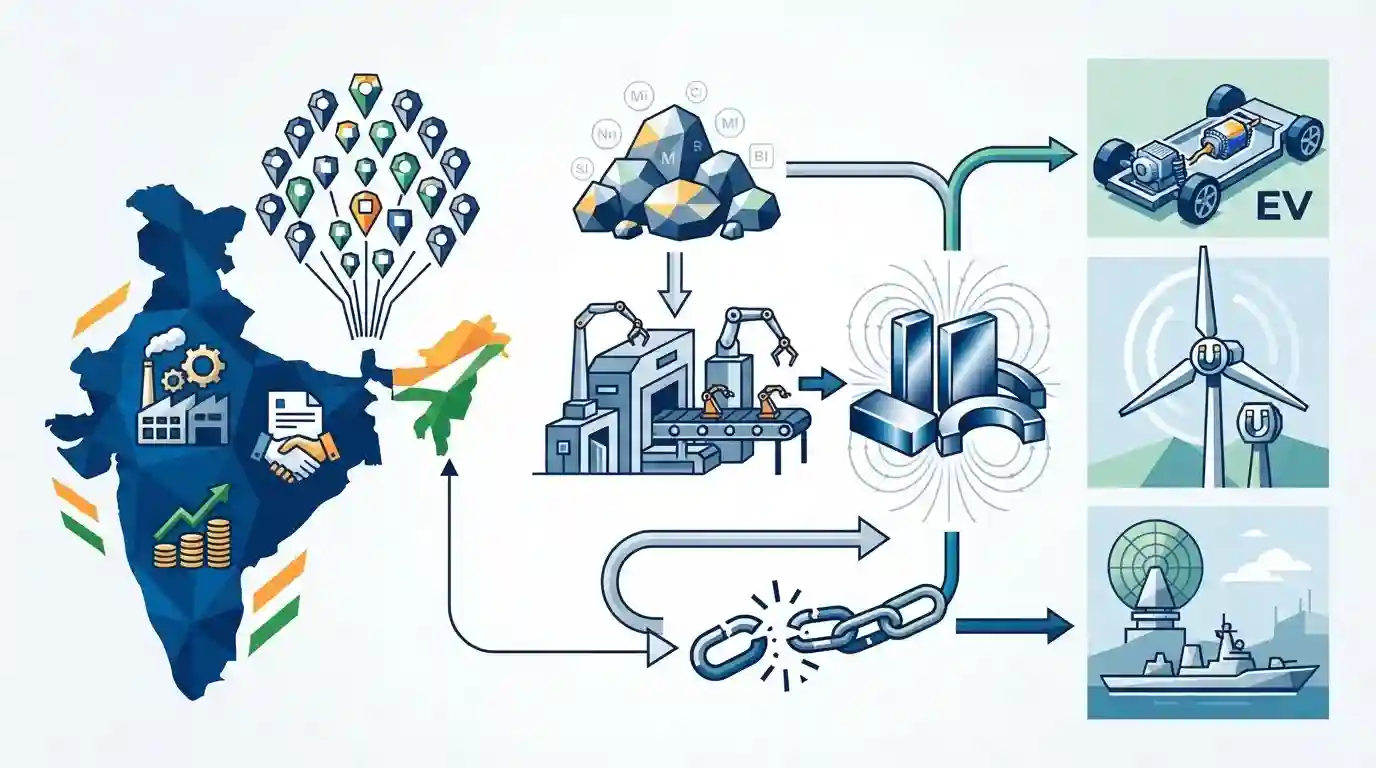
The Ministry of Heavy Industries (MHI) has received a strong response to its Scheme to Promote Manufacturing of Sintered Rare Earth Permanent Magnets (REPM), securing 20 bids from industry players. This initiative is a strategic effort to build domestic manufacturing capacity for rare earth magnets, which are critical components for electric vehicles, renewable energy infrastructure, and defense hardware. By incentivizing local production, the government aims to secure supply chains, reduce dependence on global monopolies (such as China), and advance the broader objectives of Aatmanirbhar Bharat and the clean energy transition.
મુખ્ય મુદ્દા
- The Ministry of Heavy Industries (MHI) has received 20 bids under the Scheme to Promote Manufacturing of Sintered Rare Earth Permanent Magnets (REPM).
- The scheme is designed to establish a robust domestic supply chain and boost indigenous manufacturing of these critical components.
- Rare Earth Permanent Magnets are essential for high-tech applications, including electric vehicles (EVs), wind turbines, robotics, and defense equipment.
- Promoting domestic manufacturing reduces import dependence and supports India's strategic push towards self-reliance in critical minerals and advanced technologies.
મહત્વપૂર્ણ શબ્દો
Scheme to Promote Manufacturing of Sintered Rare Earth Permanent Magnets (REPM)

A ₹7,280-crore initiative by the Ministry of Heavy Industries offering capital and sales-linked incentives to build a 6,000 MTPA domestic manufacturing capacity for rare earth permanent magnets over seven years.
UPSC context
GS-3 (Industrial Policy). Tests knowledge of Aatmanirbhar Bharat, clean energy transition, and strategies to reduce critical mineral import dependence.
Sintered Rare Earth Permanent Magnets (REPMs)
High-performance magnets known for exceptional magnetic strength-to-weight ratios. They operate without continuous electricity, enabling compact and highly efficient designs in advanced technologies.
UPSC context
GS-3 (Science & Technology/Energy). Crucial component for electric vehicle traction motors, wind turbines, aerospace, and defense applications.
Ministry of Heavy Industries (MHI)
The central government ministry responsible for promoting the engineering, automotive, and capital goods sectors. It actively drives India's advanced manufacturing initiatives, including electric mobility and critical components.
UPSC context
GS-2 (Government Policies). Important for understanding the institutional framework behind major industrial schemes like FAME and REPM manufacturing.
Neodymium-Iron-Boron (NdFeB) Magnets
The strongest and most commercially demanded type of rare-earth permanent magnet, made from an alloy of neodymium, iron, and boron. Their global supply chain is currently dominated by China.
UPSC context
GS-1/GS-3 (Critical Minerals/Supply Chain Security). Tests awareness of resource geopolitics and components vital to India's Net Zero 2070 goal.
પ્રિલિમ્સ ટ્રેપ
Private sector companies are permitted to freely mine, extract, and export Monazite from coastal sands to produce rare earth elements.
Monazite is classified as an atomic mineral because it contains thorium. Under the MMDR Act and beach sand mining rules, private sector mining of monazite-bearing sands is strictly restricted, reserving its processing for state PSUs like IREL.
સંલગ્ન સ્થિર ખ્યાલો
What is Monazite and why is it regulated in India?
- Thorium Source: It is a phosphate mineral containing thorium, a key fertile material crucial for the third stage of India's nuclear power programme.
- Coastal Placer Deposits: Naturally occurs in the beach placer sands along the coasts of Kerala, Tamil Nadu, Andhra Pradesh, Odisha, and West Bengal.
- Regulatory Monopoly: Classified as an 'Atomic Mineral' under the MMDR Act; its mining and processing are restricted to government-owned PSUs like IREL.
What are Rare Earth Elements (REEs) and their classification?
- Composition: A group of 17 chemically similar metallic elements, comprising the 15 lanthanides plus scandium and yttrium.
- LREE vs HREE: Divided into Light REEs (e.g., Neodymium, Lanthanum) and Heavy REEs (e.g., Dysprosium, Terbium), with HREEs being significantly scarcer and more expensive.
- Industrial Application: Sintered NdFeB (Neodymium-Iron-Boron) magnets are the strongest known permanent magnets, vital for electric vehicle motors and wind turbines.
આંતર-વિષય પેટર્ન
Monazite, Thorium, and Nuclear Autarky
Processing coastal beach sands for rare earths directly intersects with Department of Atomic Energy controls, as extracting monazite yields thorium crucial for India's three-stage nuclear power program.
EV supply chains and geopolitics
EV transition relies on NdFeB magnets. Localizing REPM manufacturing aligns with India's participation in the Mineral Security Partnership (MSP) to bypass China's near-monopoly on rare-earth processing.

Expect a 2026 question combining monazite coastal distribution, private mining restrictions, and the strategic utility of NdFeB in EVs.
સંલગ્ન PYQ · 4
સંલગ્ન PYQ · 4
- 2025MainsGS3
Discuss the rationale of the Production Linked Incentive (PLI) scheme. What are its achievements? In what way can the functioning and outcomes of the scheme be improved?
- 2026PrelimsGS1
Which of the following statements about Rare Earth Elements (REEs) and Critical Minerals is/are correct ? 1. Modern technological innovations including Artificial Intelligence, robotics and space exploration extensively utilise Rare Earth Elements (REEs). 2. China has the highest share in mining of REEs followed by India. 3. The Government of India launched the National Critical Mineral Mission (NCMM) in 2025 to establish a robust framework for self-reliance in the critical mineral sector. 4. Rare Earth Elements are a set of 13 metallic elements. Select the answer using the code given below :
- 2012PrelimsGS1
Recently, there has been a concern over the short supply of a group of elements called 'rare earth metals'. Why? 1. China, which is the largest producer of these elements, has imposed some restrictions on their export. 2. Other than China, Australia, Canada and Chile, these elements are not found in any country. 3. Rare earth metals are essential for the manufacture of various kinds of electronic items and there is a growing demand for these elements. Which of the statements given above is/are correct?
- 2025PrelimsGS1
Consider the following statements : Statement I: Some rare earth elements are used in the manufacture of flat television screens and computer monitors. Statement II : Some rare earth elements have phosphorescent properties. Which one of the following is correct in respect of the above statements?
