Science and Technology Clusters Annual Report and R and D Ecosystem
Source:PIB ↗
কেন এটি গুরুত্বপূর্ণ
India's gross expenditure on R&D has historically hovered around 0.65% of GDP, with research often trapped in silos. The S&T Clusters initiative addresses this structural flaw by acting as regional aggregators, making it a critical institutional reform for UPSC aspirants to understand regarding GS3 Science & Technology and innovation policies.
সারসংক্ষেপ
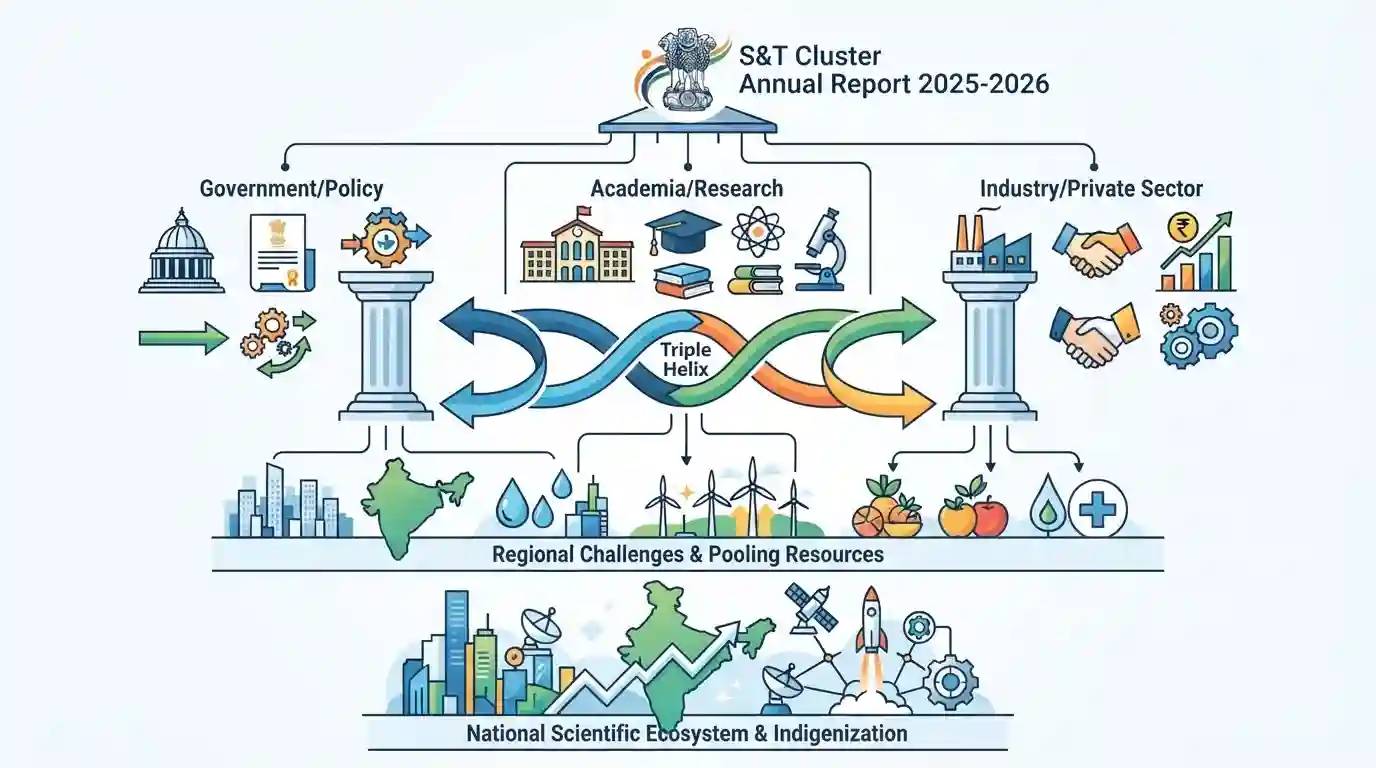
The Office of the Principal Scientific Adviser (PSA) to the Government of India recently launched the "S&T Cluster Annual Report 2025-2026." Initiated on the recommendation of the Prime Minister's Science, Technology and Innovation Advisory Council (PM-STIAC), Science and Technology Clusters operate as formal umbrella structures for R&D institutions, academia, and industry in various cities. They are designed to solve regional challenges by pooling resources and breaking down silos across institutions. The clusters embody the collaborative 'Triple Helix' model of innovation, promoting synergy between government, academia, and private industry to bolster the national scientific ecosystem.
মূল বিষয়
- The Office of the Principal Scientific Adviser launched the Annual Report 2025-2026 documenting the progress of India's S&T Clusters.
- S&T Clusters were established based on the recommendations of the Prime Minister's Science, Technology and Innovation Advisory Council (PM-STIAC) to decentralize research.
- The clusters function as regional hubs uniting academia, R&D labs, startups, and local governments to devise scientific solutions to localized challenges in sustainability, health, and mobility.
- The initiative champions the Triple Helix model of innovation, accelerating the lab-to-market journey and aligning with the broader goals of the Anusandhan National Research Foundation (ANRF).
গুরুত্বপূর্ণ শব্দ
Science and Technology (S&T) Clusters Initiative

A flagship program by the Principal Scientific Adviser’s Office launching regional consortiums that unite academia, R&D labs, industry, and local governments to address regional socio-economic challenges through technology-led innovations.
UPSC context
GS Paper 3 (Science & Technology). Tests awareness of localized R&D ecosystems, public-private partnerships, and regional technology deployment.
Anusandhan National Research Foundation (ANRF)
India's apex statutory body for funding and directing scientific research and entrepreneurship. Established by the ANRF Act 2023, it absorbed the Science and Engineering Research Board (SERB) to strengthen national R&D.
UPSC context
GS Paper 3 (S&T Policy). Crucial for questions on structural reforms in India's research funding and innovation infrastructure.
Office of the Principal Scientific Adviser (PSA)
Established in 1999, this Cabinet Secretariat-level office provides the Prime Minister and cabinet with objective advice on science, technology, and innovation policy, while coordinating major inter-ministerial S&T missions.
UPSC context
GS Paper 3 (Institutions). Important for understanding the governance framework driving India's strategic science and technology initiatives.
Prime Minister's Science, Technology and Innovation Advisory Council (PM-STIAC)
An overarching advisory council, headed by the PSA, that evaluates S&T challenges, formulates specific interventions, oversees national technology missions, and advises the Prime Minister on future research roadmaps.
UPSC context
GS Paper 3 (Science & Technology). Vital for tracking India’s overarching strategic R&D priorities, such as AI, Quantum, and EVs.
Triple Helix Model of Innovation
A conceptual framework describing how academia, industry, and government collaborate to drive innovation and economic growth. It emphasizes hybrid partnerships to bridge the gap between theoretical research and commercialized solutions.
UPSC context
GS Paper 3 (Innovation & Technology). Relevant for essays and questions analyzing R&D commercialization and knowledge-based economies.
প্রিলিমস ফাঁদ
The Office of the Principal Scientific Adviser (PSA) operates as an attached office under the Ministry of Science and Technology.
The Office of the PSA was placed under the administrative control of the Cabinet Secretariat in August 2018, not any ministry.
সংযুক্ত স্থির ধারণা
What is the PM-STIAC and how does it govern India's science strategy?
- Origin: Established in August 2018, replacing both the SAC-C and SAC-PM to streamline S&T policy advice.
- Chairmanship: Chaired by the Principal Scientific Adviser to the Government of India.
- Key Mandate: Advises the Prime Minister on S&T, coordinating nine national-level technology missions including Quantum and Deep Ocean.
What is the Triple Helix Model of Innovation?
- Core Actors: Conceptualizes systematic interactions between three primary pillars: Academia (knowledge), Industry (commercialization), and Government (regulatory/funding support).
- Modern Evolution: Evolved into Quadruple/Hexa-helix variants to integrate civil society, Venture Capital, and strategic end-users like defense.
আন্তঃবিষয় প্যাটার্ন
S&T Clusters + Urban Governance
Connecting localized S&T clusters with municipal bodies to deploy technological solutions for urban waste, mobility, and climate resilience.
ANRF + Private Sector R&D
Synergizing the Anusandhan National Research Foundation's funding model with the Triple Helix approach to crowd-in private corporate research spending.

Prelims 2026 is highly likely to test the administrative locus of the PSA (Cabinet Secretariat) alongside the operational mandates of ANRF.
সংযুক্ত PYQ · 1
সংযুক্ত PYQ · 1
- 2019PrelimsGS1
Atal Innovation Mission is set up under the
