Solar Magnetic Energy Computer Models for Space Weather Forecasting
Source:PIB ↗
কেন এটি গুরুত্বপূর্ণ
As modern civilization increasingly relies on satellite infrastructure and vast power grids, space weather anomalies like solar flares and CMEs pose significant risks. This development is highly relevant for GS3 Space Technology, as the UPSC often asks about the mechanics and impacts of solar storms (as seen in Prelims 2022).
সারসংক্ষেপ
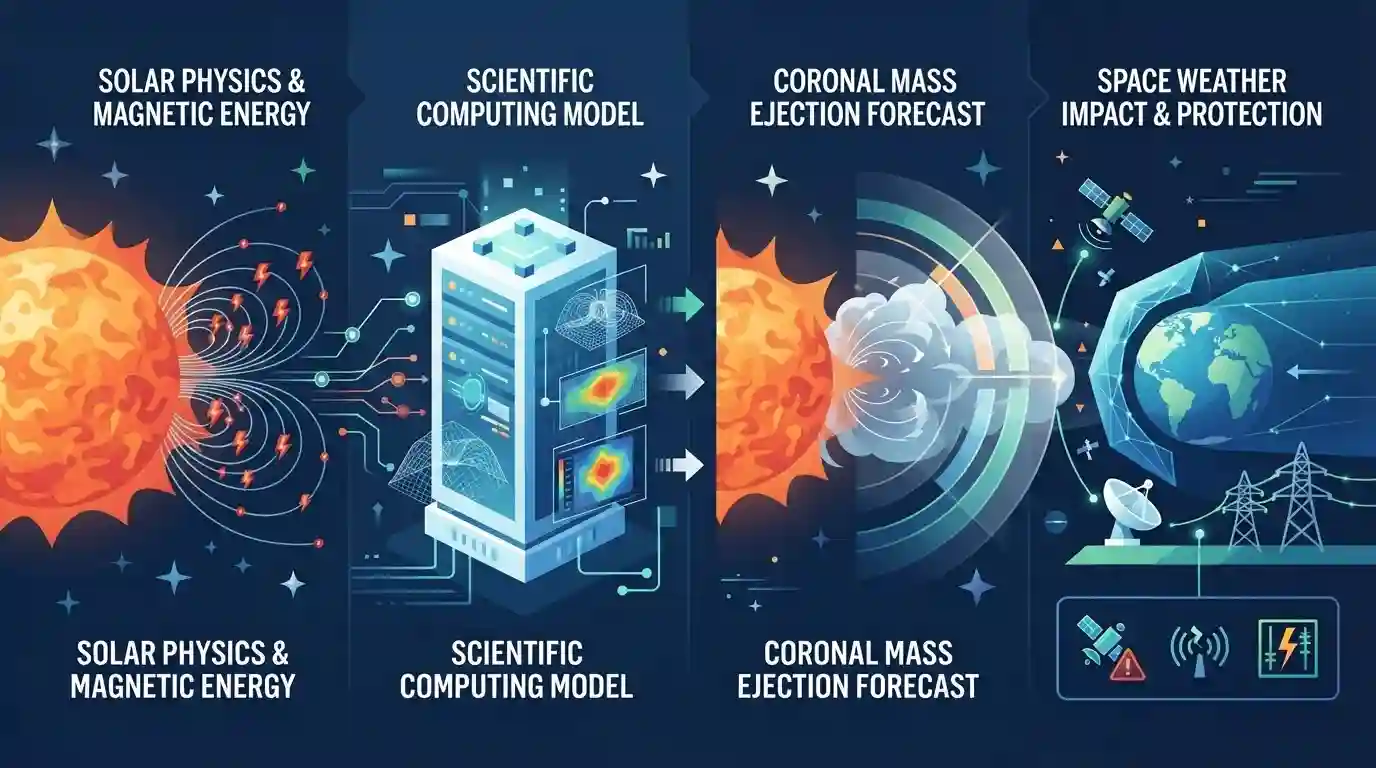
Researchers have developed a new computer model capable of tracing the buildup of magnetic energy in the solar atmosphere to better forecast Coronal Mass Ejections (CMEs). By understanding how magnetic energy accumulates and is released, this model enhances space weather prediction, which is vital for protecting Earth\'s satellites, communication networks, and power grids from disruptive solar storms.
মূল বিষয়
- Coronal Mass Ejections (CMEs) are large expulsions of plasma and magnetic field from the Sun\'s corona that can significantly affect space weather.
- The newly developed computer model traces the slow buildup of magnetic energy in the solar atmosphere and its eventual explosive release.
- Predicting the occurrence and impact of CMEs is crucial for safeguarding Earth\'s technological infrastructure, including satellite operations, GPS networks, and power grids.
- Such predictive computational models complement the observational data gathered by solar missions like India\'s Aditya-L1, enhancing our space weather forecasting capabilities.
গুরুত্বপূর্ণ শব্দ
Coronal Mass Ejections (CMEs)

Massive eruptions of magnetized plasma and magnetic fields from the Sun's corona into space, traveling at millions of kilometers per hour.
UPSC context
Critical for GS Paper 3 (Space Technology). Tests understanding of solar physics and planetary vulnerabilities to space weather.
Aditya-L1 Mission
India's first dedicated space-based solar observatory, positioned at the Lagrange 1 (L1) point to continuously study the Sun's outer atmosphere, solar wind, and coronal mass ejections.
UPSC context
Highly relevant for GS Paper 3 (Space Technology). Highlights ISRO's advancements in deep space exploration and solar physics.
Indian Institute of Astrophysics (IIA)
An autonomous premier research institute under the Department of Science and Technology, headquartered in Bengaluru, specializing in astronomy, astrophysics, and related physical sciences.
UPSC context
Relevant for GS Paper 3 (Science & Tech Institutions). Tests knowledge of India's research ecosystem and foundational astronomical observatories.
Department of Science and Technology (DST)
A Union government department under the Ministry of Science and Technology responsible for formulating policies, funding research, and supporting autonomous scientific institutions across India.
UPSC context
Features in GS Paper 2 (Governance) and GS Paper 3. Important for understanding India's scientific governance and R&D funding framework.
Magnetic Flux Ropes (MFRs)
Twisted bundles of magnetic field lines embedded in solar plasma that store immense magnetic energy and act as the primary triggers for Coronal Mass Ejections.
UPSC context
Specific to GS Paper 3 (Science & Tech). Tests deep understanding of the fundamental solar physics driving potentially disruptive space weather events.
Space Weather
The changing environmental conditions in near-Earth space, primarily driven by solar activity like CMEs and solar flares, capable of disrupting satellites, telecommunications, and power grids.
UPSC context
Essential for GS Paper 3 (Science & Technology/Disaster Management). Addresses the socio-economic impacts of cosmic phenomena on critical infrastructure.
প্রিলিমস ফাঁদ
CMEs are intense bursts of electromagnetic radiation that reach Earth in 8 minutes.
Aspirants often confuse Solar Flares (electromagnetic radiation travelling at light speed) with CMEs (plasma and magnetic fields taking 15-72 hours to reach Earth).
সংযুক্ত স্থির ধারণা
What are Lagrangian points and why is L1 crucial for the Aditya-L1 mission?
- Gravitational equilibrium: Positions in space where the gravitational pull of two large masses precisely equals the centripetal force required for a small object to move with them.
- Uninterrupted observation: A satellite placed in the halo orbit around the L1 point has the major advantage of continuously viewing the Sun without any occultation or eclipses.
How do Coronal Mass Ejections (CMEs) trigger disruptions on Earth?
- Geomagnetic storms: When a CME hits Earth's magnetosphere, it causes magnetic disturbances, inducing harmful currents (GICs) in long-distance pipelines and power grids.
- Atmospheric drag: Energy from solar storms heats Earth's upper atmosphere, causing it to expand. This increases drag on Low Earth Orbit (LEO) satellites, leading to orbital decay.
- Signal disruption: Changes in the ionosphere alter the path of radio waves, degrading high-frequency (HF) communications and reducing GPS accuracy.
আন্তঃবিষয় প্যাটার্ন
Space weather as disaster management
Severe solar storms are increasingly treated as critical infrastructure threats, pushing space weather from pure astrophysics into the realm of national disaster management and cybersecurity.
Aditya-L1 + Predictive computational models
Combining real-time observational data from Aditya-L1 with predictive computer models mirrors the 'Digital Twin' approach used in climate science for extreme weather forecasting.

Expect a multi-statement question contrasting Solar Flares, CMEs, and Solar Winds, tightly linked with Aditya-L1's payloads (VELC) in 2026.
সংযুক্ত PYQ · 2
সংযুক্ত PYQ · 2
- 2022PrelimsGS1
If a major solar storm (solar flare) reaches the Earth, which of the following are the possible effects on the Earth? 1. GPS and navigation systems could fail. 2. Tsunamis could occur at equatorial regions. 3. Power grids could be damaged. 4. Intense auroras could occur over much of the Earth. 5. Forest fires could take place over much of the planet. 6. Orbits of the satellites could be disturbed. 7. Shortwave radio communication of the aircraft flying over polar regions could be interrupted. Select the correct answer using the code given below:
- 2025PrelimsGS1
Consider the following statements : Statement I: Scientific studies suggest that a shift is taking place in the Earth's rotation and axis. Statement II: Solar flares and associated coronal mass ejections bombarded the Earth's outermost atmosphere with tremendous amount of energy. Statement III : As the Earth's polar ice melts, the water tends to move towards the equator. Which one of the following is correct in respect of the above statements?
