India and SACU Sign Terms for Preferential Trade Agreement
Source:PIB ↗
આ શા માટે મહત્વનું છે
This development is crucial for understanding India's strategic economic diplomacy and South-South cooperation, particularly its engagement with Africa. SACU is the world's oldest customs union, and a PTA here expands India's global supply chain resilience, a frequent theme in GS2 IR and GS3 Economy.
સારાંશ
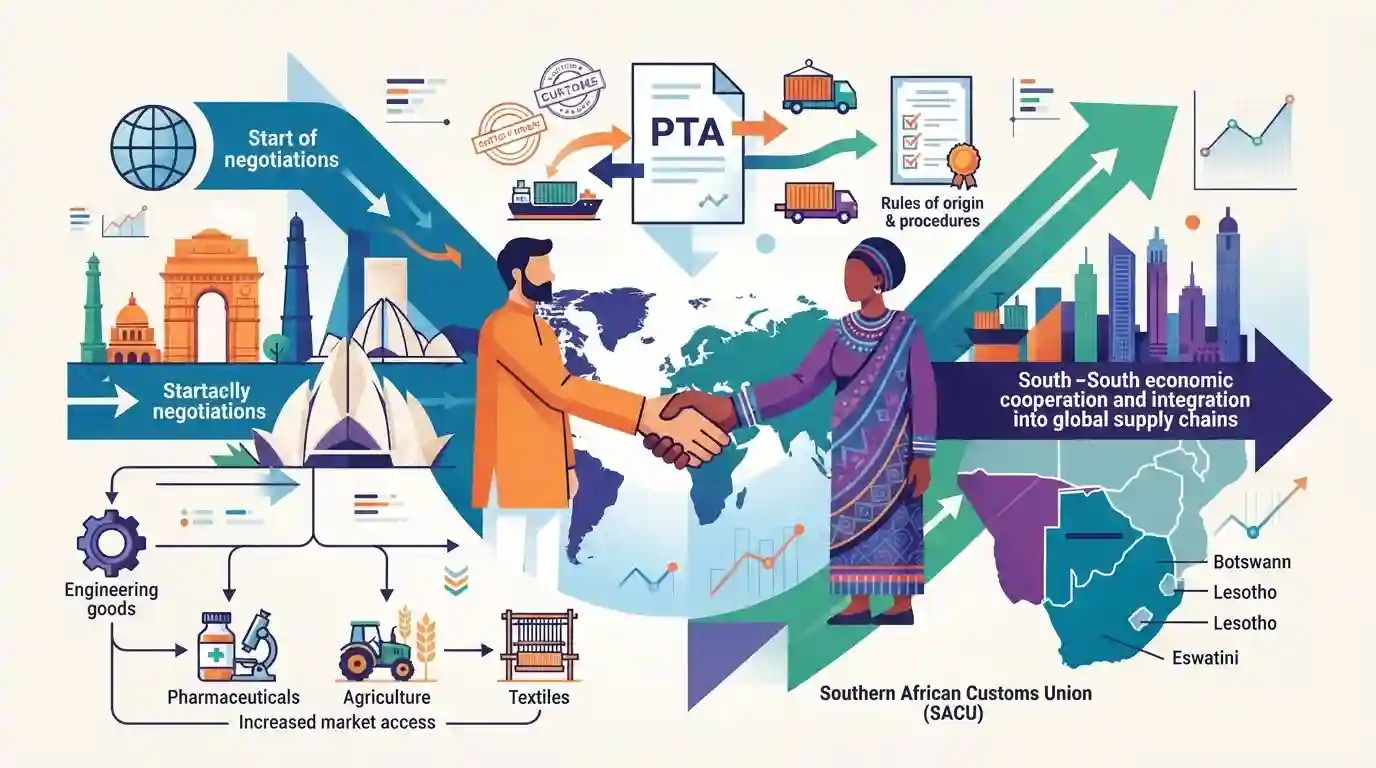
India and the Southern African Customs Union (SACU) have formally signed the Terms of Reference (ToR) in New Delhi to commence negotiations for a Preferential Trade Agreement (PTA). The initiative reflects India's intent to forge equitable, balanced trade frameworks with African nations, ensuring enhanced market access in key sectors such as engineering goods, pharmaceuticals, agriculture, and textiles. The PTA will codify rules of origin, customs procedures, and non-tariff barriers, thereby fortifying South-South economic cooperation and integrating SACU members into global supply chains.
મુખ્ય મુદ્દા
- India and the Southern African Customs Union (SACU) have signed the Terms of Reference (ToR) to initiate negotiations for a Preferential Trade Agreement (PTA).
- SACU is the oldest customs union in the world, consisting of Botswana, Eswatini, Lesotho, Namibia, and South Africa.
- The PTA negotiations aim to enhance preferential market access, integrating global supply chains across sectors like pharmaceuticals, automobiles, textiles, and agriculture.
- The agreement framework covers eight distinct chapters, including trade in goods, rules of origin, sanitary and phytosanitary (SPS) measures, and dispute settlement.
મહત્વપૂર્ણ શબ્દો
Preferential Trade Agreement (PTA)

A trade pact where partner countries agree to reduce tariffs on a specific "positive list" of goods. Unlike comprehensive Free Trade Agreements, PTAs only offer preferential tariff reductions on selected items rather than substantially all trade.
UPSC context
Important for GS-2 (IR) and GS-3 (Economy). Tests understanding of bilateral trade pacts and India's global economic diplomacy.
Southern African Customs Union (SACU)
The world's oldest customs union, established in 1910. Comprising South Africa, Botswana, Lesotho, Namibia, and Eswatini, it maintains a common external tariff, facilitates free movement of goods, and shares customs revenues among its member states.
UPSC context
Relevant for GS-2 (Regional Groupings). Tests awareness of African geopolitics and India's strategic push to expand trade in emerging markets.
Rules of Origin
Criteria used to determine the "economic nationality" of a product in international trade. They ensure that only legitimate goods from partner countries receive tariff benefits under trade agreements, preventing third-party transshipment.
UPSC context
Crucial for GS-3 (Economy). Evaluates knowledge of trade mechanics, customs regulations, and how countries prevent trade pact circumvention.
Non-Tariff Barriers (NTBs)
Obstacles to international trade that restrict imports or exports through mechanisms other than traditional tariffs. These include quotas, licensing requirements, complex regulations, customs delays, and stringent sanitary standards that often serve protectionist purposes.
UPSC context
Key for GS-3 (Economy). Tests knowledge of global trade obstacles, protectionism, and structural hurdles faced by Indian exporters worldwide.
South-South Economic Cooperation
Collaborative economic interactions, trade, and investment among developing nations of the Global South. Emerging from anti-colonial solidarity, it aims to foster self-reliance, restructure global economic governance, and reduce dependency on developed economies.
UPSC context
Vital for GS-2 (IR). Tests understanding of developing countries' collective bargaining, multipolarity, and forums like NAM or BRICS.
પ્રિલિમ્સ ટ્રેપ
A Customs Union allows member nations to independently negotiate and set individual tariff rates for non-member countries.
A Customs Union requires members to adopt a Common External Tariff (CET) on imports from non-members. Only FTAs allow members to maintain independent external tariffs.
સંલગ્ન સ્થિર ખ્યાલો
What are the primary stages of regional economic integration?
- Free Trade Area: Eliminates internal trade barriers among members while allowing them to maintain sovereign, independent external tariffs.
- Customs Union: Eliminates internal trade barriers and mandates a unified Common External Tariff (CET) on all non-member imports.
- Common Market: Builds on a customs union by permitting the completely free movement of services, labor, and capital.
How do Preferential Trade Agreements (PTAs) differ from Free Trade Agreements (FTAs)?
- PTA positive list: Operate on a positive list, meaning tariffs are reduced only on a specifically negotiated, limited group of commodities.
- FTA negative list: Operate on a negative list, targeting the elimination of tariffs on nearly all traded goods except sensitive exceptions.
આંતર-વિષય પેટર્ન
South-South trade as strategic autonomy
Securing resources through Africa's oldest customs union positions India as a reliable partner to the Global South, offering an alternative to resource-extractive economic models.
Rules of Origin and trade deflection
Stricter Rules of Origin are critical in India-SACU negotiations to prevent external manufacturing hubs from routing cheap goods through African ports to exploit tariff concessions.

Conceptual questions on levels of trade integration (Customs Union vs FTA) likely to be triggered by India-SACU PTA progress.
સંલગ્ન PYQ · 2
સંલગ્ન PYQ · 2
- 2018PrelimsGS1
Consider the following countries: 1. Australia 2. Canada 3. China 4. India 5. Japan 6. USA Which of the above are among the 'free-trade partners' of ASEAN?
- 2025MainsGS2
India-Africa digital partnership is achieving mutual respect, co-development and long-term institutional partnerships. Elaborate.
