Digital India Bhashini and NITI Aayog Advance Multilingual AI
Source:PIB ↗
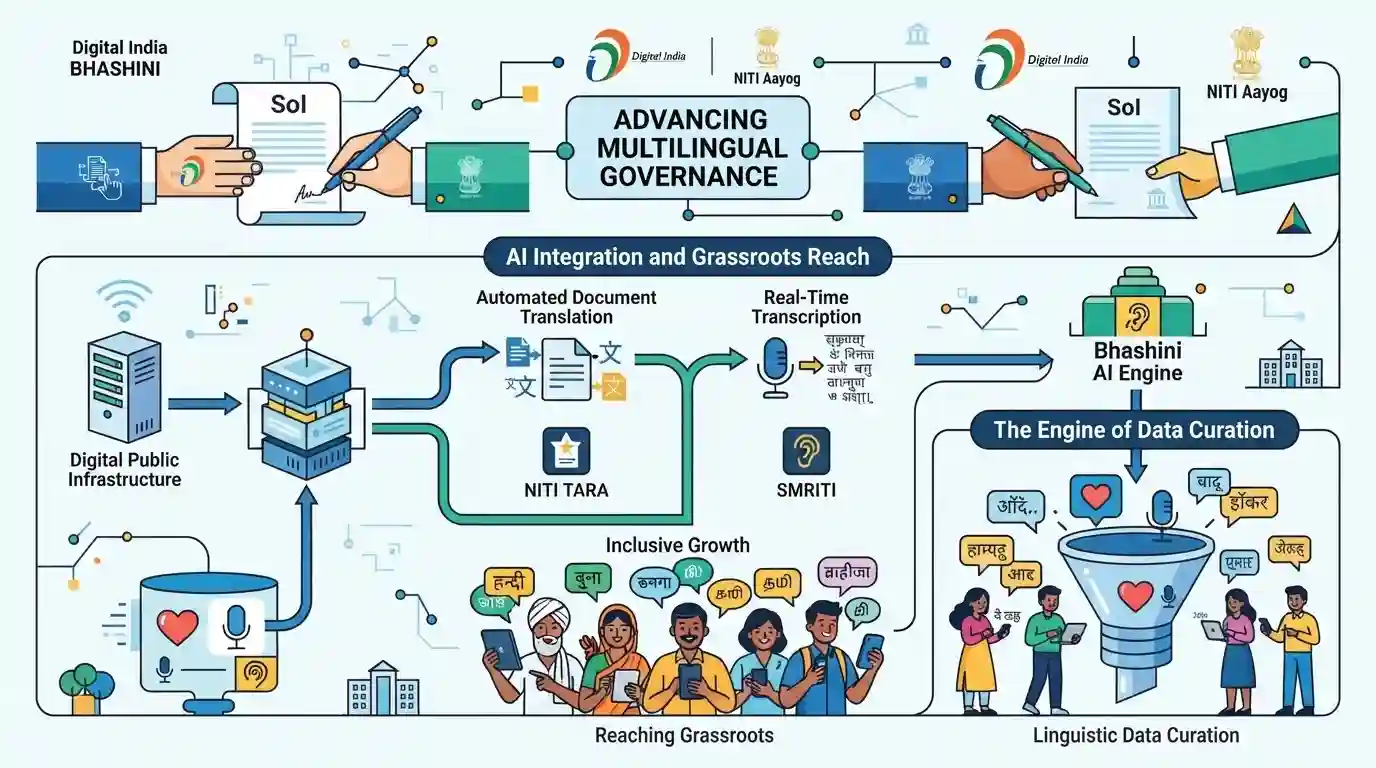
Why It Matters
This collaboration is a key example of integrating emerging technologies (AI) to solve real-world administrative challenges (linguistic diversity) in India. It illustrates the 'Interactive Service Model' of e-governance and serves as an excellent case study for Mains GS2 (E-Governance applications and citizen charters) and GS3 (Awareness in the fields of IT and AI).
Summary
Digital India BHASHINI Division (DIBD) and NITI Aayog signed a Statement of Intent (SoI) to advance multilingual, voice-first AI solutions for inclusive, citizen-centric governance. By integrating Bhashini’s artificial intelligence tools across NITI Aayog platforms—such as NITI TARA for automated document translation and SMRITI for real-time transcription—the collaboration aims to overcome linguistic barriers in public service delivery. The initiative utilizes Bhashini’s five distinct service delivery models and relies on 'BhashaDaan' for linguistic data curation, pushing forward India's digital public infrastructure and ensuring e-governance reaches grassroot levels in local languages.
Key Points
- Digital India BHASHINI Division (DIBD) and NITI Aayog have signed a Statement of Intent (SoI) to integrate multilingual, voice-first AI solutions for inclusive governance.
- The partnership aims to dismantle language barriers in public service delivery, ensuring equitable access for non-English and non-Hindi speakers.
- Bhashini’s AI tools will be integrated into NITI Aayog's ‘NITI TARA’ platform for automated translation and summarisation, and into ‘SMRITI’ for real-time meeting transcription.
- Bhashini provides its capabilities through five service models: BHASHINI Udyat, Mitra, AppMitra, Sahayogi, and Pravakta.
- The initiative relies on ‘BhashaDaan’ to crowdsource and curate linguistic data, enhancing India's digital public infrastructure.
Important Terms
Bhashini

BHASHa INterface for India is the National Language Translation Mission leveraging AI and NLP to break language barriers. It provides open-source tools for text, speech, and translation across 22 official Indian languages to boost digital inclusion.
UPSC context
Relevant for GS Paper 2 & 3 (E-Governance, Tech). Highlights India's efforts in building multilingual Digital Public Infrastructure for inclusive growth.
NITI TARA (Toolkit for Analysis, Review & Action)
An interactive device and digital platform developed by NITI Aayog. It provides data analytics, geospatial mapping, and collaborative planning tools to strengthen evidence-based governance and project monitoring at the grassroots level.
UPSC context
GS Paper 2 (Governance). Illustrates grassroots capacity building and data-driven administration, particularly relevant for the Aspirational Districts and Blocks Programme.
SMRITI (System for Meeting Recording, Information & Transcription Interface)
Developed alongside BHASHINI, SMRITI is an AI-powered system that automates meeting minutes and provides real-time multilingual translation, enhancing operational efficiency and inclusive governance for public administrators at the last mile.
UPSC context
GS Paper 2 (E-Governance). Showcases the practical integration of AI tools to streamline bureaucratic processes and improve public service delivery.
BhashaDaan
A national crowdsourcing initiative where citizens contribute voice recordings, text, and translations. It curates open-source linguistic datasets necessary to train AI models for underrepresented Indian languages, fostering technological inclusivity.
UPSC context
GS Paper 3 (AI & Technology). Tests understanding of community-driven data collection for indigenous AI development and linguistic preservation.
Digital India BHASHINI Division (DIBD)
Operating under MeitY's Digital India Corporation, this division implements the BHASHINI ecosystem. It collaborates with stakeholders to advance AI-powered multilingual governance and ensures citizen-centric digital public service delivery across India.
UPSC context
GS Paper 2 (Governance Mechanisms). Demonstrates institutional frameworks driving India's digital public infrastructure, e-governance, and language accessibility.
Prelims Trap
BHASHINI is a multilingual AI language initiative developed and administered by NITI Aayog.
BHASHINI is India's National Language DPI operating under MeitY. NITI Aayog is merely a client integrating these AI tools into its own platforms.
Static Concepts Connected
What are the foundational layers of India's Digital Public Infrastructure (India Stack)?
- Identity Layer: Provides universal, biometric-backed digital identity to citizens (e.g., Aadhaar, e-KYC).
- Payments Layer: Enables interoperable, fast financial transactions (e.g., UPI, Aadhaar Enabled Payment System).
- Data Empowerment Layer: Allows secure, consent-based digital data sharing (e.g., DigiLocker, Account Aggregator). Bhashini represents a new 'Language' layer bridging these stacks.
Which key constitutional provisions safeguard linguistic diversity in India?
- Eighth Schedule: Lists 22 official languages, serving as the target baseline for digital inclusion and translation tools like BHASHINI.
- Article 350A: Mandates the state to provide facilities for instruction in the mother tongue at the primary educational stage for linguistic minorities.
- Article 351: Directs the Union to promote the Hindi language while enriching it by assimilating forms and vocabulary from other Indian languages.
Cross-Topic Patterns
DPI Evolution: Finance to Language
India is shifting its DPI focus from identity and finance (Aadhaar, UPI) to sector-specific socio-economic inclusion, as seen in ONDC (commerce), ABDM (health), and BHASHINI (linguistic equity).
AI applied to Aspirational Districts
Integrating BHASHINI into NITI TARA enables multi-lingual data analytics down to Aspirational Blocks, connecting high-tech AI frameworks directly with grassroots rural governance and decentralized planning.

Expect a Prelims match-the-following question pairing emerging DPIs (BHASHINI, ONDC, UHI) with their nodal ministries and core functions.
Linked PYQs · 2
Linked PYQs · 2
- 2024MainsGS2
e-governance is not just about the routine application of digital technology in service delivery process. It is as much about multifarious interactions for ensuring transparency and accountability. In this context evaluate the role of the 'Interactive Service Model' of e-governance.
- 2023MainsGS3
What is the status of digitalization in the Indian economy? Examine the problems faced in this regard and suggest improvements.
