National Commission for Scheduled Castes Submits Annual Report
Source:PIB ↗
हे का महत्त्वाचे आहे
The NCSC is a pivotal constitutional body entrusted with safeguarding the interests of Scheduled Castes. Understanding its reporting mechanism, constitutional mandate (Article 338), and role in monitoring welfare schemes is highly relevant for the GS2 syllabus on Constitutional Bodies and Social Justice.
सारांश
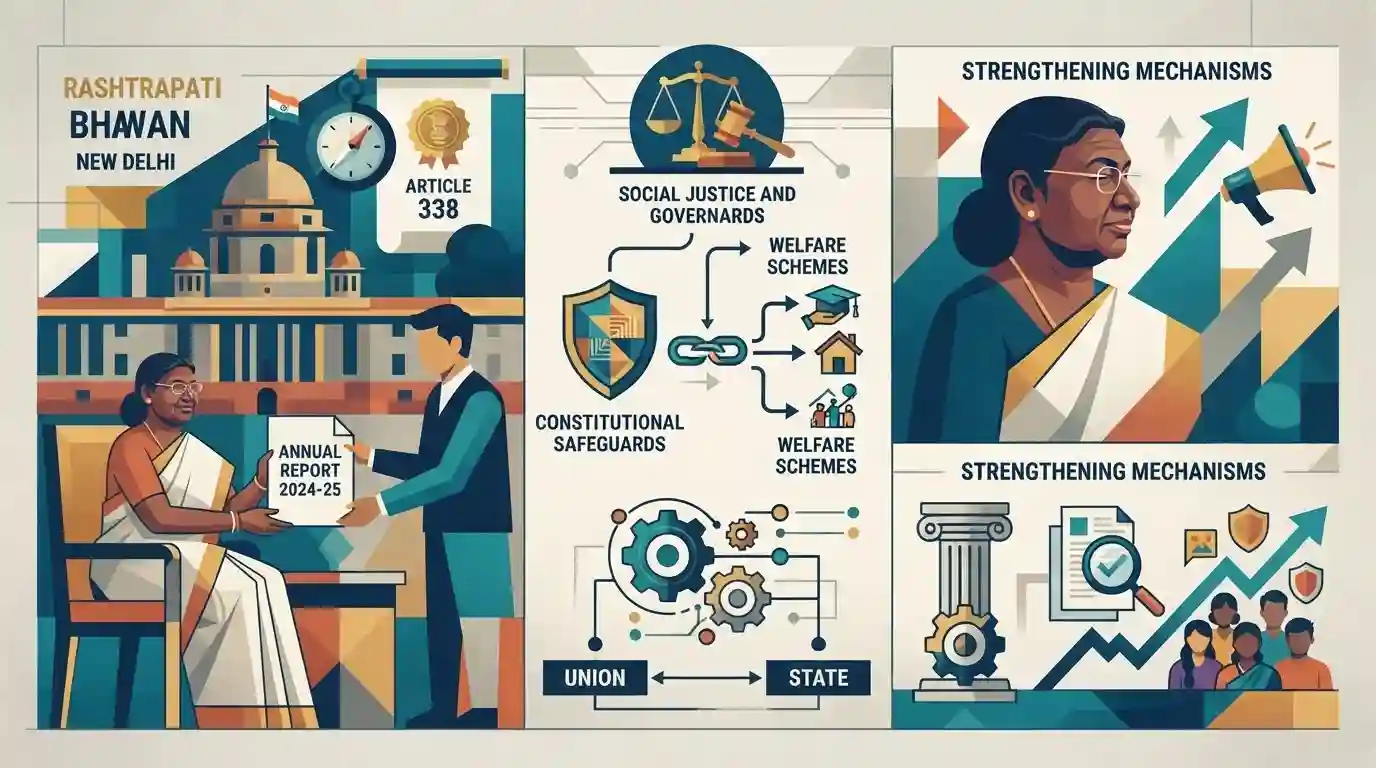
The National Commission for Scheduled Castes (NCSC) submitted its Annual Report for 2024–25 to President Droupadi Murmu at Rashtrapati Bhawan. In accordance with Article 338 of the Constitution, the report reviews the functioning of Constitutional safeguards and assesses the implementation of welfare and socio-economic development programs for Scheduled Castes by the Union and State governments. The President directed the NCSC to propose measures to strengthen institutional mechanisms to ensure more effective implementation of these safeguards and welfare schemes.
मुख्य मुद्दे
- The National Commission for Scheduled Castes (NCSC) presented its Annual Report for 2024–25 to President Droupadi Murmu, fulfilling the constitutional mandate under Article 338.
- The NCSC delegation was led by Chairman Kishor Makwana and included other members and the NCSC Secretary.
- The Annual Report provides a comprehensive review of the functioning of Constitutional safeguards, based on extensive reviews, spot visits, and consultations regarding welfare schemes for Scheduled Castes.
- President Murmu directed the Commission to recommend measures to strengthen and streamline institutional mechanisms for the effective implementation of safeguards and socio-economic development programs.
महत्त्वाच्या संज्ञा
National Commission for Scheduled Castes (NCSC)

A constitutional body in India tasked with monitoring the implementation of safeguards for Scheduled Castes, inquiring into rights deprivations, and advising on their socio-economic development.
UPSC context
GS Paper 2 (Constitutional Bodies). Tests knowledge of its mandate, composition, and role in ensuring social justice and welfare.
Article 338 of the Constitution of India
A constitutional provision establishing the National Commission for Scheduled Castes (NCSC) to investigate, monitor, and evaluate all matters relating to the constitutional and legal safeguards provided for Scheduled Castes.
UPSC context
GS Paper 2 (Indian Constitution). Tests awareness of specific constitutional mechanisms protecting vulnerable sections and establishing statutory bodies.
Union Government
The central governing authority of India, responsible for formulating national policies and welfare schemes for vulnerable sections, the implementation of which is reviewed by constitutional bodies like the NCSC.
UPSC context
GS Paper 2 (Governance). Tests understanding of the central government's role in social justice policy formulation and accountability.
State Governments
Sub-national governments in India responsible for executing central and state-specific socio-economic welfare programs for marginalized communities, monitored by the NCSC for effective implementation.
UPSC context
GS Paper 2 (Governance/Federalism). Tests understanding of decentralization and the state-level execution of schemes for vulnerable sections.
पूर्वपरीक्षा सापळा
The NCSC can penalize officials and mandate binding punitive actions when investigating violations of Scheduled Caste safeguards.
The NCSC holds civil court powers only for summoning and gathering evidence. It cannot issue binding verdicts, arrest, or penalize individuals; its recommendations are strictly advisory.
संबंधित स्थिर संकल्पना
How did the separate Constitutional Commissions for SCs, STs, and OBCs evolve?
- Initial framework: Article 338 originally provided for a Special Officer. A multi-member joint National Commission for SCs and STs was later established in 1990 via the 65th Amendment.
- 89th Amendment (2003): Bifurcated the joint commission into a separate NCSC (Article 338) and NCST (Article 338A) to ensure focused welfare monitoring.
- 102nd Amendment (2018): Granted constitutional status to the National Commission for Backward Classes (NCBC) under a new Article 338B, aligning its powers with the NCSC.
What specific "Civil Court" powers does the NCSC possess during an inquiry?
- Summoning powers: Can summon and enforce the attendance of any person from any part of India and examine them on oath.
- Document discovery: Can require the discovery and production of any document or requisition any public record from any court or office.
- Affidavit evidence: Authorized to receive evidence on affidavits and issue commissions for the examination of witnesses and documents.
आंतर-विषय नमुने
SC Sub-classification & NCSC monitoring
The recent Supreme Court ruling permitting states to sub-classify Scheduled Castes creates a new compliance, equity, and monitoring parameter for the NCSC's annual reviews.
Constitutional vs. Statutory enforcement
UPSC often links the constitutional mandate of the NCSC (Art 338) with its practical role in monitoring the implementation of statutory frameworks like the SC/ST (PoA) Act, 1989.

Expect a 2026 multi-statement question linking NCSC's civil court powers with recent Supreme Court rulings on SC sub-categorization.
संबंधित PYQ · 5
संबंधित PYQ · 5
- 2018MainsGS2
Whether National Commission for Scheduled Castes (NCSC) can enforce the implementation of constitutional reservation for the Scheduled Castes in the religious minority institutions? Examine.
- 2019MainsGS2
Performance of welfare schemes that are implemented for vulnerable sections is not so effective due to absence of their awareness and active involvement at all stages of policy process. Discuss.
- 2023PrelimsGS1
Consider the following organizations/bodies in India: 1. The National Commission for Backward Classes 2. The National Human Rights Commission 3. The National Law Commission 4. The National Consumer Disputes Redressal Commission How many of the above are constitutional bodies?
- 2026PrelimsGS1
Consider the following statements about the provisions pertaining to the Scheduled Castes and the Scheduled Tribes in India : 1. Provisions regarding the administration of the Tribal Areas in the States of Assam, Meghalaya, Tripura and Mizoram are given in the Fifth Schedule of the Constitution of India. 2. Some tribes of India are entitled to exemption from paying Income Tax on certain incomes. 3. The Constitution of India provides for reservation of seats in Panchayats for women belonging to the Scheduled Castes and the Scheduled Tribes. Which one of the following conclusions based on the above statements is correct ?
- 2022MainsGS2
Discuss the role of the National Commission for Backward Classes in the wake of its transformation from a statutory body to a constitutional body.
