CBDC Based Direct Benefit Transfer Launched in UTs
Source:PIB ↗
Why It Matters
The use of programmable CBDC for DBT is a major technological evolution in Indian welfare administration. It solves the perennial PDS problem of subsidy leakage and diversion by ensuring funds can only be spent on their intended purpose, while reducing dependence on physical cash and traditional banking infrastructure.
Summary
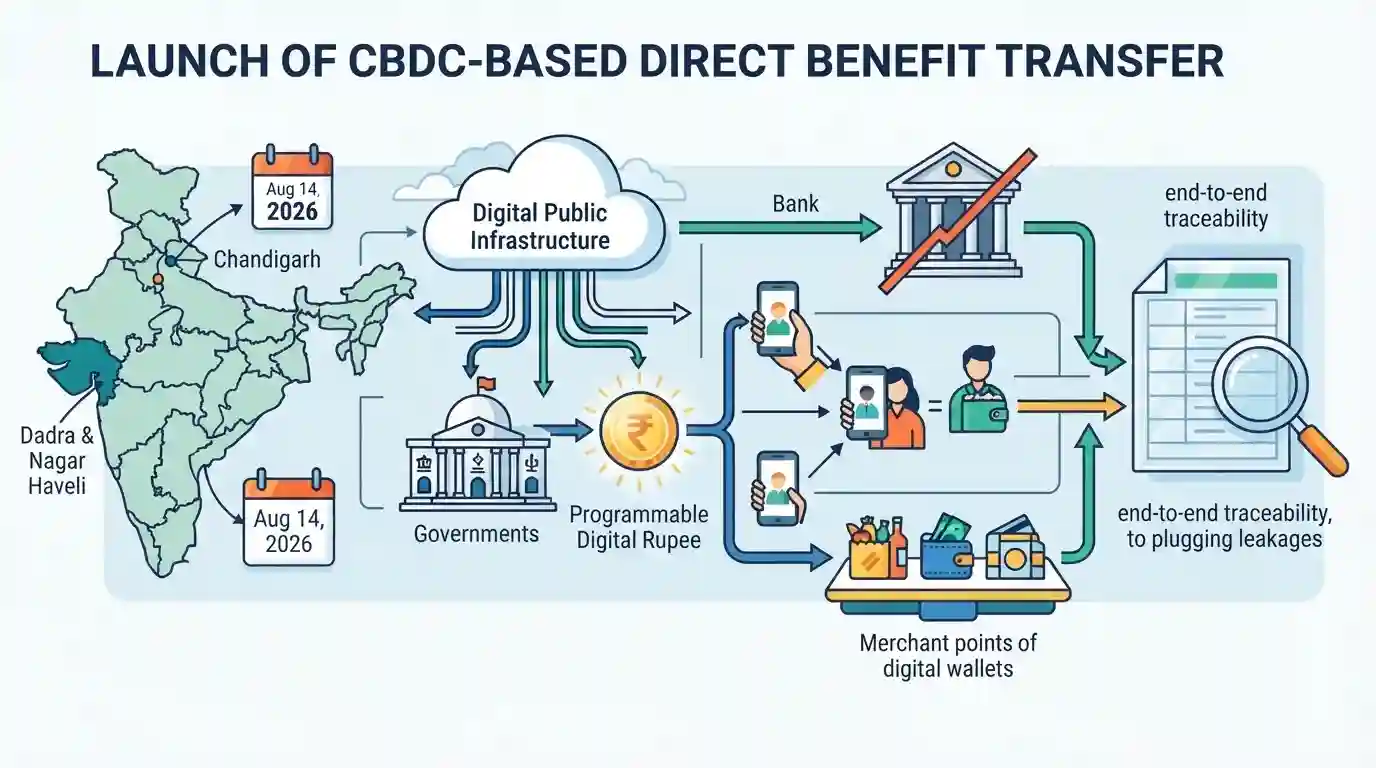
The Government of India is set to launch a Central Bank Digital Currency (CBDC)-based Direct Benefit Transfer (DBT) initiative in Chandigarh and Dadra & Nagar Haveli on August 14, 2026. Under the Pradhan Mantri Garib Kalyan Anna Yojana (PMGKAY), subsidies will be transferred directly to beneficiaries' digital wallets in the form of programmable Digital Rupee tokens, bypassing conventional bank accounts. This programmability restricts the use of funds to designated merchants for specific purposes, ensuring end-to-end traceability and eliminating the diversion of welfare subsidies. The initiative marks a significant step forward in leveraging India's digital public infrastructure to plug leakages in the Public Distribution System (PDS) while promoting financial inclusion.
Key Points
- The Government of India is launching a CBDC-based Direct Benefit Transfer (DBT) system for the Pradhan Mantri Garib Kalyan Anna Yojana (PMGKAY) in Chandigarh and Dadra & Nagar Haveli.
- Instead of traditional bank transfers, subsidies are credited as programmable Digital Rupee tokens directly into beneficiaries' CBDC wallets.
- The programmability feature ensures the digital tokens can only be spent at empanelled merchants to purchase specific items (foodgrains), entirely preventing the diversion of funds.
- This shift enhances end-to-end traceability, eliminates physical cash handling issues, and builds upon successful pilot programs conducted in Puducherry and Gujarat.
Important Terms
Pradhan Mantri Garib Kalyan Anna Yojana (PMGKAY)

A central welfare scheme in India providing free foodgrains to eligible beneficiaries under the National Food Security Act, aimed at ensuring food security and hunger relief.
UPSC context
GS Paper II: Social Justice/Welfare Schemes. Tests understanding of food security, poverty alleviation, and public distribution system reforms.
Central Bank Digital Currency (CBDC)
A digital form of a country's sovereign fiat currency issued by its central bank, serving as an electronic legal tender equivalent to physical paper cash.
UPSC context
GS Paper III: Indian Economy. Tests understanding of digital currency, monetary policy, financial technology, and central banking reforms.
Direct Benefit Transfer (DBT)
A governance initiative designed to transfer government subsidies and welfare benefits directly into beneficiaries' accounts or digital wallets, minimizing leakages, intermediaries, and administrative delays.
UPSC context
GS Paper II & III: E-governance/PDS. Tests knowledge of public service delivery, leakage control, and fiscal management.
Digital Rupee (e₹)
The official central bank digital currency (CBDC) issued by the Reserve Bank of India, acting as a secure and programmable digital version of physical currency.
UPSC context
GS Paper III: Science & Tech/Economy. Tests understanding of blockchain-based sovereign currencies, retail/wholesale payment ecosystems, and monetary innovations.
Digital Public Infrastructure (DPI)
Foundational digital systems—such as Aadhaar, UPI, and digital data exchanges—that enable the secure, seamless, and inclusive delivery of public and private services at a national scale.
UPSC context
GS Paper III: Science & Technology. Tests awareness of India's tech-driven public service delivery, e-governance, and global digital leadership.
Prelims Trap
"CBDC-based DBT requires beneficiaries to have an active commercial bank account linked to the UPI network."
CBDC wallets hold tokens that are direct RBI liabilities. They bypass commercial bank intermediation, allowing unbanked citizens to receive subsidies without needing a traditional bank account.
Static Concepts Connected
How does the Digital Rupee (CBDC) conceptually differ from UPI and e-RUPI?
- CBDC: A sovereign fiat currency and direct RBI liability, functioning independently of commercial bank deposits.
- e-RUPI: A purpose-specific, prepaid digital voucher backed by existing commercial bank deposits.
- UPI: A payment settlement interface that facilitates the transfer of existing commercial bank money between accounts.
What structural PDS challenges does programmable digital money aim to resolve?
- Fund Diversion: Cash subsidies are often spent on non-essentials; programmable tokens restrict spending to designated foodgrain merchants.
- Bank Account Failures: Traditional DBT suffers from transaction failures due to dormant or unlinked commercial bank accounts, which CBDC wallets bypass.
- Audit Opacity: Tokens provide end-to-end traceability of subsidy utilization, helping the government audit exactly where welfare funds are spent.
Cross-Topic Patterns
Programmability + Monetary Policy transmission
Programmable CBDCs could allow the RBI to apply expiry dates to stimulus tokens during recessions, forcing immediate consumption and fundamentally altering monetary policy transmission dynamics.
Evolution of the JAM Trinity
Moving from Jan Dhan accounts to CBDC wallets represents a shift from commercial-bank-led financial inclusion to a direct central-bank model, resolving the structural bottleneck of dormant rural bank accounts.

Expect a multi-statement question distinguishing the liability structures (RBI vs commercial banks) of CBDC, e-RUPI, and UPI in 2026.
Linked PYQs · 5
Linked PYQs · 5
- 2022MainsGS3
Is inclusive growth possible under market economy ? State the significance of financial inclusion in achieving economic growth in India.
- 2023MainsGS3
What is the status of digitalization in the Indian economy? Examine the problems faced in this regard and suggest improvements.
- 2022MainsGS3
What are the major challenges of Public Distribution System (PDS) in India ? How can it be made effective and transparent ?
- 2015MainsGS3
In what way could replacement of price subsidy with Direct Benefit Transfer (DBT) change the scenario of subsidies in India ? Discuss.
- 2026PrelimsGS1
Which one of the following statements about Unified Payments Interface (UPI) and Central Bank Digital Currency (Digital Rupee) is not correct ?
