Guidelines for Regulation of Private Coaching Centers
Source:PIB ↗
हे का महत्त्वाचे आहे
The rapid growth of the private coaching industry presents critical governance challenges concerning youth mental health, educational equity, and consumer rights. This topic underscores the division of responsibilities in the Concurrent List and highlights the need for robust regulatory oversight over private educational entities.
सारांश
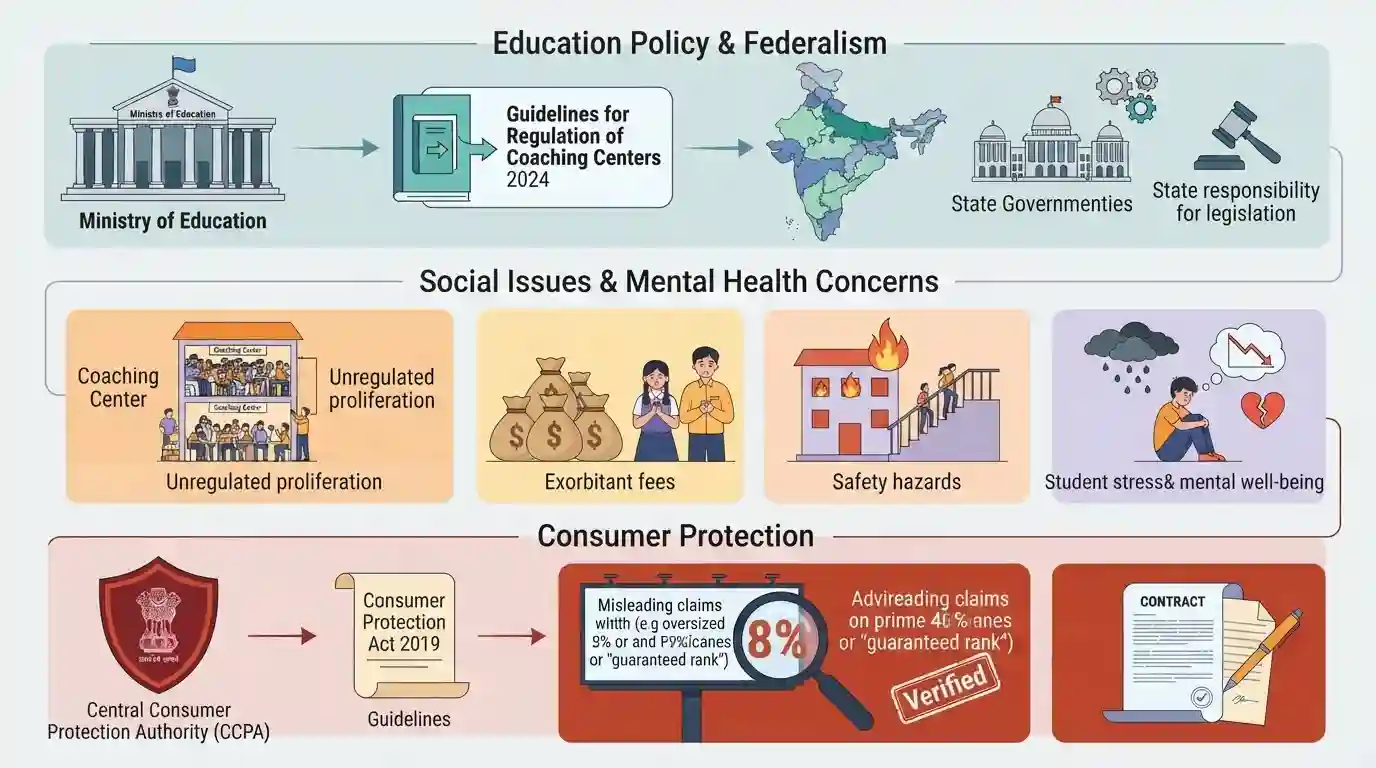
The Ministry of Education has released the 'Guidelines for Regulation of Coaching Center 2024' to assist States and Union Territories in regulating private coaching institutes. Since Education is a Concurrent List subject, State Governments hold the primary responsibility for enacting relevant legislation. The guidelines address pressing concerns including the unregulated proliferation of coaching centers, exorbitant fees, safety hazards, student suicides, and the mental well-being of learners. Additionally, the Central Consumer Protection Authority (CCPA) issued separate guidelines in November 2024 under the Consumer Protection Act, 2019, specifically to curb misleading advertisements and deceptive practices in the coaching sector.
मुख्य मुद्दे
- The Ministry of Education issued the 'Guidelines for Regulation of Coaching Center 2024' to States/UTs to regulate private coaching institutions.
- As 'Education' is on the Concurrent List, State and UT governments are primarily responsible for legislating and regulating coaching centers within their jurisdictions.
- The guidelines focus on curbing unregulated growth, exorbitant fees, safety hazards (fire and accidents), student suicides, and ensuring the mental well-being of students.
- Under the Consumer Protection Act, 2019, the CCPA released guidelines in November 2024 to prevent misleading advertisements and deceptive marketing in the coaching sector.
महत्त्वाच्या संज्ञा
Guidelines for Regulation of Coaching Center 2024

Comprehensive rules by the Ministry of Education mandating registration for private coaching institutes, setting a minimum enrollment age of 16, stipulating tutor qualifications, establishing fee refund policies, and ensuring mental well-being.
UPSC context
GS Paper 2 (Education, Social Issues). Highlights state interventions to regulate shadow education, curb academic pressure, and prevent student suicides.
Guidelines for Prevention of Misleading Advertisement in Coaching Sector, 2024
CCPA-issued rules prohibiting coaching centers from making false claims about guaranteed selections or success rates. It mandates clear disclosures and requires written consent from candidates post-selection before using their testimonials.
UPSC context
GS Paper 2 (Governance). Relevant for consumer protection, regulating misleading marketing, and enforcing corporate accountability in the education sector.
Consumer Protection Act, 2019
Legislation replacing the 1986 Act to strengthen consumer rights, covering e-commerce and product liability. It established three-tier redressal commissions and a central regulatory authority to aggressively curb unfair trade practices.
UPSC context
GS Paper 2 (Statutory Frameworks). Foundational for understanding consumer rights, public grievance redressal systems, and digital-age market regulations in India.
Central Consumer Protection Authority (CCPA)
A statutory regulatory body established under the Consumer Protection Act, 2019. It protects consumer rights as a class, initiates suo-moto actions against unfair trade practices, and penalizes false/misleading advertisements.
UPSC context
GS Paper 2 (Statutory Bodies). Tests knowledge of national regulatory institutions, their mandates, and enforcement powers against deceptive commercial practices.
पूर्वपरीक्षा सापळा
The 2024 Coaching Center Guidelines are legally binding central mandates requiring direct registration of all institutes with the Ministry of Education.
Education is a Concurrent List subject. The MoE's guidelines are advisory model frameworks; states must enact their own laws to make registration and regulation legally binding. CCPA guidelines, however, carry statutory force under the Consumer Protection Act, 2019.
संबंधित स्थिर संकल्पना
How is 'Education' constitutionally structured under the Seventh Schedule?
- Concurrent List shift: Originally in the State List (Entry 11), it was moved to the Concurrent List (Entry 25) via the 42nd Amendment Act, 1976.
- Union List exceptions: Entries 63, 64, 65, and 66 of the Union List reserve powers to the Centre for central universities and institutions of national importance.
- Executive responsibility: While both Centre and States can legislate, executive implementation of concurrent educational policies rests primarily with the State governments.
What is the regulatory mandate of the Central Consumer Protection Authority (CCPA)?
- Statutory origin: Established as a statutory body under Section 10 of the Consumer Protection Act, 2019, to protect, promote, and enforce consumer rights.
- Investigative power: Equipped with a dedicated bilateral investigation wing headed by a Director-General to conduct search, seizure, and inquiry into unfair trade practices.
- Penal mechanisms: Empowered to issue safety recalls, order reimbursement, and impose penalties of up to ₹10 lakh (and ₹50 lakh for repeat offenses) on misleading advertisers.
आंतर-विषय नमुने
Federalism and advisory central guidelines
Model central guidelines on Concurrent subjects (like education) rely entirely on state-level legislation, leading to highly uneven implementation and regulatory arbitrage across state borders.
Education commercialization and mental health
The rise of high-pressure coaching hubs (e.g., Kota) intersects urban governance, student migration, and systemic gaps in institutional mental health support, turning education into a public health issue.

Expect questions testing the division of educational powers under the Seventh Schedule paired with CCPA's statutory enforcement tools.
संबंधित PYQ · 3
संबंधित PYQ · 3
- 2015MainsGS2
For achieving the desired objectives, it is necessary to ensure that the regulatory institutions remain independent and autonomous. Discuss in the light of the experiences in recent past.
- 2022MainsGS2
The Right of Children to Free and Compulsory Education Act, 2009 remains inadequate in promoting incentive-based system for children's education without generating awareness about the importance of schooling. Analyse.
- 2025MainsGS2
The National Commission for Protection of Child Rights has to address the challenges faced by children in the digital era. Examine the existing policies and suggest measures the Commission can initiate to tackle the issue.
