Srijan Initiative Celebrates Women Weavers in Handlooms
Source:PIB ↗
ఇది ఎందుకు ముఖ్యం
The handloom sector is heavily dependent on female artisans whose work often goes unrecognized. Initiatives like 'Srijan' are important for UPSC aspirants studying the intersection of women's empowerment, the unorganized sector, and the preservation of India's intangible cultural heritage.
సారాంశం
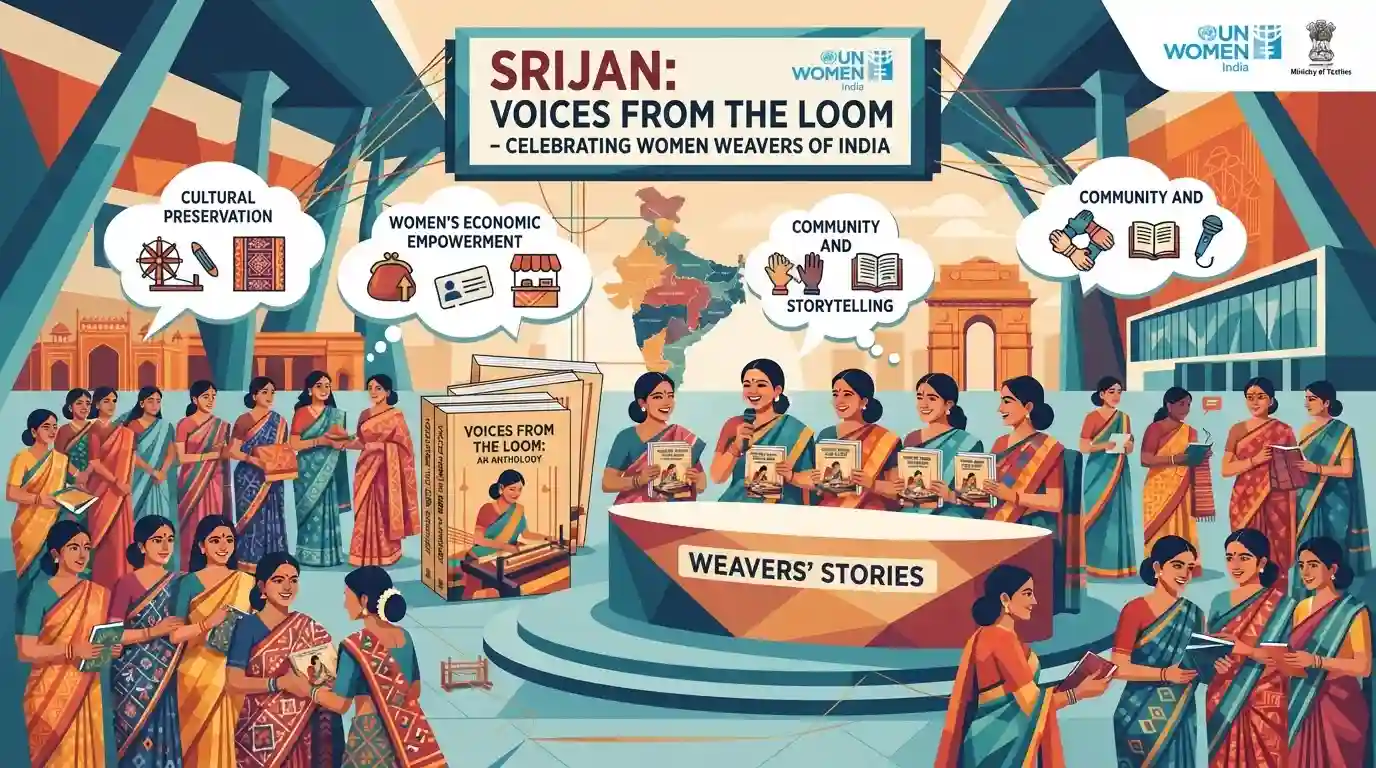
The Ministry of Textiles, through the Office of the Development Commissioner (Handlooms), is hosting ‘Srijan: Voices from the Loom’ in New Delhi to celebrate the pivotal role of women weavers in preserving India’s handloom heritage. The event will feature over 100 women from various clusters sharing their stories and the release of an anthology documenting their experiences. It highlights the intersection of cultural preservation and women's economic empowerment in the traditional artisanal sector, with participation from UN Women India.
ముఖ్య అంశాలు
- The Ministry of Textiles is organizing ‘Srijan: Voices from the Loom’ to honor and celebrate the contributions of women weavers to India\'s handloom heritage.
- The event gathers over 100 women weavers from six handloom clusters to share their resilience and creativity.
- An anthology featuring the inspiring journeys and lived experiences of these women weavers will be released.
- The initiative aims to place women at the center of the conversation regarding India\'s traditional weaving arts, shifting focus to their socio-economic empowerment.
ప్రిలిమ్స్ ఉచ్చు
The Indian handloom sector is a male-dominated artisanal craft, with female workers comprising less than a third of the total workforce.
In reality, the handloom sector is highly feminized. According to the 4th Handloom Census, women make up over 72% of the workforce.
అనుసంధానమైన స్థిర భావనలు
How did the Swadeshi Movement of 1905 revitalize the traditional handloom industry?
- August 7 Proclamation: The formal boycott of British goods was declared on this day, reviving local handlooms as symbols of economic self-reliance.
- Economic Resistance: Domestic handloom weaving served as a primary tool to bypass British textile imports and build decentralized rural resilience.
What makes the handloom sector crucial for rural non-farm employment?
- High Feminization: Over 72% of the workforce comprises women, making it a critical source of gender-inclusive self-employment.
- Rural Dominance: With nearly 89% of handloom households in rural areas, it curbs distress migration to urban centers.
- Weaver MUDRA Scheme: Provides subsidized credit at 6% interest and margin money assistance to eliminate predatory middleman lending.
అంతర-అంశ నమూనాలు
Swadeshi legacy and non-farm employment
Connecting India's freedom struggle history to current micro-enterprise policies, showing how traditional artisanal crafts act as modern economic shock absorbers.
GI tags and women's cooperatives
Integrating geographical indications with women's self-help groups (SHGs) helps female weavers secure intellectual property rights and bypass exploitative supply chains.

Prelims 2026 may link Handloom Day history (1905 Swadeshi) with structural stats on female rural non-farm labor and MUDRA credit schemes.
అనుసంధాన PYQలు · 2
అనుసంధాన PYQలు · 2
- 2018MainsGS1
Safeguarding the Indian art heritage is the need of the moment. Discuss.
- 2017MainsGS1
Examine how the decline of traditional artisanal industry in colonial India crippled the rural economy.
