National Conference on Affordable Housing Reforms and Ecosystem
Source:PIB ↗
কেন এটি গুরুত্বপূর্ণ
With over half of India's population projected to reside in urban areas by 2050, providing affordable housing is crucial for economic growth, preventing slum proliferation, and achieving SDG 11 (Sustainable Cities and Communities). The transition from direct state provisioning to a regulatory and market-enabling ecosystem represents a major policy evolution in India's urban governance.
সারসংক্ষেপ
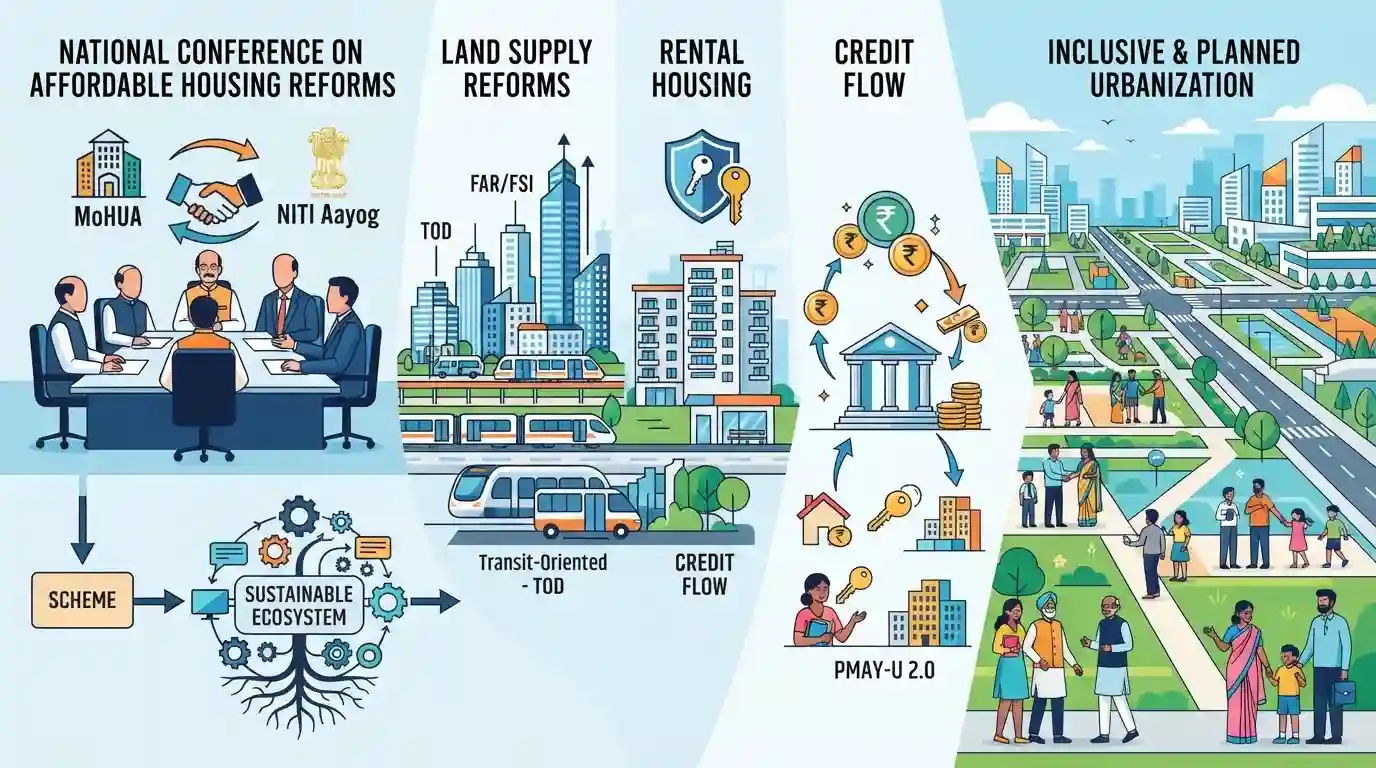
The Ministry of Housing and Urban Affairs (MoHUA) hosted the National Conference on Affordable Housing Reforms, highlighting a transition from scheme-based interventions to a sustainable ecosystem for urban housing. In collaboration with NITI Aayog, MoHUA advocated for deep structural reforms across land supply (e.g., raising FAR/FSI, transit-oriented development), rental housing (implementing the Model Tenancy Act), and credit flow (under PMAY-U 2.0) to ensure inclusive and planned urbanization across India.
মূল বিষয়
- The Ministry of Housing and Urban Affairs (MoHUA) organized the National Conference on Affordable Housing Reforms with the theme 'Reimagining Affordable Housing: From Scheme to Sustainable Ecosystem'.
- The conference marked a shift from a purely subsidy-driven, scheme-based approach (like PMAY-U) to building a self-sustaining market ecosystem for affordable housing in India.
- A joint report by MoHUA and NITI Aayog titled 'A Comprehensive Framework to Promote Affordable Housing' was discussed, focusing on key bottlenecks: Land, Rental Housing, and Finance.
- Key land-use reforms recommended include raising Floor Area Ratio (FAR) / Floor Space Index (FSI) to 5 or 6 along transit corridors, reserving at least 10% of residential zones for affordable housing, and utilizing land pooling and Transferable Development Rights (TDR).
- To unlock vacant urban housing, the conference stressed the adoption of the Model Tenancy Act (MTA) by states and expanding Affordable Rental Housing Complexes (ARHCs) to support the floating migrant population.
- Financial reforms suggested include streamlining credit under PMAY-U 2.0, utilizing green/sustainable finance, issuing municipal bonds, and offering fiscal relaxations like stamp duty exemptions and waiving land-use conversion fees.
গুরুত্বপূর্ণ শব্দ
Pradhan Mantri Awas Yojana - Urban (PMAY-U)

A flagship housing mission launched in 2015 by India's Ministry of Housing and Urban Affairs to address urban housing shortages by providing pucca houses to eligible families.
UPSC context
GS Paper II (Government Schemes) and GS Paper III (Infrastructure); tests understanding of social sector initiatives and urban planning.
PMAY-U 2.0
The second phase of the flagship scheme approved in August 2024, providing financial assistance to 1 crore urban poor and middle-class families to construct, purchase, or rent affordable homes over five years.
UPSC context
GS Paper III (Infrastructure) and GS Paper II (Welfare Schemes); tests knowledge of next-generation urban policies and financial assistance modules.
Model Tenancy Act (MTA)
A model legal framework approved by the Union Cabinet in 2021 to regulate rental housing, balance landlord-tenant interests, and establish Rent Courts for speedy dispute resolution.
UPSC context
GS Paper II (Polity) and GS Paper III (Urbanization); tests understanding of rental law reforms, housing deficits, and state legislative adoption.
Affordable Rental Housing Complexes (ARHCs)
A sub-scheme under PMAY-U initiated in 2020 to provide dignified, low-cost rental housing to urban migrants and the poor near their workplaces using existing vacant housing or new PPP constructions.
UPSC context
GS Paper I (Urbanization), GS Paper II (Welfare Schemes); tests critical analysis of migration challenges, PPP models, and urban social infrastructure.
National Institute of Urban Affairs (NIUA)
A premier autonomous institute established in 1976 under the Ministry of Housing and Urban Affairs, specializing in research, capacity building, and knowledge dissemination on urban development in India.
UPSC context
GS Paper II (Statutory/Autonomous Bodies) and GS Paper III (Urban Planning); tests awareness of key institutional bodies driving urbanization narratives and policy reforms.
প্রিলিমস ফাঁদ
The Model Tenancy Act (MTA) is a central legislation that automatically overrides existing state rent control laws under Seventh Schedule provisions.
Housing and land fall under the State List (List II). The MTA is only an advisory model framework, requiring states to legislate it individually.
সংযুক্ত স্থির ধারণা
What is Transit-Oriented Development (TOD) and how does it reform urban planning?
- Core Definition: High-density, mixed-use, pedestrian-friendly development focused around public transit hubs.
- Primary Objective: Reduces vehicular emission and urban sprawl by concentrating residential and commercial growth near mass transit.
- Planning Link: Typically requires raising Floor Area Ratio (FAR) to permit high-rise vertical expansion along corridors.
What are Transferable Development Rights (TDR) in urban land acquisition?
- Market Mechanism: A tool allowing land owners to trade development potential of restricted plots to designated receiving zones.
- Public Utility: Enables municipalities to acquire land for public infrastructure without incurring high cash compensation costs.
আন্তঃবিষয় প্যাটার্ন
Municipal Finance + Fiscal Devolution
Links the issuance of municipal green bonds for affordable housing directly to 15th Finance Commission conditions on urban local body reform.
Circular Migration + Rental Infrastructure
Examines how formalizing affordable rentals via ARHCs secures rights for floating workforces, bridging social vulnerabilities with urban labor economics.

Analytical questions in 2026 may link Model Tenancy Act's slow adoption to federal challenges in Seventh Schedule (List II) land reforms.
সংযুক্ত PYQ · 3
সংযুক্ত PYQ · 3
- 2022PrelimsGS1
Consider the following statements : 1. The India Sanitation Coalition is a platform to promote sustainable sanitation and is funded by the Government of India and the World Health Organization. 2. The National Institute of Urban Affairs is an apex body of the Ministry of Housing and Urban Affairs in Government of India and provides innovative solutions to address the challenges of Urban India. Which of the statements given above is/are correct?
- 2021MainsGS3
“Investment in infrastructure is essential for more rapid and inclusive economic growth.” Discuss in the light of India's experience.
- 2016MainsGS3
What are 'Smart Cities'? Examine their relevance for urban development in India. Will it increase rural-urban differences? Give arguments for 'Smart Villages' in the light of PURA and RURBAN Mission.
